
Owusu on Africa
How the Middle East Crisis Could Be Pulling Africa Into Its Orbit
Houthi missile strikes on Israel are reviving the strategic logic behind a little-noticed diplomatic gambit – and the Horn of Africa may pay the price.

By Fidel Amakye Owusu
Months ago, when Israel unilaterally recognized Somaliland, the move was met with puzzlement from much of the international community. Analysts questioned the rationale. Washington conspicuously distanced itself from the decision.
The strategic logic, however, was never hard to find – if one knew where to look.
Israel’s recognition of Somaliland was not a gesture of goodwill toward a breakaway territory long starved of diplomatic legitimacy. It was a calculated security move, designed to neutralize adversarial footholds along one of the world’s most consequential maritime corridors.
Türkiye’s growing presence in the region added another layer of complexity to the calculus. But it was the Houthi threat – smoldering across the Gulf of Aden – that represented the most immediate and pressing concern.
A Southern Front Reopened
With Houthi fighters once again firing missiles at Israel from Yemen, that calculus has snapped back into focus. Reuters has reported that oil prices climbed following the latest strikes, a reminder that conflicts in this region rarely stay contained.
Israel already faces pressure on multiple fronts: Hezbollah menaces from the north, Iran maneuvers from the east, and now the Houthis are reasserting themselves from the south. To dismiss any one of these threats as peripheral would be a strategic miscalculation.
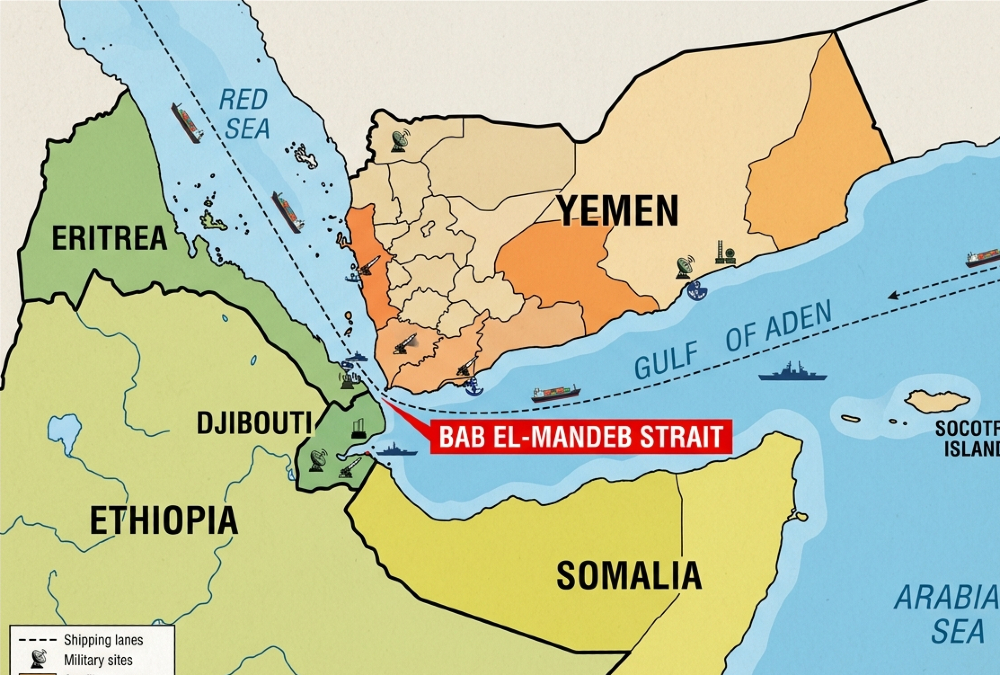
What makes the Houthi threat particularly alarming is geography. The Bab el-Mandeb Strait – the narrow chokepoint connecting the Red Sea to the Gulf of Aden – sits within convenient striking range of Houthi-controlled territory.
During the height of the Gaza conflict, the group demonstrated its willingness and capability to disrupt maritime traffic along this critical trade corridor, rattling global shipping markets and raising insurance premiums across the board.
Somaliland as a Strategic Chess Piece
It is against this backdrop that Israel’s recognition of Somaliland assumes renewed significance. Somaliland’s geographic proximity to Yemen positions it as a potential platform from which Israel could project pressure, gather intelligence, and relieve its southern flank.
In theory, the recognition could be “activated” – translated from diplomatic symbolism into operational reality.
In practice, however, the obstacles are considerable. The recognition is recent.
Somaliland’s authorities, acutely aware of their vulnerable position and the destructive reach of Houthi firepower, are unlikely to eagerly invite their territory to become a theater of someone else’s war. Sovereignty, even unrecognized sovereignty, comes with instincts of self-preservation.
Yet the mere existence of this strategic arrangement – however embryonic – is enough to draw Africa into a conflict that has already consumed much of the Middle East.
The Stakes for Africa
The Horn of Africa can ill afford further destabilization. The region is already bending under the weight of overlapping crises: a catastrophic civil war in Sudan, persistent instability in Somalia, and unresolved ethnic tensions in Ethiopia.
Any spillover from a widening Middle Eastern conflict would not land on stable ground – it would land on a region already at a tipping point.
The economic consequences would compound the human toll. African countries that depend on Red Sea trade routes have already absorbed significant disruption from Houthi activity. Renewed escalation threatens to reverse hard-won developmental gains and push millions deeper into poverty, undoing the work of years in a matter of months.
A Call for African Agency
The imperative, then, is clear – even if the path is not. Regional powers with the reach and credibility to act – Ethiopia, Egypt, Kenya – must engage proactively with stakeholders across the Horn of Africa to insulate the continent from the conflict’s gravitational pull.
This is not merely a matter of diplomacy; it is a matter of economic survival and regional security.
The Middle East crisis has long since ceased to be a localized affair. Its shockwaves are felt in shipping lanes, commodity markets, and refugee flows across continents.
Africa, positioned at the intersection of so many of these pressures, cannot afford to be a passive observer. The question is no longer whether the conflict will reach Africa. The question is whether Africa will be ready when it does.
Fidel Amakye Owusu is an International Relations and Security Analyst. He is an Associate at the Conflict Research Consortium for Africa and has previously hosted an International Affairs program with the Ghana Broadcasting Corporation (GBC). He is passionate about Diplomacy and realizing Africa’s global potential and how the continent should be viewed as part of the global collective.
