
A Diaspora View of Africa
Christian Persecution Focus Falls on Ethiopia

By Gregory Simpkins
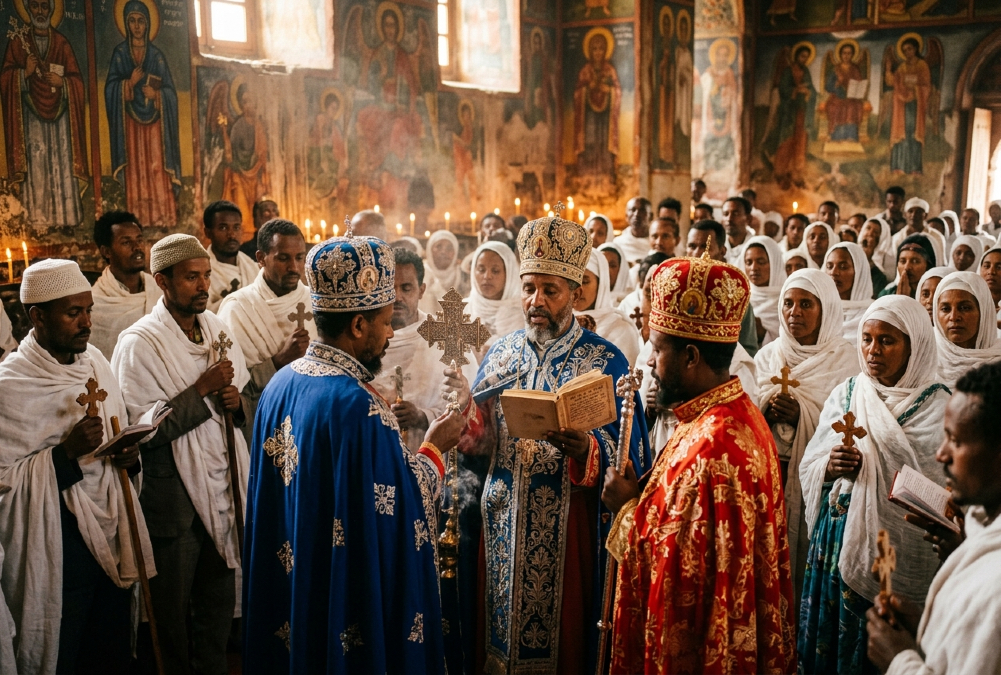
The focus of attention on the persecution of Christians in Africa has shed a harsh light on Nigeria, which has been labeled the most dangerous country for believers. However, abuse of Christians and their churches is not isolated to the West African giant. Increasing attention is being paid to what is happening to the Ethiopian Orthodox Church.
According to the current report from Open Doors, a group that monitors global religious freedom, n 2025, armed groups carried out widespread attacks in the Oromia region and parts of Amhara. They burned, demolished or looted at least 25 churches. Worshippers were assaulted, religious materials destroyed and entire congregations scattered.
Christians are also said to be at heightened risk of kidnapping, especially in Oromia’s rural districts and border areas with Amhara. Families report that captives are often released only after large ransoms are paid. Ongoing instability and ethnic tensions also continue, creating difficult situations for many followers of Jesus.
Documented Violence and a Fractured Church
The US State Department does not appear to be maintaining up-to-date monitoring of religious freedom worldwide. The Department’s most recent report on religious freedom in 2023 cites past Ethiopian government abuse of the Orthodox Church.
“In February (2023), Oromia regional security forces shot and killed a number of Ethiopian Orthodox Tewahedo Church (EOTC) parishioners in a church in Shashemene town. According to the EOTC Secretariat, security forces shot the parishioners as they were trying to prevent the church from being seized by members of a splinter group, the Holy Synod of Oromia Nations and Nationalities (HSONN), which broke away from the EOTC in January. Investigators from the Ethiopian Human Rights Commission (EHRC) confirmed that eight individuals were killed in the shooting and determined police used “excessive force.”
In a January 27 report by Eurasia Review, persecution of the Ethiopian Christian Church is described as a much older phenomenon:
“The Ethiopian Orthodox Church is among the oldest Christian institutions in the world, yet it has faced sustained external and internal pressures since the sixteenth century, beginning with Portuguese Jesuit interventions. Subsequent periods witnessed continued incursions by both Islamic powers and Western evangelical missions. These efforts often relied on direct proselytization practices that were intrusive and coercive in nature, particularly when directed at economically marginalized communities. The author has observed these dynamics firsthand over several decades.”
The news service further states that the Ethiopian government is involved in current church persecution:
“Of particular concern is the role of the Ethiopian state in the contemporary period. Since the rise of the TPLF/EPRDF, there has been documented evidence of systemic discrimination against the Ethiopian Orthodox Church and its adherents, alongside preferential treatment and institutional support extended to evangelical, Pentecostal, and Protestant groups. This pattern of state alignment has contributed to religious inequality, social fragmentation, and the erosion of long-standing communal structures. The Prime Minister and his high-ranking official belong to this group. They openly use the muscle of the state institutions to suppress the Orthodox Christians.”
Government Leadership and Religious Persecution
Prime Minister Abiy Ahmed was instrumental in resolving the 2023 Orthodox church dispute, but his record on human rights is mixed. Early reforms improved some civil liberties, but his tenure has been dominated by major conflicts involving widespread human rights violations by government forces and allies, plus specific tensions and interference involving the EOTC.
Abiy is a Pentecostal (from a mixed Muslim-Orthodox family background) and Ethiopia’s first Oromo prime minister. Assessments draw from UN bodies, Human Rights Watch, Amnesty International, the Ethiopian Human Rights Commission (EHRC), U.S. State Department reports, and other sources. Claims of systematic targeting of Orthodox Christians or Amharas are contested, with government forces and non-state actors (including rebels) both implicated in violence.
The EOTC is Ethiopia’s largest religious institution (roughly 40 percent of the population) and historically intertwined with Amhara identity and national unity narratives. Orthodox Christians have faced attacks on churches, clergy and communities – especially in Oromia and mixed areas – by various actors including Oromo Liberation Army-linked groups, local militias and sometimes government security forces. Reports document killings, church burnings/lootings and displacement of Orthodox/Amhara communities. Recent violence in the Arsi Zone (Oromia) has been particularly deadly; the government blames the OLA, which denies responsibility.
Key points of government involvement:
- 2023 Oromia schism: Three archbishops formed a breakaway “Holy Synod of Oromia Nations and Nationalities,” citing linguistic/ethnic representation grievances (demands for more Afaan Oromo services and Oromo clergy). The main Holy Synod excommunicated them. Parishioners resisted church takeovers. In Shashemene (February 2023), Oromia regional security forces used lethal force against crowds protecting St. Michael’s Church, killing at least eight (the EHRC confirmed excessive force). The EOTC and critics accused the federal government of favoring or protecting the splinter group. The settlement Abiy mediated restored the original archbishops while addressing some language/representation issues. Social media was restricted during the unrest.
- Broader accusations: Some Orthodox advocates and Ethiopian Diaspora sources claim systematic state-backed persecution or demographic engineering against Orthodox/Amhara communities, citing security force inaction or complicity in attacks, interference in church affairs and Abiy’s Protestant background. Alleged private remarks by Abiy expressing hostility toward the Orthodox Church or Amharas appear in partisan reporting even though they lack independent high-level corroboration in mainstream investigations. The government frames its role as maintaining order and addressing legitimate ethnic grievances within a multi-ethnic federation.
Contested Narratives
Violence against Orthodox Christians often overlaps with ethnic (Amhara) targeting amid Ethiopia’s broader identity conflicts rather than purely religious policy. In April 2024, Stop Amhara Genocide, a human rights organization dedicated to raising awareness about the ongoing Amhara genocide in Ethiopia, released a report confirming ethnic-related violence against the EOTC.
In its April 5 2024 press release, the organization said its report highlighted the alarming trend of attackers targeting Orthodox Christians, viewing their faith as synonymous with the Amhara people. Tragically, the assailants have explicitly stated their intention to destroy the Orthodox Church as a means to eradicate the Amhara population. The report documents numerous incidents of violence, including the burning of churches, the killing of clergy and congregants, and the kidnapping and murder of priests. The report also highlighted the ongoing government interference in church affairs, including the suspension of salaries and legal charges against outspoken clergy members who have criticized the government’s actions.
“The international community must stand in solidarity with the Ethiopian Orthodox Tewahedo Church and its followers, condemning these heinous acts of violence and ensuring that those responsible are held accountable,” said Yodith Gideon, Director at Stop Amhara Genocide. “Failure to act swiftly and decisively risks further deterioration of the situation and perpetuates the suffering of innocent individuals and communities.”
The Government of Ethiopia has been criticized for its role in the Tigray War (2020-2022), which seems to be flaring up yet again. Given the critical role of Ethiopia in the Horn of Africa and the fragile circumstances of regional relations, there would be a reluctance to act against the government for its involvement in religious persecution. However, the ongoing persecution of the EOTC and Amhara people is a situation that must not be tolerated any longer.
Gregory Simpkins, a longtime specialist in African policy development, is the Principal of 21st Century Solutions. He consults with organizations on African policy issues generally, especially in relating to the U.S. Government. He further acts as a consultant to the African Merchants Association, where he advises the Association in its efforts to stimulate an increase in trade between several hundred African Diaspora small and medium enterprises and their African partners.
