
Opinion
Africa’s Hunger Crisis Is Man-Made. So Are Its Solutions.

By Jean Claude Niyomugabo
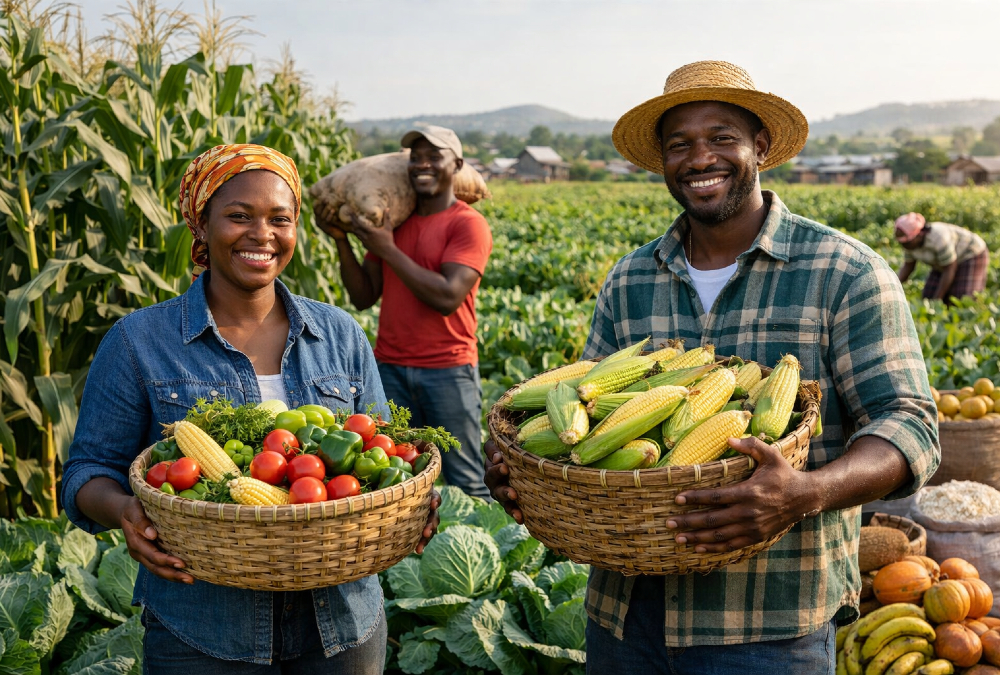
Across the rural communities of sub-Saharan Africa, a quiet paradox plays out each harvest season. Tomatoes blush red in the midday sun. Maize fills storage rooms that lack the most basic ventilation.
Farmers bring in their crops with genuine optimism – only to discover that prices have cratered, buyers are scarce, and a portion of what they worked all year to grow will simply rot.
The land performed its function. The farmer performed his. And yet, people go hungry.
This is not a story about agricultural failure. It is a story about systemic failure – and, more importantly, about the human capacity to reverse it.
Hunger in Africa is not a natural phenomenon. It is a policy outcome.
The Full Pot, the Empty Table
Consider a simple analogy. A family spends hours preparing a feast – rice, beans, vegetables, meat. The food is plentiful, fragrant, and ready. But no one thought to set the table. The plates remain in the kitchen. Everyone sits down to nothing.
Is the problem the food? Clearly not. The problem is the system that failed to connect the food to the people who needed it.
That is precisely how food insecurity operates across much of Africa. Crops are grown. Calories exist. But cold-storage infrastructure is absent, market-price information is inaccessible, reliable buyers are rare, and coordination between producers and consumers is essentially nonexistent.
The consequences are grimly predictable. When farmers – lacking market intelligence – all plant the same high-demand crop in the same season, supply floods the market at harvest time, prices collapse, and surpluses spoil in fields or makeshift granaries.
Meanwhile, in the same country’s cities, food prices climb. Supermarket shelves grow thin. Hunger coexists, absurdly, with abundance.
The Real Barriers Are Not Biological
The conventional narrative around African hunger leans heavily on the language of natural disaster – drought, flood, climate volatility. These are real pressures, and they deserve serious attention.
But framing hunger primarily as an act of nature obscures a more uncomfortable truth: most of it is man-made.
Roads that become impassable in the rainy season isolate farmers from urban markets for months at a time. Intermediary traders exploit informational asymmetries, compressing producers’ margins while driving up consumer prices.
Public investment in agricultural extension services – the technical support systems that help farmers diversify crops, time their planting, and access credit – has been chronically underfunded across the continent.
Then there is the question of youth. Farming is increasingly perceived by young Africans as a last resort rather than a legitimate livelihood.
Without investment in agricultural education and startup support, the sector risks losing the very generation that could modernize it.
If broken human decisions created these conditions, better human decisions can dismantle them.
The Architecture of a Fix
The diagnosis, uncomfortable as it may be, is also clarifying. Hunger rooted in systemic dysfunction is hunger that policy can address. The solutions are not exotic or prohibitively expensive – they are, in many cases, already proven.
Cooperative structures can aggregate small farmers’ output, smooth price volatility, and give producers collective bargaining power against middlemen. Investment in cold-chain logistics and post-harvest processing infrastructure would dramatically reduce spoilage, which by some estimates accounts for up to 40 percent of food losses in parts of sub-Saharan Africa.
Digital platforms connecting farmers directly to urban buyers are already operating at scale in Kenya, Nigeria, and Ethiopia – disrupting exploitative intermediary networks and giving producers real-time market data. Replicating and expanding these models requires coordinated public and private investment, not technological reinvention.
Reframing agriculture as an entrepreneurial pursuit – through vocational training, access to finance, and mentorship networks – could stem the rural-to-urban migration that is simultaneously depopulating farmland and overcrowding cities ill-equipped to absorb new arrivals.
The Accountability That Follows
None of this is to minimize the difficulty of the task. Political economies that benefit from dysfunctional food systems – traders who profit from opacity, officials who extract rents from infrastructure bottlenecks – do not surrender their advantages without resistance.
Structural reform is, by definition, a contest over power.
But the reframing matters enormously. When hunger is understood as a consequence of nature, it invites fatalism and charity. When it is understood as a consequence of policy, it demands accountability and reform.
Africa’s farmers are not the problem. They are, in fact, the most compelling evidence that the continent has everything it needs to feed itself.
What remains to be built is the system that connects what they produce to those who need it most. That system is not a product of geography, climate, or fate. It is a product of decisions. And decisions, unlike droughts, can be changed.
Jean Claude Niyomugabo is an entrepreneur and digital communication specialist with a strong passion for Africa’s development. He is dedicated to harnessing the power of social media to drive positive change and enhance livelihoods. With diverse interests and a strategic approach to digital engagement, he strives to create meaningful impact through innovation and connectivity.
