
Opinion
Africa’s Food Insecurity Is a Manufactured Narrative – The Myths and the Realities

By Balbir Singh
For decades, academic papers, NGO briefings, donor reports, and media commentary have repeated a single storyline: Africa is chronically food insecure. It is a narrative so deeply entrenched that it has become an unquestioned “truth.”
But after traveling across the continent and reviewing credible data, one conclusion becomes difficult to ignore:
Africa’s food insecurity crisis is far less about production – and far more about a system that profits from portraying Africa as perpetually hungry.
A wide ecosystem of international NGOs, donor agencies, consultants, and research institutions benefits financially and politically from sustaining this image. Yet the reality on the ground tells a very different story.
The Myth: Africa Cannot Feed Itself
The Reality: Africa Produces Enough Food to Feed Three Times Its Population
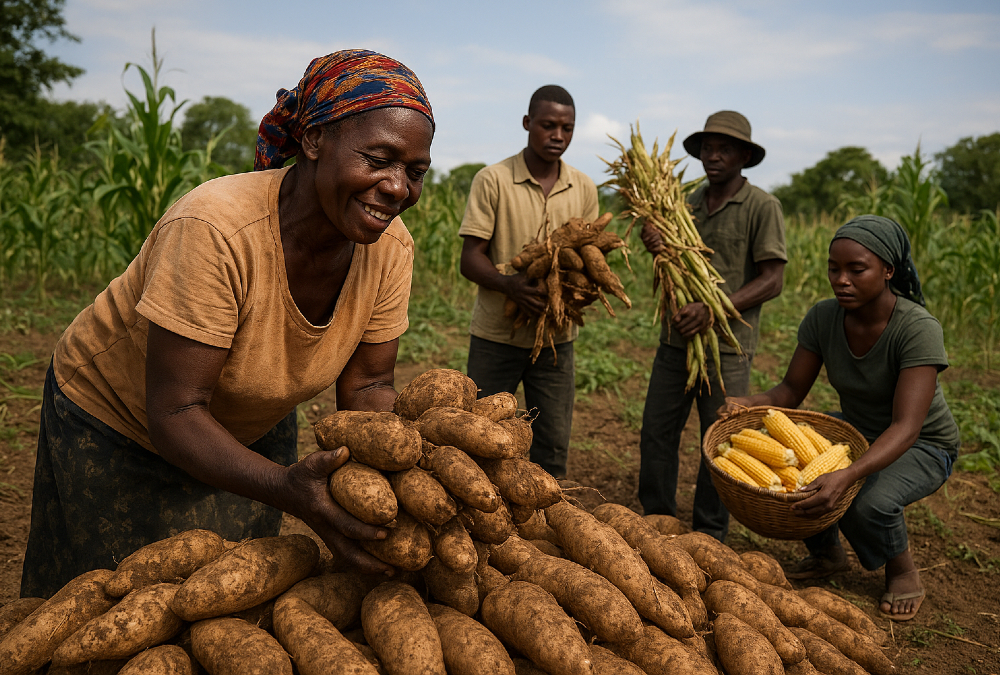
Africa is not short of food. In fact, it is one of the world’s most abundant producers of staples such as yam, cassava, sorghum, millet, watermelons, cucurbits, mangoes, avocados, and pineapples. Conservative agricultural assessments show that the continent produces enough calories to feed more than 3 billion people — nearly triple its population.
The problem? Up to 85 percent of perishable food spoils during harvest seasons due to a near-total absence of storage, processing, and cold-chain infrastructure.
What gets harvested simply does not reach consumers.
Food insecurity in Africa is not agricultural. It is structural.
Where the System Fails
1. Logistics: The Bridge Between Abundance and Hunger Is Broken
Rural farming regions across Africa are notoriously cut off from reliable road networks. When rains arrive, roads often become completely impassable.
As a result:
- Up to 70 percent of produce rots on farms or during transit.
- Farmers earn nothing.
- Urban markets remain undersupplied.
- Importers fill the gap with foreign goods.
History offers a parallel. The Indian famine of 1918 was not caused by a shortage of food.
It was caused by the inability to transport surplus grain from one region to another. Nearly a million people died because the supply chain failed – not because the land failed.
Africa today is facing a similar logistics-driven crisis wrapped in the language of “food insecurity.”
2. Processing: Africa Exports Raw Materials and Imports Finished Food
Africa exports vast quantities of oilseeds – only to import refined vegetable oil at higher prices. The technology needed for local oil extraction is simple and widely available, yet international NGOs rarely promote it.
The result is predictable:
- Lost economic value
- Low farmer incomes
- Increased dependency on food imports
Africa is not failing to produce food; it is failing to retain value.
3. Storage: The Missing Piece No One Wants to Fix
From grain silos to refrigerated warehouses, Africa’s storage infrastructure is almost nonexistent. Without it, seasonal harvests become seasonal losses.
Yet meaningful investment in storage receives only a fraction of the funding directed toward “awareness campaigns” or “capacity-building seminars.”
The outcome is an artificial shortage created by structural neglect.
4. Import Culture: Rice and Wheat Are Being Marketed as “Modern Food”
Africa is home to some of the most nutritious indigenous foods on the planet. But donor-driven “modernization” campaigns have aggressively pushed rice, wheat, noodles, bread, and pasta – products consumed heavily in exporting countries but never produced at scale in Africa.
This shift distorts diets, increases import dependency, and undermines local food systems that have sustained communities for centuries.
5. Copy-Paste Agricultural Technology
Much of the agricultural technology pushed into Africa is imported, mismatched, and unsuitable for local conditions. African agricultural systems are part of a unique ecological and cultural civilization – not a blank slate for foreign experimentation.
Local innovations often work far better, yet global funding largely flows toward Western-designed solutions.
6. The “Academic Incentive Problem”
In management, there is a saying: an oiled tongue never speaks the truth. International organizations pay generous salaries to academics, consultants, and policy advisors who reinforce the narrative of African food insecurity.
These voices become role models and thought leaders – shaping policy discussions while rarely questioning the underlying assumptions.
The result is a feedback loop where research, funding, and media all reinforce the same storyline, regardless of its accuracy.
The Hard Truth
Africa’s food insecurity is not a natural condition, nor is it an agricultural inevitability. It is a manufactured narrative – one that benefits organizations with a vested interest in keeping Africa dependent on external funding, imported food, and foreign-designed solutions.
The real crisis is not food production. It is logistics, storage, processing, and supply-chain fragility – all issues that can be fixed with infrastructure, investment, and political will.
Everything else is noise.
Balbir (Shekhawat) Singh, PhD, is a results-driven agribusiness techno-commercial professional with over 18 years of experience in sales, marketing, agronomy, product management, farming, commodity trading, and agri-inputs (fertilizers, seeds, agrochemicals). Passionate about advancing sustainable farming, he currently serves as Director General/CEO of Sodesep SA-Fertilizer Abuja, Nigeria. He has worked across emerging markets including India, Uganda, Kenya, Cameroon, Tanzania, Indonesia, and Nigeria.
