
Opinion
Africa’s Farming Revolution: Why Data, Not Guesswork, Will Feed the Continent

By Jean Claude Niyomugabo
Over the past three years, I have walked through greenhouses in China, olive groves in Italy, high-tech farms in the UK, and vast desert agribusinesses in Egypt. One truth emerged, loud and clear: the future of farming isn’t rooted in guesswork – it’s driven by data.
In a climate-controlled tomato greenhouse in Shandong, China, sensors silently monitor humidity, temperature, and soil moisture. Every irrigation cycle is triggered not by intuition, but by real-time analytics.
Water is conserved, yields are consistent, and waste is nearly eliminated.
In Tuscany, Italian olive growers deploy drones and satellite imagery to assess tree health, detect early signs of disease, and optimize harvest timing down to the week – sometimes the day.
In Egypt’s Western Desert, where water is scarcer than gold, large-scale farms rely on smart irrigation systems connected to digital dashboards. These systems track everything from solar exposure to soil nutrient levels, ensuring every drop of water and every gram of fertilizer delivers maximum impact.
These farmers aren’t gambling with the seasons. They are practicing agriculture as a science – precise, timely, and actionable.
And as I watched this transformation unfold across continents, one question haunted me: Why not the rest of Africa?
Africa holds 60 percent of the world’s uncultivated arable land. Yet, for millions of smallholder farmers, agriculture remains a high-stakes game of chance – dictated more by tradition than by technology, by hope than by data.
But it doesn’t have to be this way.
We are standing at a pivotal moment – one where data-driven agriculture could become the most transformative shift in African food production since the advent of the plow.
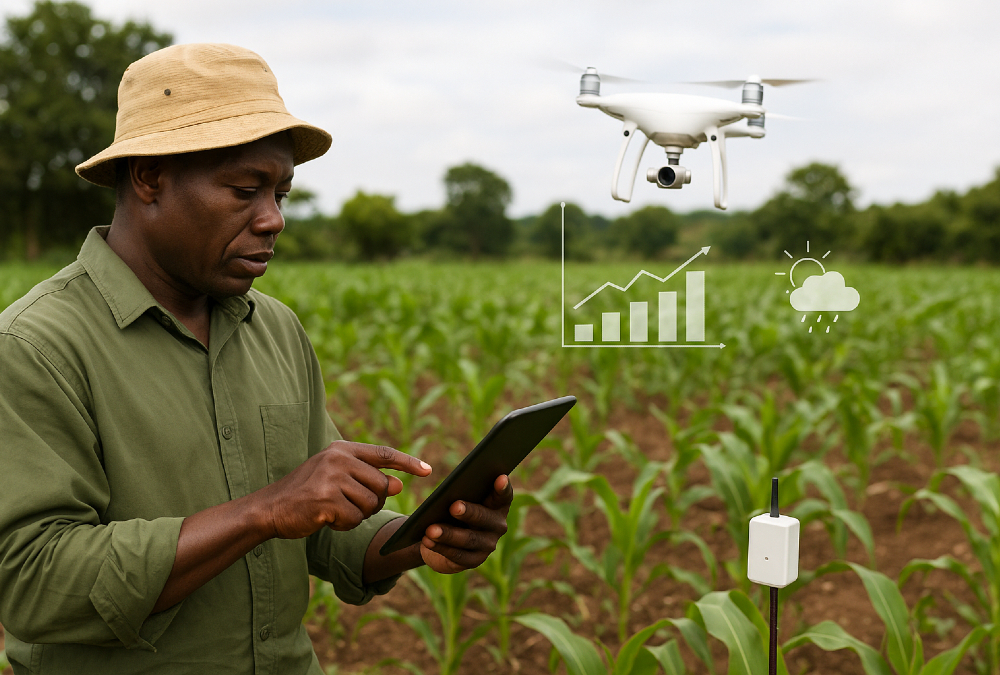
Imagine a maize farmer in Rwanda receiving a mobile alert the night before optimal planting conditions arrive, based on hyper-local weather forecasts. Picture a dairy farmer in Kenya using digital ear tags to monitor milk yields, detect illness early, and improve herd health.
Envision a cocoa grower in Ghana getting real-time SMS updates on market prices and tailored fertilizer recommendations.
These are not futuristic fantasies. They are real, proven, and already working – on farms across the continent.
The tools exist. The technology is ready. The demand is growing. The challenge now is scale.
To unlock Africa’s agricultural potential, we must build the digital backbone that makes data accessible, affordable, and actionable for every farmer – no matter how remote.
First, governments must lead
Investments in rural broadband, weather monitoring networks, and open-access agricultural data platforms are not luxuries – they are infrastructure. Just as roads and electricity powered 20th-century development, digital connectivity will power 21st-century food security.
Policies must encourage innovation, not stifle it. Regulatory frameworks should support data privacy, promote interoperability, and incentivize public-private partnerships in agri-tech.
Second, the private sector must step up
Startups and tech companies have a historic opportunity to design mobile apps, low-cost sensors, AI-driven advisory tools, and precision farming platforms tailored to Africa’s diverse agro-ecologies and smallholder realities. This isn’t just good for business – it’s essential for resilience.
Third, NGOs and development partners must bridge the knowledge gap
Technology is only as powerful as the farmer’s ability to use it. Training programs, digital literacy initiatives, and localized extension services are critical to ensure that data doesn’t just reach farmers – it empowers them.
When farmers can access and understand data, they can:
- Slash input costs by applying water, seeds, and fertilizers only when and where needed.
- Predict pest outbreaks and mitigate crop losses before they spread.
- Optimize planting and harvesting schedules for higher yields.
- Make informed financial decisions, from loans to market sales.
Data is not just a stream of numbers. Data is power.
I have come to see data as the new hoe. The new fertilizer. The new seed.
It gives farmers confidence. It gives buyers transparency. It gives governments the foresight to plan for droughts, surpluses, and national food security.
This is how we shift farming from subsistence to strategy. From unpredictable to profitable. From survival to sustainability.
We extract oil. We mine minerals. But in the 21st century, we must also learn to extract insight – from data.
The future of African agriculture will not be built on land alone. It will be built on information – timely, localized, and democratized.
This is more than innovation. This is transformation.
And Africa isn’t just ready. Africa is poised to lead.
Jean Claude Niyomugabo is an entrepreneur and digital communication specialist with a strong passion for Africa’s development. He is dedicated to harnessing the power of social media to drive positive change and enhance livelihoods. With diverse interests and a strategic approach to digital engagement, he strives to create meaningful impact through innovation and connectivity.
