
Opinion
Will Africa’s Growth Giants Finally Join Nigeria on the Global Stage?

By Gregory September
The IMF’s 2026 global growth projections tell a story of seismic economic shifts – and one African nation’s quiet but consequential arrival.
When the International Monetary Fund released its projections for the top ten contributors to global real GDP growth in 2026, the headline story was familiar: China and India together account for a staggering 43.6 percent of worldwide expansion, a figure that underscores just how thoroughly economic gravity has shifted eastward.
Asia-Pacific as a whole commands roughly half of all global growth. The West, meanwhile, anchors the bottom of the list – Germany contributes a modest 0.9 percent, the United States a comparatively respectable 9.9 percent.
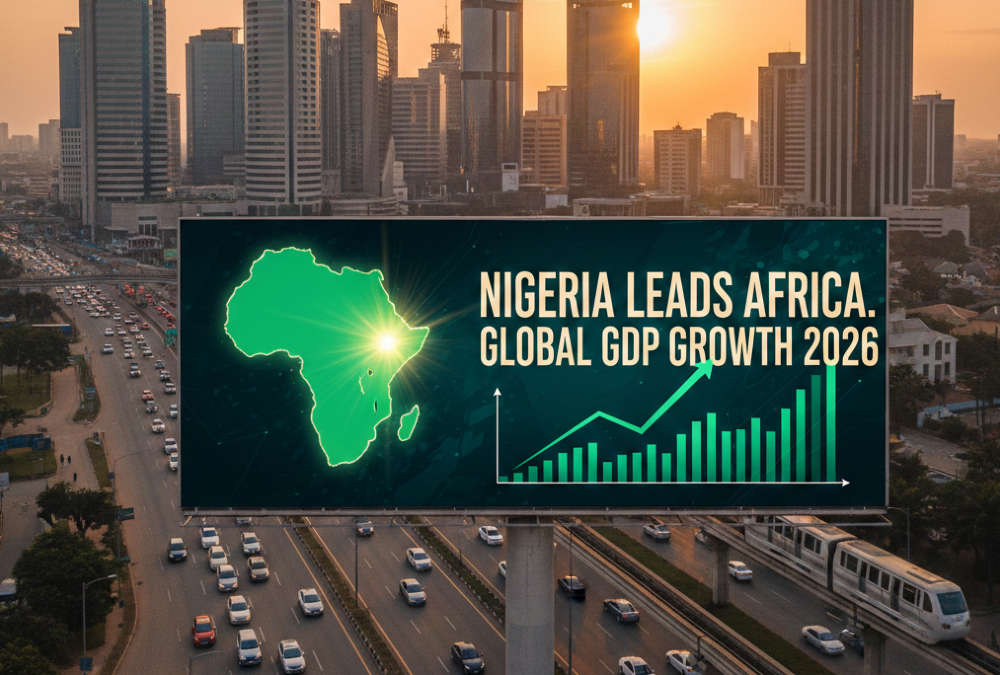
But buried near the middle of that ranking is a number that deserves far greater attention than it typically receives: Nigeria, contributing 1.5 percent to global real GDP growth. It is a small share in absolute terms, yet its significance is outsized.
Nigeria is the only African country on the list. In a ranking that spans three continents and includes some of the world’s most dynamic emerging markets, an entire continent of 1.4 billion people has exactly one representative – and that representative is carrying Africa’s flag largely alone.
Nigeria is not merely growing – it is growing fast enough to matter on a global scale. That distinction demands serious attention.”
The Weight of Being First
Nigeria’s presence on this list is not accidental. With a population exceeding 220 million – the largest on the continent – and an economy that, despite persistent structural challenges, remains Africa’s biggest by nominal GDP, Nigeria has long been positioned as the continent’s most likely breakout candidate.
What the 2026 IMF data confirm is that this potential is, at least in part, being realized. Nigeria is not merely growing – it is growing fast enough to matter on a global scale. That distinction demands serious attention.
The country’s growth is being driven by a combination of factors: a youthful demographic dividend, expanding consumer markets, increased investment in the non-oil sectors of its economy, and, critically, a series of macroeconomic reforms – including the unification of Nigeria’s notoriously fragmented exchange rate – that have begun to restore credibility with international investors. None of this has been painless.
Inflation remains punishing for ordinary Nigerians, and the short-term costs of reform have been borne disproportionately by the poor. But the medium-term trajectory is, according to the IMF’s own arithmetic, unmistakably upward.
The Question Africa Must Answer
The more urgent question is whether Nigeria will remain the exception on this list, or whether it heralds the beginning of a broader African arrival in the top tier of global growth contributors. The answer, as ever with Africa, is complicated by the continent’s extraordinary diversity – 54 countries at wildly different stages of institutional development, infrastructure quality, and economic sophistication.
Generalizing about “Africa’s” prospects is a trap that serious analysts resist. And yet patterns matter.
Several African economies have legitimate claims to future inclusion on a list like this. Ethiopia, with its population of over 120 million and a sustained growth record interrupted but not destroyed by civil conflict, is rebuilding.
Egypt, stabilizing after years of turbulence and benefiting from its pivotal geographic position and diversified economic base, is watched closely by institutional investors.
Kenya continues to punch above its weight as East Africa’s financial hub. Tanzania, Côte d’Ivoire (Ivory Coast), and Rwanda are all posting growth rates that, if sustained, could translate into meaningful contributions to global output within a decade.
The continent possesses extraordinary reserves of untapped potential – in natural resources, agricultural productivity, and above all, human capital.
What these countries share – alongside Nigeria – is a set of structural tailwinds that no amount of cyclical pessimism should obscure. The continent possesses extraordinary reserves of untapped potential: in natural resources, agricultural productivity, and above all, human capital.
Africa’s working-age population will be the largest in the world by mid-century. When that demographic wave is coupled with improving education outcomes, expanding digital infrastructure, and – critically – better governance and macroeconomic management, the case for multiple African nations joining Nigeria on future versions of this list is not merely aspirational. It is analytically defensible.
The Conditions That Matter
But potential, as Africa’s history amply demonstrates, does not automatically convert into realized growth. The conditions that will determine whether more African countries join Nigeria on the global growth map in 2030, 2035, or 2040 are well understood, even if they remain maddeningly difficult to engineer.
Debt sustainability is the most immediate concern: a number of African governments entered the post-pandemic period carrying debt loads that constrain their ability to invest in the public goods – infrastructure, education, healthcare – that accelerate economic development. The restructuring of sovereign debt, much of it owed to bilateral creditors including China, has proceeded too slowly and with insufficient transparency.
Trade integration is the second pillar. The African Continental Free Trade Area (AfCFTA), launched with considerable fanfare, has the theoretical potential to create the world’s largest free trade zone by number of countries.
In practice, implementation has been uneven, border frictions remain high, and intra-African trade as a share of total African trade remains far below comparable figures for Europe or Asia. Closing that gap would be transformative – not just economically, but geopolitically, as it would reduce African economies’ chronic vulnerability to external demand shocks.
Finally, there is the matter of institutional quality. The countries in this year’s IMF top-ten list share, broadly, a commitment to macroeconomic stability, rule of law, and openness to trade and investment.
These are not incidental features – they are the foundation upon which growth compounds over time. African nations that invest seriously in building and sustaining these institutions will accumulate advantages that accrue slowly but powerfully.
A Turning Point, Not Yet a Trend
Nigeria’s appearance in the IMF’s 2026 growth rankings is a data point, not a verdict. It does not mean that Africa’s long-awaited economic emergence has arrived on schedule, nor that the obstacles to sustained, broad-based development on the continent have been resolved.
Poverty remains deep and widespread. Political instability periodically derails promising trajectories.
Climate change poses an existential threat to agricultural systems that hundreds of millions of Africans depend upon.
What it does mean is that the possibility space has expanded. The question of whether more African nations will appear on future versions of this list is no longer purely hypothetical.
It has become a question of policy, governance, and geopolitical alignment – all of which are, at least in principle, within human control.
China’s 26.6 percent share of global growth did not materialize by accident. It was the product of decades of deliberate policy choices, institutional development, and strategic investment.
India’s 17 percent share reflects a similar, if differently constructed, story of intentional development. Nigeria’s 1.5 percent is, in its own way, a first chapter in what could become a comparable narrative for Africa – if the continent’s governments, its international partners, and its people choose to write it that way.
The rest of the world, increasingly attentive to where growth is actually happening, would do well to pay closer attention to that story as it unfolds.
Gregory September is a South African academic, author, and geopolitical analyst with extensive experience in government and Parliament. He is the founder and CEO of SAUP (Sustainability Awareness and Upliftment Projects NPC), which focuses on sustainability education and community development. He previously served as Head of Research and Development for the Parliament of South Africa. His work centers on sustainability, African geopolitics, and economic development, and he regularly contributes to analysis of global political and economic affairs.
