
Opinion
Why Namibia, Bigger Than Forty Nations, Holds Fewer People Than a Mid-Sized City

By Gregory September
Namibia’s sparse population is not a policy failure. It is the verdict of geography – and understanding it reframes some of Africa’s most contested debates.
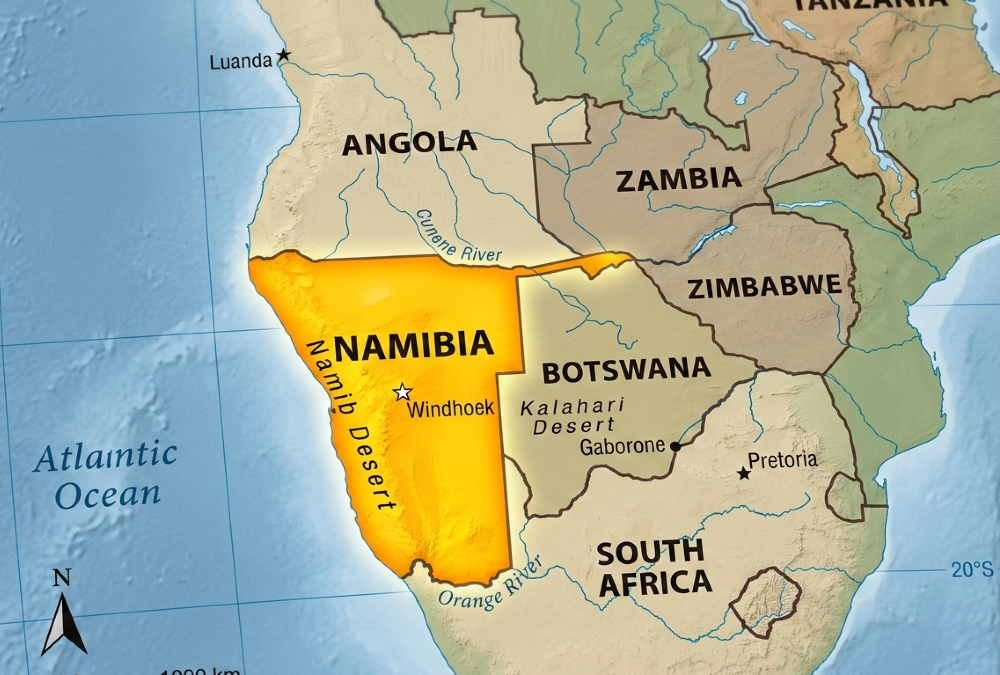
At roughly 824,000 square kilometers, Namibia is one of the fifteen largest countries in Africa. It is bigger than France and Germany combined.
It dwarfs more than forty of the continent’s other nations. And yet, on any given day, fewer than three million people call it home – a population density of just three to four people per square kilometer, one of the lowest ratios anywhere on earth.
The instinctive reaction to that statistic is to reach for a political explanation: colonial dispossession, unequal land distribution, poor governance. These forces are real and deserve scrutiny.
But they are not the primary reason Namibia’s landscape is so strikingly empty. For that answer, one must look not to history books but to a map, and then to the sky.
Namibia’s structural constraint is not governance. It is water. It is climate. It is ecology.
A Landscape Built on Thirst
Namibia is framed by two of the world’s most formidable deserts. Along its Atlantic coastline runs the Namib, a geological ancient – one of the oldest deserts on the planet, whose fog-drenched dunes have sculpted their own peculiar ecosystems over tens of millions of years.
To the east, the Kalahari’s semi-arid scrublands extend across the border into Botswana and South Africa. Between these two extremes lies terrain that, while not always technically classified as desert, is climatically unforgiving.
A commonly repeated claim holds that “three-quarters of Namibia is desert.” In strict ecological terms, that is an overstatement. Formal desert vegetation – hyper-arid zones where almost nothing grows without irrigation – covers perhaps 15 to 20 percent of the country.
But if one broadens the lens to include semi-arid and arid landscapes, the majority of the country receives insufficient rainfall to support intensive agriculture. The threshold that agronomists typically cite for viable rain-fed crop farming is roughly 400 to 500 millimeters of annual precipitation.
Across much of Namibia, farmers are fortunate to see 250.
The consequences cascade predictably. Low rainfall means thin soils, limited groundwater recharge, and fragile vegetation cover.
Fragile vegetation means limited carrying capacity for livestock. Limited carrying capacity means that the land simply cannot feed dense human settlement in the way that, say, the Ethiopian Highlands or the Niger Delta can.
Namibia’s sparseness is not an anomaly to be corrected. It is an equilibrium shaped over millennia.
Why This Matters Beyond Geography Trivia
Namibia’s demographic arithmetic matters for at least four interconnected debates that tend to generate more heat than light.
- Land reform. Redistributing land without redistributing water infrastructure is, at best, an incomplete solution. The country’s white-owned commercial farms occupy vast acreages not because of arbitrary colonial caprice alone, but because viable livestock ranching in arid environments requires enormous land-to-animal ratios. Reformers and policymakers alike must grapple with ecology, not only equity.
- Green hydrogen. Namibia has attracted serious investment attention for its potential as a green hydrogen producer, exploiting its abundant solar and wind resources and its deep-water port at Lüderitz. The same aridity that constrains agriculture is, in this context, an asset: clear skies and coastal winds. Geography that forecloses one pathway can open another.
- Population density comparisons with Europe. Critics who point to Africa’s land mass and ask why the continent cannot simply “spread out” its population misunderstand the relationship between habitable area and total area. Namibia is a vivid illustration of that misunderstanding: most of its land cannot sustain dense human settlement without transformative and expensive intervention.
- The “overpopulation” narrative. Africa is routinely discussed as a single demographic unit teetering on the edge of Malthusian crisis. Namibia complicates that story sharply. Some African nations face acute demographic pressure on limited arable land. Others, like Namibia, face the opposite challenge: spatial underutilization and the difficulty of building economic density in ecologically marginal terrain. Conflating the two leads to bad policy.
Political Economy Literacy Starts With the Land
Africa is not a country. It is a continent of fifty-four nations, hundreds of distinct ecosystems, and wildly divergent demographic trajectories.
Rwanda’s population density is roughly 180 times that of Namibia’s. The Congo Basin holds some of the most productive rainforest on earth; the Sahara holds almost none of that productive capacity.
A continent-level diagnosis applied uniformly will consistently produce continent-level misdiagnosis.
Namibia is not, then, merely a curiosity for geography enthusiasts. It is a structural case study in the relationship between environment and development – a reminder that before asking what a country should do differently, one must first ask what the land will allow.
Climate is not destiny, but it is constraint. Water is not just a resource; in much of the arid world, it is the binding limit on every other ambition.
Understanding that difference – between a country that is land-rich and water-poor and one that is simply dense and under-governed – is the beginning of serious thinking about African development. It is also, in an era of accelerating climate change, increasingly urgent.
As rainfall patterns shift and aquifers deplete across the Global South, Namibia’s present may begin to look, in uncomfortable ways, like someone else’s future.
Gregory September is a South African academic, author, and geopolitical analyst with extensive experience in government and Parliament. He is the founder and CEO of SAUP (Sustainability Awareness and Upliftment Projects NPC), which focuses on sustainability education and community development. He previously served as Head of Research and Development for the Parliament of South Africa. His work centers on sustainability, African geopolitics, and economic development, and he regularly contributes to analysis of global political and economic affairs.
