
Opinion
Why Africa Must Embrace AI to Secure Its Agricultural Future

By Jean Claude Niyomugabo
By 2050, Africa’s population will surge to 2.5 billion – more than double its size today. Feeding this future will not be a matter of more land or more labor.
It will require smarter systems, data-driven decisions, and technological leapfrogging. And at the heart of that transformation lies one indispensable tool: artificial intelligence.
Africa’s farmers are among the most resilient on Earth. Yet they operate under conditions that would break most modern agribusinesses: erratic rainfall, degrading soils, invasive pests, fragmented supply chains, and minimal access to credit, markets, or timely advice.
Climate change is no longer a distant threat – it’s a daily reality. And traditional farming methods, while deeply rooted in culture and knowledge, are no longer sufficient to sustain food security, let alone drive economic growth.
AI Turns Data Into Decisions – Not Just Tools Into Hands
Enter AI.
Not as a replacement for the farmer – but as a force multiplier for the farmer.
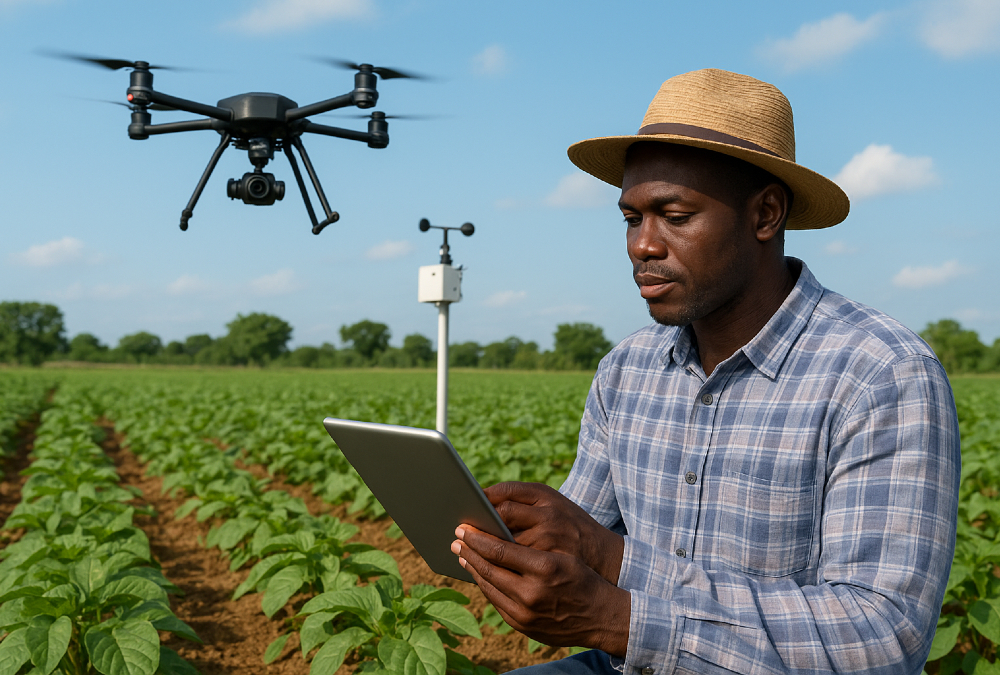
Artificial intelligence is transforming agriculture from guesswork into precision science. Through satellite imagery, drone surveillance, and ground-based sensors, AI can now map soil nutrient levels in real time, predict localized weather patterns with 90 percent+ accuracy, and detect early signs of crop disease – often before the human eye can spot them.
Algorithms recommend the exact type and quantity of fertilizer needed, reducing waste by up to 40 percent while boosting yields. Mobile platforms deliver these insights directly to a farmer’s smartphone – even in remote villages with limited connectivity.
The impact is profound.
In Kenya, AI-powered apps now identify fall armyworm infestations via photo uploads, alerting farmers to targeted interventions before entire fields are lost. In Nigeria, platforms like Farmcrowdy and AgroCenta use AI to connect smallholders with tractor services, storage, and buyers – slashing post-harvest losses and cutting out exploitative middlemen.
Rwanda’s pilot AI-driven irrigation systems are conserving water while increasing yields by 30 percent. South Africa is deploying machine learning to optimize planting schedules across vast commercial farms – and the lessons are trickling down to smallholders.
This isn’t science fiction. It’s scalable reality.
The Real Challenge Isn’t Technology – It’s Access
But access remains the greatest barrier.
Too often, AI solutions are designed for large-scale agribusinesses in high-income countries – expensive, data-hungry, and culturally disconnected from Africa’s 500 million smallholder farmers. For AI to deliver on its promise, it must be:
- Affordable: Built on low-bandwidth platforms, optimized for basic smartphones.
- Localized: Trained on African soils, climates, and crops – not imported models that fail in the field.
- Inclusive: Delivered through community networks, radio broadcasts, and SMS, not just apps.
- Supported: Backed by public investment, regulatory clarity, and digital infrastructure.
Governments have a critical role to play. AI can inform national food policy with predictive analytics, optimize irrigation infrastructure, reduce costly grain imports, and create early-warning systems for famine.
The World Bank estimates that AI-driven agriculture could increase African food production by 30–40 percent by 2030 – and lift 100 million people out of poverty.
Africa Doesn’t Need to Imitate – It Needs to Innovate
The alternative? A future of chronic food insecurity, mass migration, and economic stagnation.
Africa does not need to wait for permission to innovate. It has already begun.
From the rice fields of Senegal to the maize belts of Zambia, African entrepreneurs, researchers, and farmers are building AI tools that are not only effective – but uniquely African. This is not about importing Silicon Valley solutions.
It’s about harnessing global technology to solve local problems – with local ingenuity.
Food security is not a luxury. It is a human right.
And the dignity of Africa’s farmers – who produce over 80 percent of the continent’s food – depends on their ability to thrive, not just survive.
AI is not the silver bullet. But it is the bridge – connecting traditional knowledge with cutting-edge insight, subsistence farming with commercial viability, and local abundance with global markets.
Africa has a choice: fall behind in the next agricultural revolution – or lead it.
The time to cross that bridge is now.
Jean Claude Niyomugabo is an entrepreneur and digital communication specialist with a strong passion for Africa’s development. He is dedicated to harnessing the power of social media to drive positive change and enhance livelihoods. With diverse interests and a strategic approach to digital engagement, he strives to create meaningful impact through innovation and connectivity.
