
Opinion
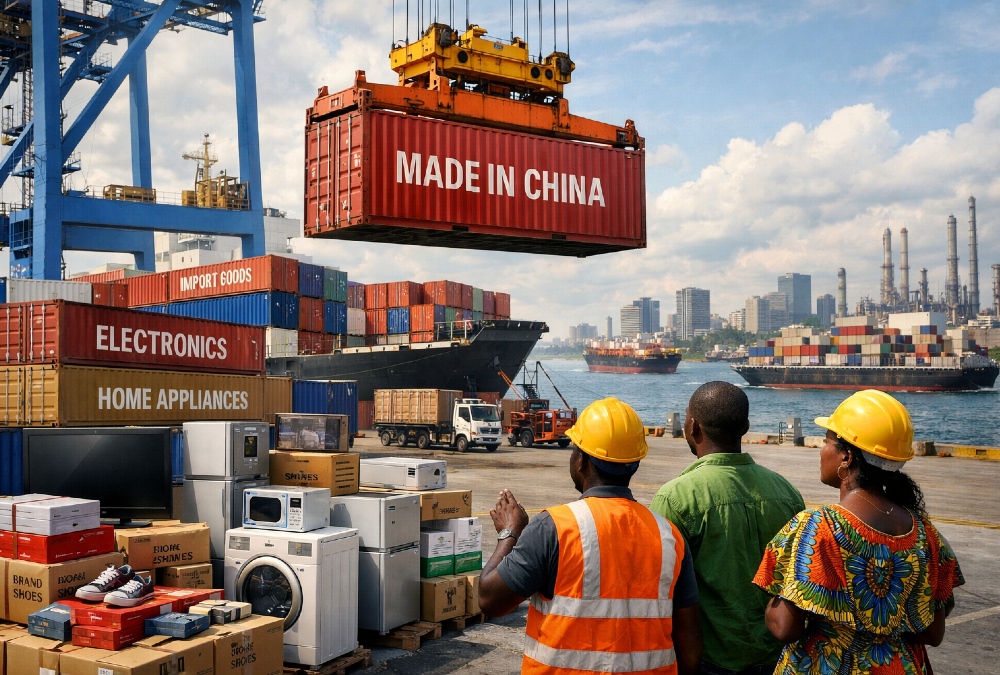
Why Africa Imports Finished Goods – And Why That’s a Rational Choice

By Dishant Shah
The dominance of finished goods in African markets isn’t about capability – it’s about cold economic calculation.
Local manufacturing across Africa isn’t failing because the continent lacks productive capacity. It’s losing ground because, in most cases, importing remains the economically rational choice.
The prevalence of finished goods in African markets stems not from ideological preferences or policy failures, but from fundamental mathematics that quietly tilts the playing field toward imports.
The structural disadvantages run deep
Consider the challenge of scale. Most African factories operate far below optimal capacity, hamstrung by demand fragmented across national borders, sluggish logistics networks, and regional integration that looks stronger on paper than in practice.
A facility designed to run at volume limps along at half-speed, while overseas competitors ship products manufactured at full utilization. The efficiency gap becomes insurmountable before production even begins.
The input equation compounds the problem. African manufacturing remains heavily dependent on imported raw materials, components, machinery, and spare parts.
Currency fluctuations or port delays can halt production lines entirely. By contrast, importing a finished product consolidates all that complexity into a single, predictable transaction.
The supply chain simplifies dramatically.
Energy costs present another structural disadvantage. Across much of the continent, power remains expensive and unreliable.
Backup generators aren’t contingency planning – they are baked into the cost structure. Once energy expenses and downtime are properly accounted for, the notion of “cheap labor” providing a competitive advantage largely evaporates.
Capital availability explains much of the remainder. Manufacturing locks up cash through extended cycles: inventory accumulation, work-in-progress, and receivables collection.
Importing finished goods dramatically shortens the cash conversion cycle. In environments where capital is both scarce and expensive, velocity often matters more than margin. Businesses optimize for what’s constrained.
The hidden costs of fragmented ecosystems
Risk visibility also shapes decision-making. Import risks are transparent: foreign exchange exposure, customs procedures, shipping delays.
Manufacturing risks lurk beneath the surface: equipment failure, quality control drift, maintenance gaps, skills attrition. Given the choice, businesses gravitate toward risks they can clearly identify and price into their models.
Yet perhaps the most overlooked factor is the ecosystem trap. Because importing dominates, domestic supplier networks never reach critical mass.
Without consistent demand, local component manufacturers, tooling vendors, and specialized service providers remain small or exit the market entirely. This keeps manufacturing costs stubbornly high, which further justifies the decision to import.
The cycle becomes self-reinforcing.
Changing the mathematics, not the rhetoric
What appears to outsiders as a lack of industrial ambition is frequently a rational response to underdeveloped ecosystems, prohibitively expensive capital, and fragile infrastructure. The dominance of imported finished goods doesn’t represent a failure of will or vision.
It reflects how risk, time, and capital actually behave on the ground – and how businesses adapt to those realities with clear-eyed pragmatism.
Until the fundamental economics shift – through improved infrastructure, deeper regional integration, more reliable energy, and the patient development of supplier ecosystems – imports will continue to make better business sense than local production across much of Africa. Policy interventions that ignore these structural realities are unlikely to move the needle.
The challenge isn’t changing minds. It’s changing the mathematics.
Dishant Shah is a partner at Legion Exim, a company specializing in facilitating the export of high-quality engineering products directly sourced from manufacturers in India to Africa. His areas of expertise include new business development and business management.
