
Opinion
When “Cashless” Becomes Helpless: Ghana’s Mobile Money Meltdown

By Curtis Akunfu
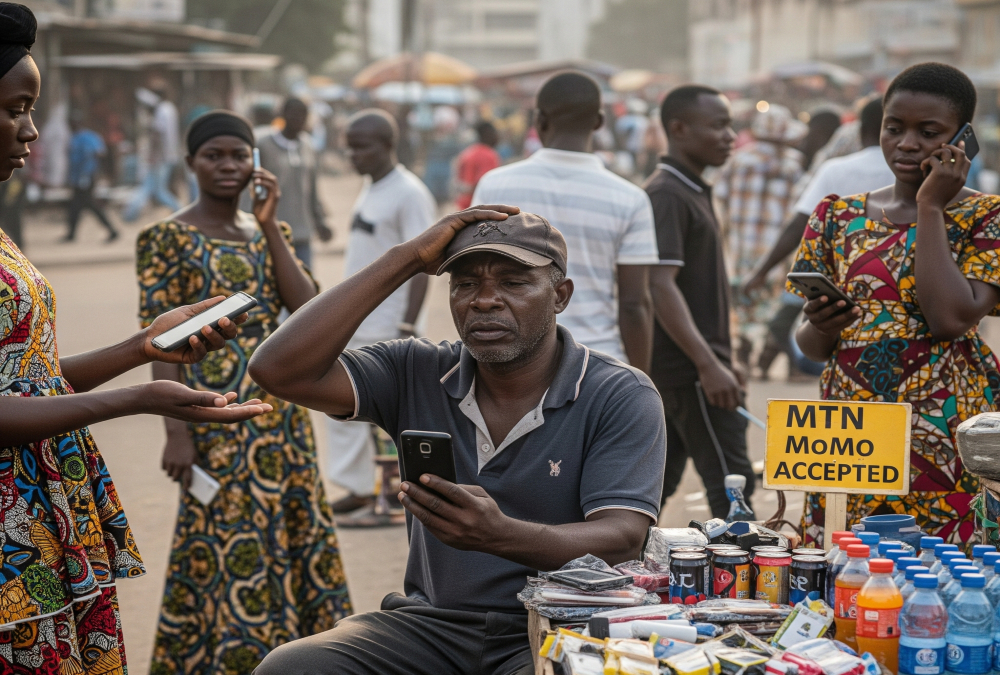
This past weekend, I stood at a fruit stall in Accra, phone in hand, ready to pay. The vendor smiled: “We accept MoMo.” I dialed the familiar USSD code. Nothing. I tried again. Still silence. No error message. No confirmation. Just a void.
I wasn’t broke – I had money in my account. But in that moment, I might as well have been.
What should have been a 10-second transaction turned into a humiliating spectacle. The vendor’s smile faded.
I felt invisible, excluded – not by poverty, but by a broken system. And I’m not alone.
For two full days, Ghana’s mobile money network – long hailed as the backbone of our digital economy – simply stopped working. Not for minutes. Not for hours. For days.
And in that silence, a harsh truth emerged: our much-celebrated “cashless” revolution is built on fragile foundations.
More Than a Glitch – A National Infrastructure Failure
Let’s be clear: this wasn’t a minor technical hiccup. It was a systemic collapse that paralyzed everyday commerce.
While urban professionals shrugged off the outage with a grumble, the real damage was felt far from city centers:
- A cocoa farmer in Ahafo waited for input financing to plant his next crop – funds delayed, livelihood at risk.
- A diabetic patient in the Volta Region, with no cash on hand, couldn’t pay for insulin because the pharmacy’s MoMo (MTN Mobile Money) terminal was down.
- Rural traders, who rely entirely on mobile money due to limited bank access, were suddenly cut off from the economy.
This isn’t just inconvenient. It’s dangerous. And it exposes a fundamental flaw in how we have designed our digital financial ecosystem: we have built a cashless future without ensuring it can function when it matters most.
USSD: The Lifeline That Shouldn’t Be a Liability
In Ghana, mobile money doesn’t run on sleek apps or high-speed internet. For most users, it runs on USSD – the old-school, text-based protocol that works on even the most basic phones.
It’s the unsung hero of financial inclusion.
But here’s the irony: we have made the entire system dependent on a technology we have failed to fortify.
When the USSD network buckled under pressure, everything collapsed:
- Network congestion: Gateway overload brought telco systems to their knees.
- API fragmentation: Poor integration between telecoms, banks, and fintechs created brittle handoffs.
- Session fragility: A dropped signal mid-transaction? That’s not a bug – it’s a design flaw.
- Zero redundancy: No backup. No failover. When the main system fails, the lights go out.
USSD was supposed to be the resilient, always-on rail of digital finance. Instead, it’s become a single point of failure – exposing millions to financial exclusion every time the network stumbles.
Digital Inclusion Is a Mirage Without Resilience
We have praised Ghana for leading Africa in mobile money adoption. And rightly so – over 60 percent of adults now use digital financial services.
But adoption without reliability is a hollow victory.
True inclusion means serving the farmer with a 10-year-old phone, not just the urbanite with a smartphone and Wi-Fi. Yet too many digital finance tools assume:
- Internet connectivity (unreliable in rural areas)
- Mid-tier devices (unaffordable for many)
- Digital literacy (uneven across regions)
When the system fails, it’s the most vulnerable who suffer first. That’s not progress. That’s tech privilege masquerading as innovation.
A Call for Accountability and Action
If mobile money is to be the heartbeat of Ghana’s economy, it must be treated like critical infrastructure – because it is. And that means we must demand better.
- Build for Resilience
Telcos and fintechs must invest in redundant systems, load-balanced gateways, and failover protocols. USSD networks should be as robust as power grids – engineered to withstand stress, not collapse under it. - Prioritize Transparency
When systems go down, the public deserves timely, clear communication. Not silence. Not vague tweets. A national incident dashboard, like those used in banking or aviation, should be standard. - Design for the Margins
Inclusion starts with the user at the edge: the rural trader, the elderly, the low-income earner. Digital finance must be built for them first – not retrofitted after the fact.
The Irony of Going Cashless
We have been lauded for “leapfrogging” traditional banking. But when our digital systems fail, we are forced to scramble for cash – proof that our cashless future is neither secure nor sustainable.
The goal isn’t to eliminate cash. It’s to build a financial system that works – all the time – for everyone.
If MoMo, Vodafone Cash, and other platforms want to be the lifeblood of Ghana’s economy, they must stop letting the pulse flatline.
Because right now, “cashless” doesn’t mean freedom. It means vulnerability. And that’s not the future we signed up for.
Curtis Akunfu is the Managing Director of Duapa Agri, a vertically integrated agribusiness operating across West and East Africa. With nearly 20 years of leadership in Africa’s agri-commodities sector, he also serves as a Global Council Member and Chair of the Agricultural Finance and Investment Working Group at the World Agriculture Forum.
