
Opinion
What Trump’s Actions Against Venezuela Mean for Africa

By Farhia Noor
An African proverb warns: “When elephants fight, it is the grass that suffers.”
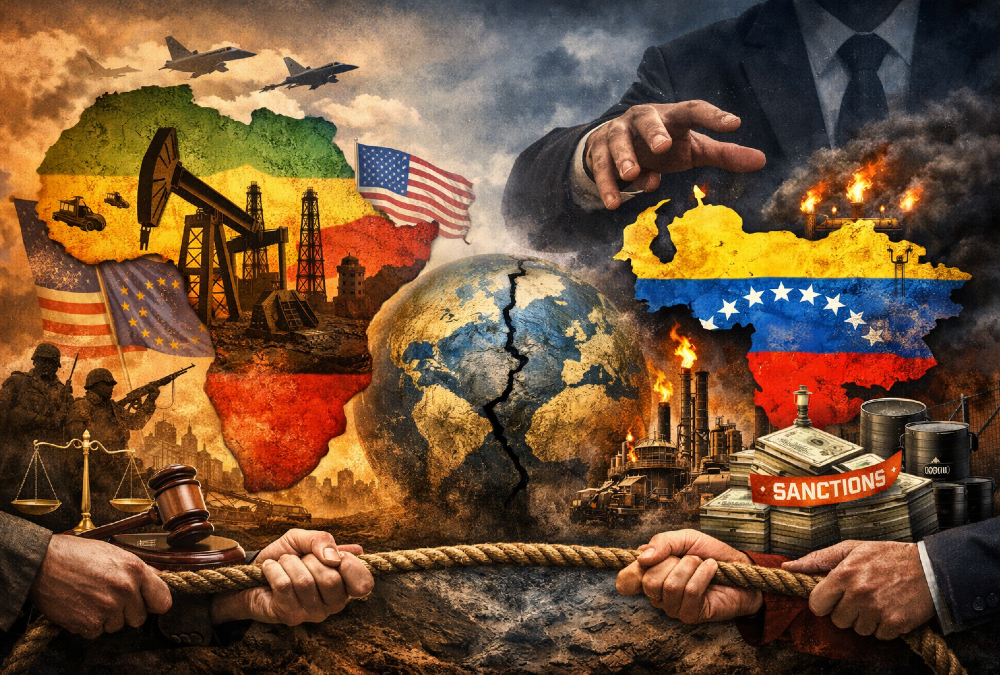
The recent escalation of American policy toward Venezuela represents far more than regional pressure on Latin America – it signals a profound warning to every resource-rich nation, particularly those across the African continent.
We must confront an uncomfortable truth: this crisis has never been solely about democracy or human rights. At its core, it concerns oil, power, and geopolitical control.
Venezuela committed what modern power structures consider a cardinal sin: it attempted to exercise sovereignty over its own natural resources on its own terms.
The Pattern We Have Seen Before
History reveals a disturbingly consistent pattern. A nation is first labeled difficult, then undemocratic, then characterized as a threat.
Finally, punishment becomes justified through sanctions, isolation, targeted arrests, and economic warfare. Africa has witnessed this playbook unfold repeatedly across Libya, Congo, and Sudan – different narratives, identical outcomes.
Question of Sovereignty and International Law
Africa cannot afford to sidestep the fundamental question this raises: Does any foreign president possess the right to arrest or attack another nation’s leader?
Under established international law, no sitting president holds unilateral authority to arrest or remove the leader of a sovereign nation. That power legitimately belongs to only two entities: a country’s own legal system, or an internationally recognized court acting with global legitimacy.
When one powerful nation unilaterally decides which leader qualifies as “legitimate,” which election “counts,” and which government deserves punishment, law ceases to function as justice and becomes merely an instrument of power. When enforcement becomes selective, it abandons principles in favor of interests.
This should profoundly concern African nations. If this precedent becomes normalized, no African presidency can claim true sovereignty.
The implications extend far beyond Venezuela’s borders.
The Strategic Lesson for Africa
The international system does not target nations simply because they are weak – it targets them when they are resource-rich but strategically vulnerable. For African leaders and nations, several lessons emerge with clarity:
Resources without unity constitute a liability rather than an asset. Exporting raw materials while importing dependence invites external pressure.
Foreign praise provides no protection when interests shift. When you fail to control your own narrative, international law becomes weaponized against you.
In the contemporary global order, oil does not automatically translate into wealth. Oil represents leverage, and leverage becomes dangerous without strategic unity and institutional protection.
A New Path Forward for the Continent
Africa must transition from reactive postures to proactive preparation. This requires African leaders to fundamentally restructure continental economic relationships: prioritizing intra-African trade over exclusive export orientation, processing resources domestically rather than shipping raw materials abroad, building robust regional financial, legal, and security systems, and speaking with unified continental authority when any African nation faces external targeting.
Africa does not suffer from a lack of resources. It suffers from a lack of unity concerning those resources. Venezuela should not be viewed as Africa’s mirror, but rather as its warning signal.
Another African proverb captures this imperative perfectly: “Until the lion learns to write, every story will glorify the hunter.” The fundamental question confronting the continent is deceptively simple yet existentially critical: Who will write Africa’s story?
The answer to that question will determine whether Africa’s vast natural wealth becomes a foundation for prosperity and sovereignty, or remains a justification for external intervention. The choice, ultimately, belongs to Africa itself.
Farhia Noor is a seasoned business consultant based in Dar es Salaam, Tanzania. With a proven track record in developing enterprises and executing turnkey projects across both government and private sectors, she brings deep expertise to the table. Farhia is also a committed advocate for community-led development and is passionate about advancing sustainable, intra-African growth.
