
Opinion
West Africa at a Crossroads: Transit Corridor or Industrial Hub?
A cascade of global shocks has handed West Africa a rare strategic opening. The question is whether the region’s leaders have the resolve to take it.

By Ziad Hamoui
The disruption rippling through the Strait of Hormuz is only the latest in a series of crises – from the COVID-19 pandemic to mounting geopolitical tensions – that have forced a fundamental rethink of global supply chains. For multinationals and logistics planners scrambling for resilient alternatives, West Africa is suddenly appearing on maps it was largely absent from a decade ago.
But presence on a map is not the same as readiness. The region faces a stark choice: remain a longer shipping detour for goods moving between other continents, or emerge as a productive hub in its own right.
That choice, however, is not being made for the first time. Each successive shock has exposed the same structural weakness – fragmented markets, underdeveloped corridors, and policy misalignment – and each time, the response has been rhetorical rather than structural.
The question is no longer whether Africa should accelerate regional integration. It is why progress remains so slow despite repeated and urgent wake-up calls.
The Architecture of Ambition
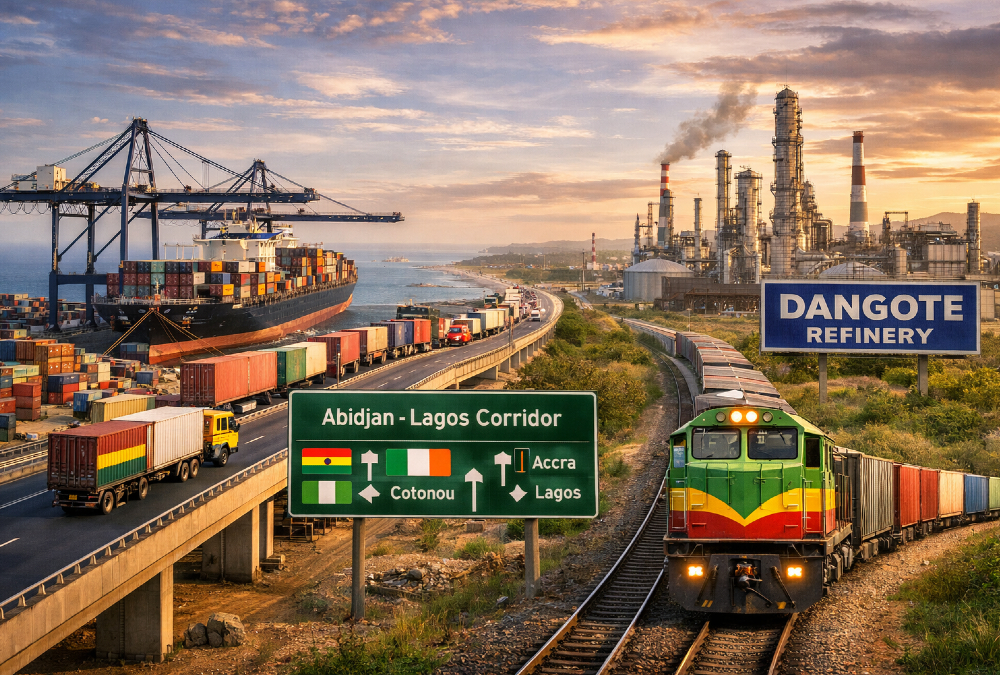
Two infrastructure projects crystallize what is at stake. The US$15.6 billion Abidjan–Lagos Corridor – stretching 1,028 kilometers (639 miles) across Côte d’Ivoire (Ivory Coast), Ghana, Togo, Benin, and Nigeria – is far more than a road.
It is the backbone of a potential regional production system, one in which Ivory Coast supplies inputs, Ghana performs processing, and Nigeria handles distribution, all connected through a single, efficient trade spine. Conceived correctly, this is how West Africa moves from isolated national economies to integrated, competitive value chains.
The 950-kilometer (590-mile) Ghana–Burkina Faso railway speaks to the same logic, though from a different angle. Landlocked economies in West Africa face logistics costs running as much as 50 percent above global averages.
That is not merely an inconvenience; it is a structural tax on competitiveness that compounds across every sector. A functioning rail corridor does not simply reduce the cost of moving goods – it reframes the very narrative around landlocked status, converting what has historically been described as a geographic liability into a potential land-linked advantage.
Hard Infrastructure is Necessary, Not Sufficient
Here is where the honest accounting begins. The region has no shortage of corridor announcements. What it has consistently lacked is the complementary layer of governance and digital infrastructure required to make physical corridors perform.
Without interoperable digital customs systems, coordinated single-window trade platforms, and real-time cargo visibility tools, the most ambitious highway degrades into a series of expensive bottlenecks. Efficiency is a systems outcome, not a construction outcome. Cutting a ribbon on a new road changes nothing if trucks sit idle at borders for 72 hours waiting for manual customs clearance.
This is not conjecture. Research by organizations tracking intraregional trade in West Africa, including Borderless Alliance, consistently documents the gap between infrastructure investment and actual corridor performance.
The physical assets exist; the policy and digital alignment does not. Until that gap closes, corridors will continue to underperform relative to their potential – and relative to competing routes in Southeast Asia and Eastern Europe that are actively competing for the same supply chain investment.
Momentum, However Cautious, is Real
The picture is not uniformly bleak. Nigeria’s non-oil exports have been expanding, a signal that the country’s economic base is – slowly – diversifying beyond hydrocarbons.
Cross-regional trade between ECOWAS and the East African Community is increasing, and new logistics corridors connecting North and West Africa are taking shape. Perhaps most tellingly, the private sector is not waiting for governments to catch up.
The Dangote Petroleum and Petrochemicals Refinery is the most visible illustration of this shift. When the facility was announced, skeptics characterized it as an outsized and quixotic bet on a continent where large-scale industrial projects rarely proceed on time or on budget.
The global energy shock of recent years has reframed that judgment entirely. The refinery is now widely understood as a strategic buffer – a proof of concept that deliberate, at-scale investment in regional value chains can generate both commercial returns and systemic resilience.
That is what industrial ambition looks like when it is executed rather than merely planned.
Competitiveness Will Be Won in The Connective Tissue
The next phase of West Africa’s economic development will not be determined by how much infrastructure the region builds. It will be determined by how effectively that infrastructure is connected, regulated, and digitized.
The competitive differentiator in an era of supply chain fragmentation is not the presence of a port or a highway – it is the capacity to move goods predictably, transparently, and at a cost that attracts investment rather than repelling it.
The policy priorities are not obscure. Harmonizing customs procedures across ECOWAS corridors, deploying interoperable single-window trade platforms, and investing in real-time logistics data infrastructure are all well-understood interventions. What has been missing is the political will to implement them at speed and scale, and the institutional coordination to sustain that implementation across multiple governments and jurisdictions.
The Window is Open – But it Will Not Stay Open Indefinitely
Global supply chain planners are making long-term investment decisions right now. Regions that function as coherent, integrated systems will capture a disproportionate share of that investment.
Regions that remain fragmented will absorb shocks – and lose ground to more disciplined competitors.
West Africa has the geography, the demographic dividend, and, in projects like the Abidjan–Lagos Corridor and the Dangote Refinery, the early infrastructure to make a compelling case for itself. What it needs now is execution: aligned policies, integrated systems, and the kind of cross-border institutional trust that transforms a collection of national economies into a regional market.
The disruption in the Strait of Hormuz will pass. The structural question it has forced – which regions have built the capacity to compete, and which have merely talked about it – will not.
Ziad Hamoui is the Co-Founder and Past President of the Borderless Alliance, a leading private-sector advocacy group promoting economic integration and removing trade and transport barriers in West Africa. With extensive experience in Ghana’s road transport, logistics, and shipping sectors, he currently serves as Executive Director of Tarzan Enterprise Ltd., a long-established family business. He is a former Co-Chair of the Africa Food Trade Coalition, Co-Founder of the Trade Facilitation Coalition for Ghana, and serves on multiple high-level advisory committees on trade, transport, agriculture, and security. A Chartered Fellow of the Chartered Institute of Logistics and Transport (CILT) Ghana, he is also a former member of its Governing Council.
