
Opinion
The Hidden Harvest: Why Solar Cold Storage Could Finally Crack Africa’s Food-Loss Crisis
The problem was never purely physical – and for the first time, neither is the solution.

By Kevine Otieno
People often question the claim that African food systems lose 40 percent of their harvest after the crop has been picked. Standing in front of a market stall piled high with tomatoes and mangoes, the statistic can seem implausible. The food, clearly, exists.
So does the buyer.
What separates the two is warm air and an absence of leverage.
Within a few kilometers of where a tomato was picked in western Kenya, or where a smallholder harvested her plot in Ethiopia, a willing consumer is ready to pay. Yet food rots before it reaches them – not because the distance is too great, but because the farmer has no choice but to sell the moment she harvests, at whatever price the market offers that morning.
She cannot wait. She has no signal telling her when to hold, and no buyer prepared to reward quality she cannot credibly demonstrate.
The standard prescription for this kind of failure is infrastructure. Build roads. Construct silos. Erect warehouses.
That prescription has been applied to African food systems, with international financing, for decades – and it has been fairly and repeatedly criticized. The needle on post-harvest loss has not moved.
The reason is instructive: the problem was never purely physical. You can pour concrete next to every farm in sub-Saharan Africa, and a smallholder who must sell immediately to service a debt, feed her family, or simply because she has no other option will still sell immediately.
Infrastructure donated without addressing the underlying economics tends to sit idle, deteriorate, and eventually become a cautionary exhibit in the case against aid-dependent development.
Why Solar Cold Storage Is a Different Proposition
So why should solar-powered cold storage be any different from the refrigerated warehouse that rusted outside a regional capital a generation ago?
Because it does not merely store food. It restructures the economics of the transaction.
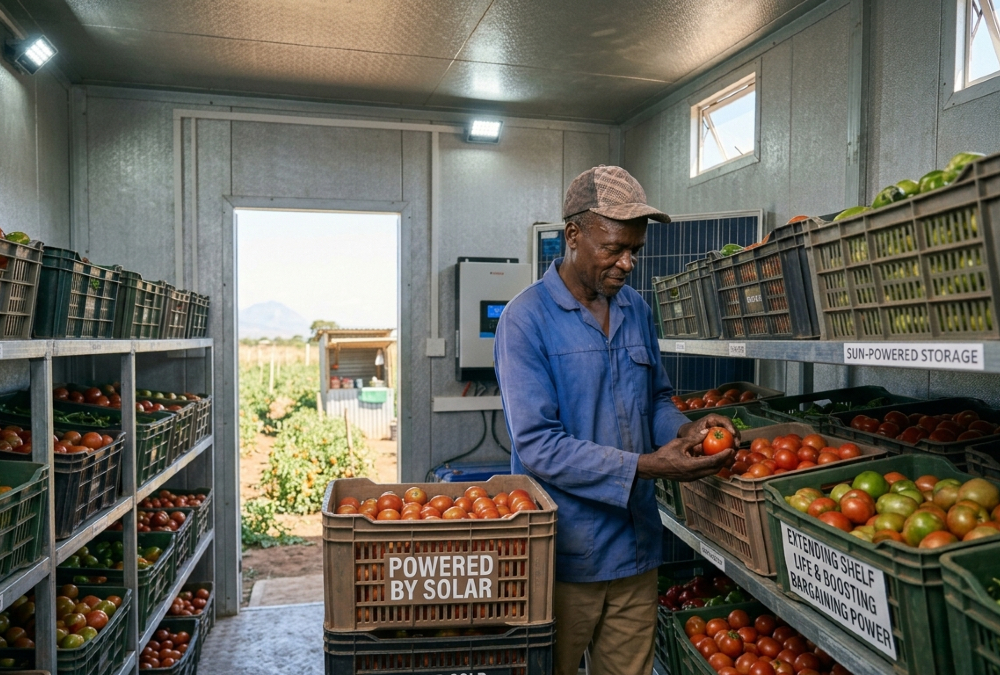
A farmer who can hold her tomatoes for ten days, rather than forty-eight hours, has bargaining power she did not previously possess. She can wait for a better price. She can aggregate her harvest with her neighbors’. She can credibly claim, to a buyer in Nairobi or Addis Ababa, that her produce has been handled with care and kept at a consistent temperature.
That is not a marginal improvement – it is a qualitatively different commercial relationship.
And the operator of that cold store has a direct financial incentive to make the model work. A pay-per-kilogram business needs utilization to survive.
That means aggregating supply, cultivating buyer relationships, and solving the market-information gaps that cold storage alone cannot fix. This is not a public good waiting for a government mandate. It is a service business with skin in the game.
The solar component addresses the constraint that killed previous refrigeration investment in rural Africa almost before it began: the requirement that the grid, the road, and the cold room all arrive simultaneously. They rarely did.
Off-grid photovoltaics have changed that calculus. A 10-tonne unit now costs between US$15,000 and US$25,000, runs 60 – 70 percent cheaper than diesel-powered alternatives, and can break even in under two years at realistic utilization rates.
The technology no longer demands that rural Africa wait for an electricity grid that may not arrive for another decade.
The market reflects the opportunity. Valued at US$15 billion in 2026, the solar cold-chain market across Africa is projected to reach US$18.3 billion by 2031. The loss rate driving that demand has not moved meaningfully in decades.
What Cold Storage Cannot Do – and What It Can
It would be dishonest to present solar cold storage as a comprehensive solution. It is not.
It does not fix market information. It does not provide smallholders with the working capital they need to store rather than distress-sell. It does not build buyer relationships overnight, or resolve the trust deficits that fragment agricultural value chains across the continent.
These are real structural gaps that refrigeration alone will not close.
What it does do is remove one specific, significant constraint – and, critically, it places an operator in the value chain who has a commercial reason to address several of the surrounding ones. That is a meaningfully different proposition from infrastructure donated and left to discover its own purpose.
The scale of the remaining opportunity is considerable. Today, only 15 percent of Kenyan smallholders access any form of cold storage.
Kenya is, by regional standards, relatively well-served. The communities where domestic food loss is highest – those outside the export corridors that attract commercial investment – are also those where the commercial appetite for new infrastructure is lowest.
The unit economics are proven. The technology works. The gap is financing: specifically, who will fund the first unit in the communities that the market, left to itself, will not reach.
That is the question worth asking. Not whether solar cold storage can transform African food systems – the evidence that it can is accumulating – but whether the capital required to scale it beyond commercially attractive markets will materialize before another generation of smallholders is forced to sell at harvest-time prices they did not choose.
Kevine Otieno is a food scientist and systems thinker with more than a decade of experience in food safety, One Health, and sustainable agriculture across Africa. Having trained over 100,000 stakeholders, led disease outbreak crisis responses, and built digital platforms expanding access to agricultural science, he works to make food systems safer, more nutritious, and climate-resilient for Africa’s most vulnerable communities. He also mentors graduate students in food science and agri-food systems.
