
Opinion
Africa’s Hydropower Paradox: Vast Potential, Grid Challenges
With less than 11 percent of its hydropower potential developed, Africa faces a defining choice between energy abundance and continued scarcity.

By Mark-Anthony Johnson
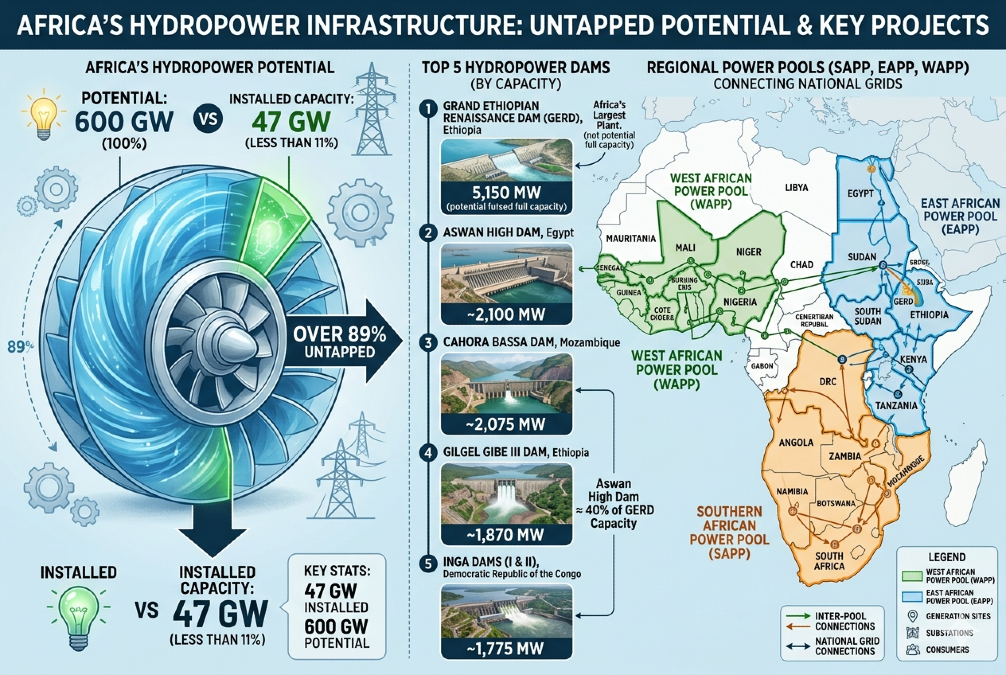
Hydropower accounts for roughly 20 percent of total electricity generation across Africa, underpinning an installed conventional capacity of more than 47 gigawatts. For a continent perpetually grappling with chronic energy deficits, that figure represents both a lifeline and a rebuke – because by any serious reckoning, Africa has barely scratched the surface of what its rivers can deliver.
Engineers and energy economists estimate the continent’s technical hydropower potential at approximately 600 GW. Africa currently exploits less than 11 percent of it.
The gap between what exists and what is being used is not merely a statistic; it is a policy failure of generational proportions, one that leaves hundreds of millions of people without reliable electricity while the water flows largely unharnessed.
Mega-Projects Leading the Way
Where investment has materialized, it has tended to arrive at scale. Africa’s five largest operational hydropower facilities illustrate just how transformative ambition, capital, and engineering can be when they converge:
- Grand Ethiopian Renaissance Dam (Ethiopia): 5,150 MW
- Julius Nyerere Hydropower Dam (Tanzania): 2,115 MW
- Aswan High Dam (Egypt): 2,100 MW
- Cahora Bassa Dam (Mozambique): 2,070 MW
- Gibe III Dam (Ethiopia): 1,870 MW
These projects, concentrated largely in Eastern and Southern Africa, are not modest undertakings. The Grand Ethiopian Renaissance Dam alone ranks among the largest hydropower installations anywhere in the world, a symbol of what state-directed infrastructure investment can achieve when sustained over decades.
Yet even these giants represent isolated nodes of generation rather than the foundation of a coherent continental energy system.
A Grid That Cannot Keep Up
Generation capacity, however impressive on paper, means little if the electricity it produces cannot reach the people who need it. Here, Africa confronts a second, equally daunting challenge.
In several sub-Saharan nations – among them the Democratic Republic of Congo, Ethiopia, Mozambique, Namibia, and Zambia – hydropower accounts for more than 90 percent of total domestic electricity generation. The dependence is profound, and the vulnerabilities it creates are real.
Vast geographic distances, chronic underinvestment in local distribution lines, and aging, often dilapidated infrastructure combine to produce transmission and distribution losses that would be considered scandalous in any developed economy.
The consequence is a paradox that defines energy poverty in its starkest form: nations rich in generating capacity yet unable to deliver reliable power to their own citizens.
Power Pools: The Emerging Solution
The most promising structural response to these inefficiencies lies in regional integration. Across the continent, countries are accelerating the development of cross-border power pools – interconnected grids that allow nations to trade surplus electricity, stabilize local networks, and collectively absorb the shocks that drought and seasonal rainfall variation inflict on purely domestic systems.
Three power pools now anchor this emerging architecture:
- Southern African Power Pool (SAPP)
- Eastern Africa Power Pool (EAPP)
- West Africa Power Pool (WAPP)
These mechanisms are not merely logistical conveniences. They represent a fundamental shift in how African nations conceptualize energy security – away from autarchy and toward interdependence.
When rainfall fails in one basin, surplus capacity from another can fill the gap. When a country invests in new generation, regional markets provide the demand that justifies the capital expenditure.
The Stakes Could Not Be Higher
Africa’s demographic trajectory makes the urgency self-evident. With a population projected to double by 2050, the continent’s energy demand will rise accordingly.
The choice is not between hydropower and some alternative; it is between developing a resource that already exists in abundance or accepting that future generations will inherit the same energy poverty that has stunted economic development for decades.
The infrastructure is being built. The power pools are expanding. The technical potential – all 600 GW of it – is not going anywhere. What remains is the will to close the gap between what Africa has and what Africa uses.
Mark-Anthony Johnson is the founder and CEO of JIC Holdings, a global asset and investment management firm founded in 2009. With over 30 years of experience and strong ties to Africa, his investments span mining, infrastructure, power, shipping, commodities, agriculture, and fisheries. He is currently focused on developing farms across Africa, aiming to position the continent as the world’s breadbasket.
