
Opinion
Visa Restrictions and the Cost of Caribbean Disunity

By Ronald Sanders
When powerful states make policy decisions, small states reflexively personalize them. When small states fragment, powerful states need not justify their actions at all.
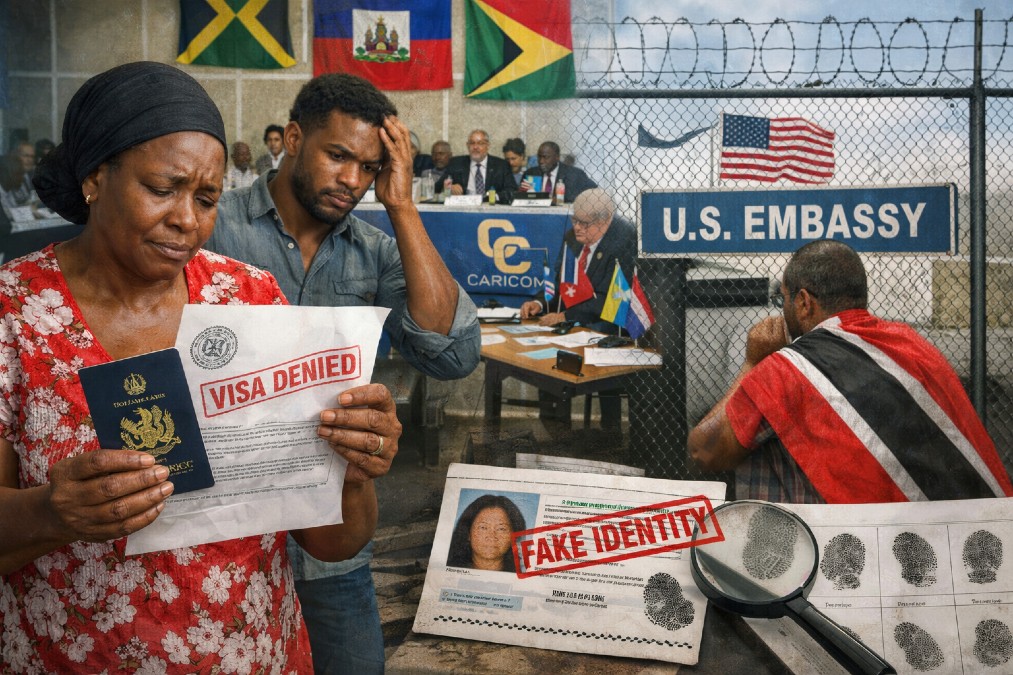
This is the uncomfortable lesson the Caribbean Community (CARICOM) must absorb from Washington’s recent decision to impose partial visa restrictions and pause certain immigrant visa issuances – commonly known as “green cards” – for nationals of several countries, including Antigua & Barbuda and Dominica.
Across the Caribbean, a misleading narrative crystallized almost instantly. Opposition parties and political opportunists scrambled to characterize the U.S. action as targeted sanctions against sitting governments, each tailoring the narrative to extract maximum domestic political advantage.
Some governments maintained strategic silence. One appeared almost gleeful, relieved that neighbors had been singled out while it escaped notice.
That reaction exposed far more about Caribbean institutional weakness than about American intent. The reality, substantiated by official U.S. statements and immigration data, reveals something altogether different: this is not diplomatic punishment aimed at Caribbean governments.
It is a domestic U.S. policy recalibration, driven by internal political pressures and fiscal considerations that extend well beyond any single region.
A Domestic Policy Shift, Not a Caribbean Rebuke
The U.S. policy review hinges on two explicitly stated concerns.
First, public expenditure containment. American authorities cite data demonstrating that substantial proportions of immigrant households eventually access public assistance programs.
President Donald Trump has been unambiguous: immigrants must achieve financial self-sufficiency and must not burden American taxpayers. One may contest the policy’s merits or its underlying assumptions, but it represents neither innovation nor illegality within established U.S. immigration jurisprudence.
Second, demographic accounting and political representation. Visa overstayers who remain illegally in the United States are nonetheless counted in population totals that determine congressional apportionment and federal funding allocations.
In today’s polarized America, this transcends technical administration—it strikes at the heart of political power and democratic legitimacy.
These considerations explain why the pause applies specifically to immigrant visas rather than tourist, student, or business travel categories. They also clarify why the affected countries list spans the globe, encompassing nations across Africa, Asia, Latin America, Eastern Europe, and much of the Caribbean.
This is quintessentially domestic policymaking.
The statistical evidence reinforces this interpretation.
U.S. government data reveal that throughout CARICOM, the percentage of immigrant households receiving public assistance runs notably high: Antigua & Barbuda at 41.9 percent; Dominica at 45.1 percent; St. Lucia and Guyana at 41.7 percent; Belize at 41.8 percent; Grenada at 40.7 percent; St. Kitts & Nevis at 39.1 percent; St. Vincent & the Grenadines at 38.1 percent; Trinidad & Tobago at 37.1 percent; Jamaica at 36.7 percent; The Bahamas at 34.0 percent; and Barbados at 33.9 percent.
Haiti registers even higher at 52.3 percent. These figures constitute not governmental indictments but actuarial inputs into U.S. domestic assessments of “public charge” risk.
Why B1-B2 Tourist Visas Face Restrictions
Yet another dimension demands forthright acknowledgment: the restriction on new B1-B2 visitor visas for Antigua & Barbuda and Dominica specifically. This measure connects primarily to concerns about visa overstaying, unlawful residence, and the utilization of public services – particularly emergency healthcare – without payment.
These anxieties intersect significantly with Citizenship by Investment (CBI) programs, not because such programs lack legitimacy per se, but because U.S. law enforcement agencies conclude that identity verification protocols require substantial strengthening.
President Trump articulated this plainly in his official Proclamation, noting that CBI programs have historically proven vulnerable to exploitation, including the concealment of true identity or asset ownership to circumvent travel or financial sanctions. Enhanced biometric verification systems aim to address precisely these vulnerabilities.
Moreover, it has become widely understood – though not formally acknowledged – that nationals of several additional CARICOM countries are already experiencing intensified scrutiny and informal visa denials, pending agreement on improved biometric arrangements. This pattern represents not selective persecution but rather a comprehensive demand for enhanced identity verification.
Sovereignty as a Two-Way Street
Another fundamental truth requires plain statement: The United States possesses the sovereign right to regulate entry into its territory, to suspend visa categories temporarily, and to deport persons residing unlawfully who depend on public resources. Every CARICOM state exercises identical authority.
We deny entry routinely. We deport overstayers. We enforce immigration laws when national interests demand it.
To deny Washington this prerogative would constitute both hypocrisy and diplomatic malpractice. The legitimate issue concerns not authority itself but rather how consequences are managed, particularly for law-abiding travelers who consistently comply with regulations.
Where the Caribbean Undermined Itself
If the U.S. action proves comprehensible – even if contestable – the Caribbean response has been demonstrably inadequate. There emerged no coordinated CARICOM position, no timely joint clarification, no collective insistence that facts prevail over fiction.
Instead, the region offered silence, mutual recrimination, and political theater. Governments calculated how to protect themselves individually rather than how to defend the region collectively.
That fragmentation produced entirely predictable consequences. When the U.S. State Department subsequently published its comprehensive list, it became unmistakable that 11 of CARICOM’s 14 independent states faced restrictions.
Fragmentation purchased no protection whatsoever – it merely postponed recognition.
This episode lays bare CARICOM’s central contradiction. We convene consultations but too frequently fail to reach conclusions.
We proclaim regional unity but practice national unilateralism when pressure materializes. Self-censorship – anticipating what powerful partners expect and preemptively adjusting behavior – has supplanted collective resolve.
Fragmentation does not preserve sovereignty. It surrenders sovereignty incrementally, piece by expedient piece.
Charting a More Effective Path Forward
What the moment requires is neither performative outrage nor intra-Caribbean blame allocation. CARICOM governments should convene urgently to establish a unified framework for engagement with the United States – one that distinguishes unlawful overstayers from compliant travelers; separates individual “public charge” assessments from broader national reputation concerns; and addresses biometric and identity-verification issues through collective, technically rigorous solutions.
Any cooperation extended must remain transparent, voluntary, and bounded by clear parameters. Absent such coordination, each country will persist in its current approach: isolated, reactive, ineffectual.
When small states quarrel among themselves over another nation’s domestic policy decisions, they do not shape outcomes – they merely endure them. For small states, sovereignty is defended neither through silence nor opportunism nor schadenfreude at a neighbor’s difficulties.
It is defended through coherence, discipline, and the institutional courage to speak with one authoritative voice when facts and principles matter most.
The Caribbean stands at a crossroads. It can continue fragmenting under external pressure, surrendering influence through division.
Or it can rediscover the collective strength that regional integration was designed to provide. The choice, ultimately, belongs to CARICOM itself – but the window for choosing wisely is narrowing.
Ronald Sanders is Antigua & Barbuda’s Ambassador to the US and the OAS
