
Opinion
The Unseen Ledger: How Trust, Not Banks, Fuels Africa’s Real Economy
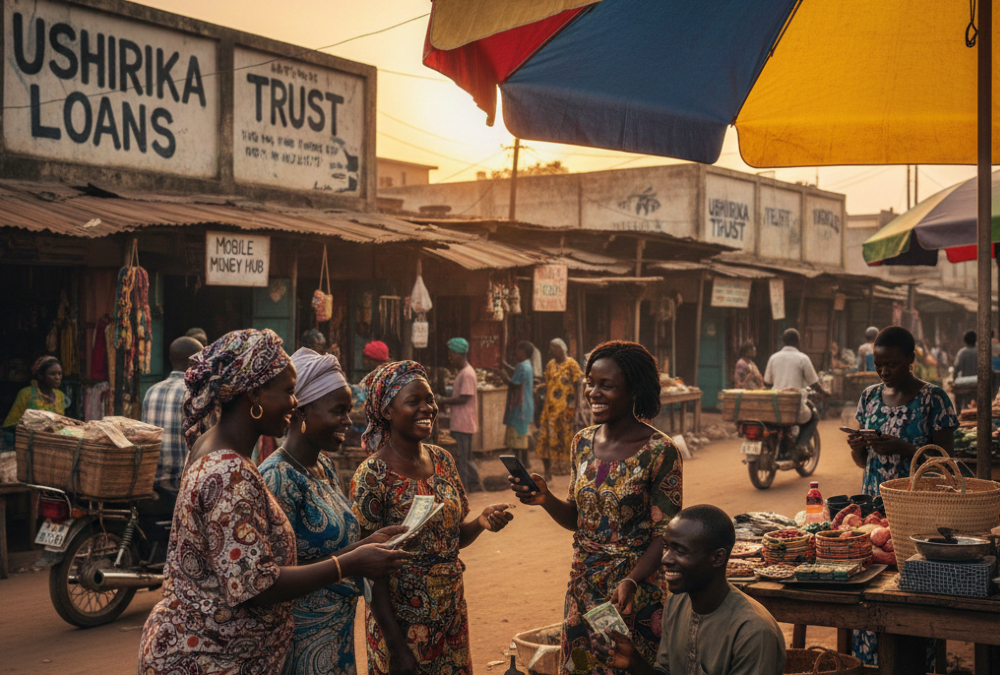

By Dishant Shah
While banks remain flush with capital, millions of African entrepreneurs access credit through trust-based systems that formal institutions fail to recognize.
Across Africa, millions of businesses and households operate entirely outside the formal banking system. This is not a failure of ambition or a lack of demand for credit.
Rather, it reflects a fundamental misalignment: traditional banks have yet to grasp how trust operates on the ground, where reputation carries more weight than credit scores and social capital substitutes for collateral.
For the small trader, subsistence farmer, or independent transporter, approaching a bank typically means navigating bureaucratic forms, providing guarantees beyond reach, securing collateral they don’t possess, and enduring weeks of processing delays. Yet business operates on a different timetable.
School fees come due. Inventory must be replenished.
Opportunities emerge and vanish within days, not weeks.
Faced with this reality, people turn elsewhere. When formal credit remains distant, sluggish, and impersonal, it silently excludes the very entrepreneurs and small enterprises driving economic activity across the continent.
The Architecture of Exclusion
The consequences of this disconnect manifest in predictable patterns. Banks maintain liquidity while becoming increasingly irrelevant to the real economy.
Small and medium enterprises remain economically active yet largely undocumented, operating beyond the statistical reach of official metrics. Governments perceive risk where communities recognize reliability.
Credit officers demand paperwork while ignoring decades of flawless informal transaction histories.
This gap explains why Africa’s real economy frequently grows despite formal financial institutions, not because of them. The banking sector’s failure to adapt has created a vacuum – one that informal credit networks have filled with remarkable efficiency.
Trust as Infrastructure
In these informal systems, credit operates according to different principles entirely. Reputation matters more than résumés.
Transaction history supersedes balance sheets. Social consequences prove more powerful than legal recourse.
A trader extends credit because she knows your family’s standing in the community. A supplier offers payment terms because you have never defaulted across ten years of dealings.
Rotating savings groups circulate capital with confidence because social shame travels faster than lawyers, and community ostracism carries genuine economic consequences.
There are no credit scores, no extensive paperwork, no loan officers scrutinizing documents. Instead, accountability embeds itself in the fabric of daily life.
Trust becomes infrastructure.
Scale Without Recognition
Across West, East, and Southern Africa, these rotating savings and credit associations – along with supplier credit arrangements – quietly fund working capital at extraordinary scale. In Kenya, mobile money platforms like M-Pesa achieved unprecedented success not through technological sophistication alone, but by digitizing existing trust networks rather than imposing banking logic on unwilling users.
The numbers tell a compelling story. The World Bank estimates that Africa’s informal economy accounts for 50 to 60 percent of employment in many countries.
That vast economic ecosystem survives and thrives on trust-based credit mechanisms, not collateral-based lending. Even the ambitious promise of the African Continental Free Trade Area risks faltering unless financial systems adapt to how Africans actually conduct business and manage cash flows.
A Question of Perspective
The distinction between formal and informal finance ultimately reflects divergent priorities. Banks lend to protect capital and minimize exposure.
Communities lend to protect relationships and maintain social cohesion. One model prioritizes contractual obligation; the other relies on social obligation. One seeks legal enforceability; the other depends on reputational consequences that often prove more binding.
Africa did not wait for permission to construct its own credit system. Communities simply built mechanisms that function within their economic and social realities.
Markets emerged to meet demand that formal institutions ignored.
Rethinking Financial Sophistication
Perhaps the most profound insight is this: what appears “informal” or “unsophisticated” to external observers often represents highly evolved financial architecture – one optimized for environments where traditional banking assumptions break down. These systems solve complex problems of information asymmetry, moral hazard, and enforcement without relying on expensive legal infrastructure or extensive documentation.
The question facing African policymakers and financial institutions is not whether informal credit networks will persist – they demonstrably will. Rather, the question is whether formal finance can learn from these systems, integrate their insights, and finally become relevant to the hundreds of millions of people it currently fails to serve.
Sometimes the most advanced financial system looks informal only to those who have not yet understood it.
Dishant Shah is a partner at Legion Exim, a company specializing in facilitating the export of high-quality engineering products directly sourced from manufacturers in India to Africa. His areas of expertise include new business development and business management.
