
Opinion
The Real Harvest: Why AI in Agriculture Must Solve Uncertainty, Not Just Create Data

By Jean Claude Niyomugabo
The dazzling machines on display in Kentucky made one thing clear: the real frontier of agricultural AI is not in the field – it is in the decision.
I kept repeating the same line to myself last week in Louisville, Kentucky, at the National Farm Machinery Show: AI in agriculture will matter only when it reduces smallholder uncertainty, not when it merely increases information.
Standing next to some of the largest agricultural equipment on earth, the thought felt both obvious and urgent.
The tractors and combines from John Deere, Case IH, New Holland, and CNH were not machines you simply walk around. They demanded a tour. Their scale was genuinely impressive – cathedral-like in their mass, immaculate in their engineering.
But what arrested my attention was not the steel. It was the shift in the conversations happening around it.
Exhibitor after exhibitor described the same trajectory: guidance systems, machine-vision sensors, autonomous features, and integrated data platforms that link equipment telemetry to agronomic intelligence. The message was unmistakable.
The future of farming is not horsepower alone. It is software, data, and decision support layered on top of it.
At one point, standing beside a self-steering, GPS-guided combine the size of a small house, I found myself thinking that if these machines get any smarter, they may soon start questioning why I still take notes on my phone.
And then my mind traveled home.
A Different Kind of Uncertainty
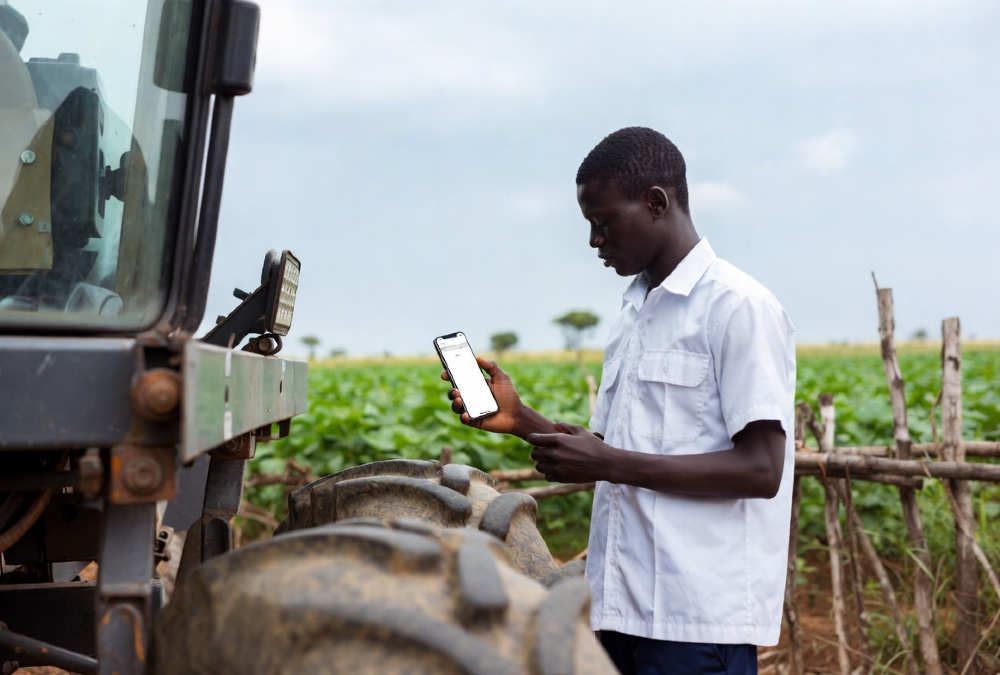
Since 2021, I have worked with smallholder farmers in Rwanda and across sub-Saharan Africa. The agricultural realities they navigate could not be more different from those on the show floor in Kentucky – and not simply because of scale.
For smallholders, every decision is a layered act of risk management. What to plant when seasonal rainfall patterns have become erratic.
How to irrigate when water access is constrained and unpredictable. When to apply inputs when fertilizer prices spike without warning.
When to sell when markets are volatile and price signals arrive too late or not at all.
In that context, more information does not automatically translate into less risk. It can just as easily produce more confusion – particularly when recommendations are generic rather than localized, algorithmically confident rather than contextually grounded, or simply not trusted by the farmers they are meant to serve.
A smallholder navigating thin margins and real hunger does not need ten alerts. She needs one reliable answer, at precisely the right moment.
That distinction – between information and actionable certainty – is the most important design question in agricultural AI today, and it remains almost entirely unresolved.
The Foundation Is the Point
The temptation in agricultural technology circles is to lead with the interface: the app, the dashboard, the chatbot, the yield prediction tool. But the interface is only as valuable as the foundation beneath it.
And in most smallholder contexts, that foundation is either absent or too fragile to support consequential decisions.
The right foundation looks something like this: public digital infrastructure and district-level data systems that accumulate institutional knowledge season after season. Weather patterns cross-referenced against soil conditions.
Pest-pressure data integrated with input-supply logistics and market-price signals. Ground-truthed against what farmers actually observe and report from their own fields.
Built this way – and, critically, designed with farmers, extension services, and local institutions rather than simply deployed at them – AI can do something genuinely transformative. It can convert policy intent into measurable outcomes rather than reports.
It can help extension workers prioritize interventions in real time. It can give a farmer in a remote district the kind of confident, localized guidance that was previously available only to those with access to expensive agronomists or the luck of proximity to well-resourced cooperatives.
This is not a technological fantasy. The components exist. What has been missing is the political and institutional will to invest in the unglamorous infrastructure layer: the data collection systems, the interoperability standards, the community trust-building, and the local capacity that makes any of it function at scale.
Two Paths, One Sector
The machines in Louisville represent one legitimate path of agricultural progress – precision, efficiency, and automation at scale for large commercial operations in wealthy countries. That progress is real, and it will continue.
But agriculture is not a monolith. The majority of the world’s farmers work plots of less than two hectares, rely on rain-fed cultivation, and operate without the digital connectivity, financial safety nets, or institutional support that make precision agriculture viable.
For them, the question is not whether AI can optimize a yield map. It is whether AI can be trusted enough, localized enough, and timely enough to meaningfully shift the odds on a decision that might determine whether a household eats well or poorly for an entire season.
The gap between those two problems is vast. Bridging it will require not just better models, but better data governance, deeper community engagement, and sustained investment in the digital public goods that no single company has the incentive to build alone.
Progress in agriculture has always been uneven. The Green Revolution lifted yields in some places while bypassing others entirely.
The precision agriculture revolution is following a similar pattern. There is no technological law requiring AI to repeat that history – but avoiding it will demand deliberate choices about where investment flows, whose uncertainty gets prioritized, and what “impact” is actually allowed to mean.
The real work is not in the showroom. It is in the field, at the intersection of real uncertainty and the right decision, at the right time.
Jean Claude Niyomugabo is an entrepreneur and digital communication specialist with a strong passion for Africa’s development. He is dedicated to harnessing the power of social media to drive positive change and enhance livelihoods. With diverse interests and a strategic approach to digital engagement, he strives to create meaningful impact through innovation and connectivity.
