
Opinion
The Lobito Corridor: A Beacon of Development or a New White Elephant?

By Danilo Desiderio
In a continent brimming with potential, infrastructure promises progress. Yet too often, grand projects fail to deliver on their lofty ambitions – becoming not engines of inclusive growth, but monuments to misplaced priorities.
In a previous article, “It’s Time for White Elephants to Turn Black,” we warned of a growing crisis: Africa’s infrastructure boom, fueled by foreign capital and geopolitical ambition, risks entrenching dependency rather than fostering self-reliance.
Citing Oxford Economics’ 2024 Africa Risk-Reward Index, we highlighted a troubling trend: instead of connecting African cities, industries, and people, much of the continent’s new infrastructure follows a colonial-era “spoke-and-wheel” model – funneling resources from the interior to coastal ports for export, primarily to benefit external markets. These so-called “white elephant” projects – costly, underutilized, and debt-intensive – have begun to erode public trust, especially among Africa’s youth, who are increasingly skeptical of development models that bypass their needs.
Now, as the African Union (AU), AUDA-NEPAD, and the Angolan government prepare to host the Third Summit on Financing African Infrastructure Development in Luanda (October 28–31, 2025), the stakes could not be higher. Titled “Mobilizing Capital for High-Impact Corridors,” the summit aims to unlock investment from African and global financiers to advance infrastructure projects that support the African Continental Free Trade Area (AfCFTA) – a transformative vision for regional integration and economic sovereignty.
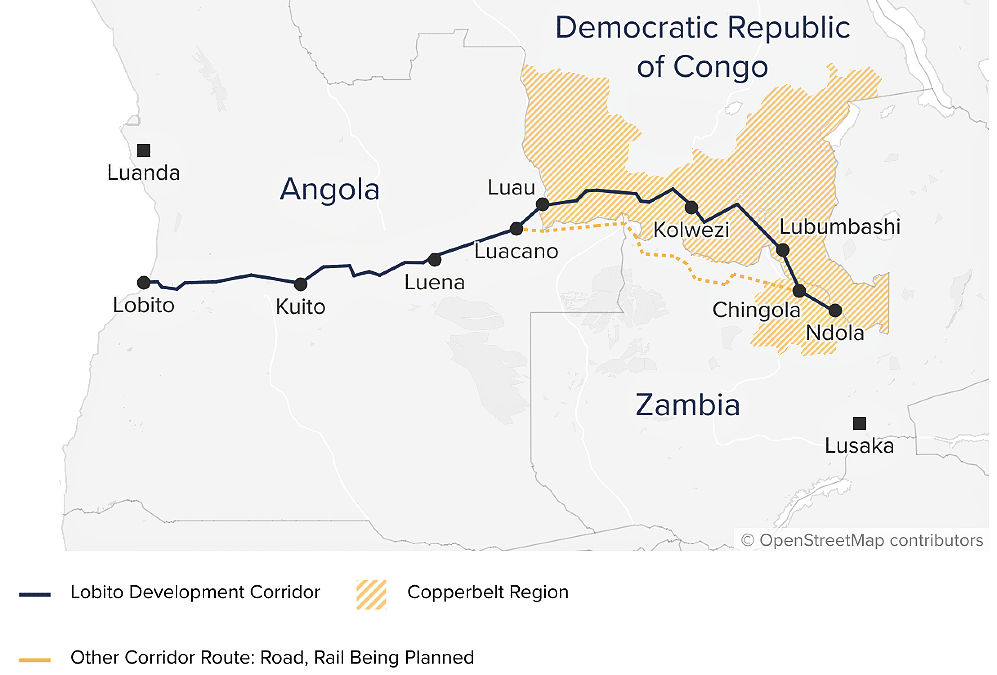
But beneath the rhetoric of pan-African unity and shared prosperity lies a more complex reality. The spotlight is on one project in particular: the Lobito Corridor – a US$1.5 billion transnational railway and logistics initiative linking mineral-rich regions of the Democratic Republic of the Congo (DR Congo) and Zambia to the Angolan port of Lobito on the Atlantic coast.
Backed by the United States, the European Union, and key private investors like Trafigura and Vulcan Industries, the corridor is being promoted as a strategic alternative to Chinese-led infrastructure in Central Africa. Its goal? To fast-track exports of critical minerals – cobalt, copper, and lithium – essential for the global green energy transition.
Meanwhile, China is advancing its own rival project: a railway from the DR Congo to Tanzania’s port of Bagamoyo on the Indian Ocean, aimed at securing access to the same resources for Asian markets.
This is not merely competition – it is a new front in the geopolitical scramble for Africa’s mineral wealth.
The Geopolitics of Infrastructure: When Development Serves Foreign Interests
Recent analysis by Bilaterals.org and independent development economists underscores a troubling pattern. Large-scale infrastructure initiatives like the Lobito Corridor often prioritize export efficiency over domestic value addition.
They are typically financed through sovereign debt or public-private partnerships that shift risk onto African governments. In many cases, environmental safeguards are weak, land acquisition displaces vulnerable populations, and local firms are sidelined in favor of foreign contractors.
Moreover, these corridors risk deepening the “resource curse” – where abundant natural wealth leads not to prosperity, but to economic distortion, corruption, and social inequality. When infrastructure is designed primarily to extract and export, it reinforces Africa’s role as a supplier of raw materials rather than a hub of industrial innovation.
The upcoming Luanda summit must confront this paradox. Will it champion infrastructure that empowers African economies from within – or will it become another platform for external powers to broker deals that serve their strategic interests under the guise of development?
There is a better path forward.
Africa does not need more white elephants. It needs black elephants – infrastructure that is productive, inclusive, and rooted in African priorities.
Projects that connect Lagos to Nairobi, Abidjan to Dakar, and Lusaka to Dar es Salaam – not just to ship minerals abroad, but to move people, goods, and ideas across the continent. Investments that prioritize regional supply chains, renewable energy grids, digital connectivity, and urban resilience.
Redefining Success: What Africa’s Infrastructure Needs
To achieve this, the summit must do more than mobilize capital. It must redefine the criteria for success. This means:
- Prioritizing projects that advance AfCFTA’s goal of intra-African trade;
- Ensuring transparent procurement and equitable benefit-sharing;
- Requiring environmental and social impact assessments with community participation;
- Leveraging African financial institutions – pension funds, sovereign wealth funds, and regional development banks – as lead investors;
- Insisting on local content, skills transfer, and sustainable debt frameworks.
The Lobito Corridor could be a test case. If managed with African agency at its core – if it includes smelting plants, processing zones, and rail links that serve domestic markets – it could become a model of responsible development.
But if it remains a conduit for raw mineral exports, financed by opaque loans and operated by foreign entities, it will join the growing list of vanity projects that enrich few while indebting many.
Toward an Infrastructure Future Built by Africa, for Africa
Africa stands at a crossroads. The infrastructure choices made today will shape the continent’s trajectory for generations.
The time has come to move beyond geopolitical competition and extractive economics. The future of African development must be built not for the world – but by and for Africa itself.
Projects like the Lobito Corridor should not be judged solely by tonnage shipped or minerals exported, but by how many jobs they create locally, how much value they add within African economies, and how well they integrate the continent’s markets. True development is not measured by foreign investment headlines, but by improved livelihoods, strengthened institutions, and resilient regional systems.
The 2025 Luanda summit must be more than a showcase of donor commitments. It must be a turning point – a moment when African leaders, financiers, and civil society unite around a shared vision: infrastructure that serves Africans first.
Only then can white elephants truly turn black.
Danilo Desiderio serves as the CEO of Desiderio Consultants Ltd in Nairobi, Kenya, specializing in African customs, trade, and transport policies. He is a customs and trade expert at the World Bank and a senior associate to the Horn Economic and Social Policy Institute (HESPI).
