
Opinion
The Invisible Engine: West Africa’s $10 Billion Food Trade

By Ziad Hamoui
Official trade statistics capture barely a sixth of West Africa’s actual regional food trade. This massive data gap is undermining food security and misdirecting billions in infrastructure investment.
West Africa’s policymakers have been flying blind. For years, official statistics have reported regional food trade at roughly US$1.7 billion annually – a figure that appears in policy documents, development plans, and ministerial briefings across the region.
New research from the OECD now reveals a startling truth: the actual figure sits closer to US$10 billion. The official numbers are off by a factor of six.
This isn’t a rounding error. It represents a fundamental misunderstanding of how West African economies actually function.
The Invisible Majority
The explanation for this statistical chasm lies not in falsified records or corrupt officials, but in the basic architecture of how trade data gets collected.
Customs posts dutifully record what passes through formal checkpoints.
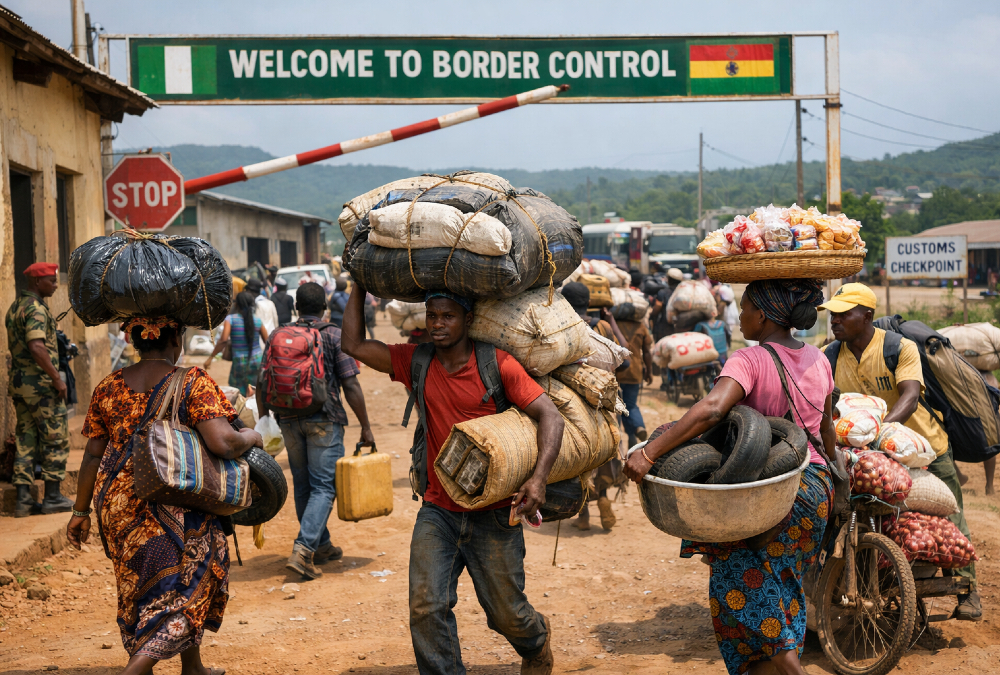
The problem? The vast majority of West Africa’s intra-regional trade never goes near a customs post.
Thousands of informal border crossings facilitate a daily torrent of commerce that exists completely outside official measurement systems. The traders using these routes aren’t criminals or smugglers – they are legitimate economic actors operating within networks that predate modern borders and formal customs procedures by centuries.
The system doesn’t recognize them, so the statistics don’t capture them.
The consequences of this blind spot extend far beyond academic quibbling over methodology.
When official data suggests that only 15 percent of West African food trade stays within the region, policymakers naturally conclude that regional integration efforts have failed and that the continent remains hopelessly dependent on external markets. Yet excluding cocoa and cashew exports – commodities destined for global markets by their nature – the reality is strikingly different: nearly 38 percent of West Africa’s food trade circulates regionally, a proportion comparable to intra-EU trade flows.
Feeding Millions in the Shadows
The food security implications alone demand urgent attention. Each year, 68 trillion kilocalories cross West African borders through these formal and informal channels combined.
That represents enough energy to meet the complete annual dietary needs of 80 million people – nearly a quarter of the region’s entire population. In protein terms, 2.6 billion kilograms of livestock and fish products move regionally every year, forming invisible supply chains that keep millions fed.
This isn’t the romanticized vision of subsistence farmers carrying baskets across village boundaries. West African regional trade operates at genuine scale and sophistication.
Countries in the region trade with a median of 12 partners out of 14 possible Economic Community of West African States (ECOWAS) members.
Major exporters like Senegal, Ghana, and Côte d’Ivoire (Ivory Coast) conduct between 39 percent and 58 percent of their regional food trade with non-neighboring countries, indicating complex, long-distance supply chains that would be impressive in any global context.
When Ground Truth Diverges From Data
At Borderless Alliance, we have spent years watching the disconnect between official statistics and observable reality. Standing at border crossings, engaging with thousands of cross-border traders, documenting the relentless movement of goods – the trade was manifestly there.
It simply refused to appear in government reports or international databases.
Ghana’s maiden Informal Cross-Border Trade Survey, conducted in late 2024, finally quantified what field experience had long suggested. Informal trade accounted for 61.2 percent of total commerce with Togo and 55.7 percent with Ivory Coast.
For decades, policymakers have been designing interventions for a formal economy that represents a minority – sometimes a small minority – of actual commercial activity.
The Cost of Ignorance
The management axiom holds true: you cannot manage what you cannot measure. How can governments design effective food security strategies when their baseline data captures perhaps a sixth of relevant trade flows?
How can regional bodies allocate infrastructure investment efficiently when they lack basic information about where goods actually move? How can trade facilitation measures target bottlenecks when the busiest trade routes don’t appear in official records?
West African governments and their development partners invest billions annually in roads, ports, and border infrastructure. These are necessary investments, but they rest on assumptions about trade flows that may be fundamentally incorrect.
A highway connecting the wrong cities, a port expansion in a location marginally relevant to actual trade patterns, border posts that formalize crossings traders have deliberately avoided – all represent capital misallocated because the underlying data was incomplete.
Investing in Reality
The solution requires investing not just in physical infrastructure but in the statistical infrastructure that reveals where physical infrastructure should go. That means formal recognition and measurement of informal trade flows.
It means deploying survey methodologies that capture the full spectrum of commercial activity, not just what passes through official checkpoints. It means training statistical agencies to see the economy that exists, not the economy that regulatory frameworks imagine.
The OECD and the ECOWAS Commission deserve recognition for this critical research, conducted through the ECOWAS Agricultural Trade Programme. But acknowledgment must translate into action.
Every West African statistical agency should prioritize regular informal trade surveys. Regional bodies must incorporate this expanded understanding into policy frameworks.
Development partners should condition infrastructure financing on evidence that projects address actual, measured trade flows rather than assumed ones.
Evidence-based policy requires evidence that reflects reality. For too long, West Africa’s policymakers have been crafting strategies based on a statistical mirage – a formal economy floating disconnected from the vibrant, massive informal networks that actually move food, create employment, and sustain livelihoods across the region.
The informal economy isn’t invisible because it’s hidden. It’s invisible because we have chosen not to look.
That choice has proven expensive. The question now is whether institutions are ready to acknowledge what’s been there all along – and adjust their policies accordingly.
Ziad Hamoui is the Co-Founder and Past President of the Borderless Alliance, a leading private-sector advocacy group promoting economic integration and removing trade and transport barriers in West Africa. With extensive experience in Ghana’s road transport, logistics, and shipping sectors, he currently serves as Executive Director of Tarzan Enterprise Ltd., a long-established family business. He is Co-Chair of the Africa Food Trade Coalition, Co-Founder of the Trade Facilitation Coalition for Ghana, and serves on multiple high-level advisory committees on trade, transport, agriculture, and security. A Chartered Fellow of the Chartered Institute of Logistics and Transport (CILT) Ghana, he is also a former member of its Governing Council.
