
Opinion
The Four Real Forces Driving Africa’s Economic Transformation in 2025

By Davida Ademuyiwa
Africa’s economic narrative has long been framed by potential – “the next frontier,” “the last great untapped market.” But in 2025, the conversation is shifting from promise to progress.
Real capital is flowing. Real companies are scaling. And real transformation is underway.
Behind the headlines and hype, four interconnected trends are emerging as the true engines of Africa’s economic renaissance. These aren’t speculative forecasts – they’re measurable, investment-backed shifts reshaping the continent’s future.
Let’s cut through the noise and examine the forces actually powering Africa’s rise.
1. Infrastructure Development: The Foundation of Growth
Africa’s infrastructure deficit is well-documented: the continent requires over US$170 billion annually to close gaps in energy, transport, water, and digital connectivity. But where some see a challenge, investors see opportunity.
Infrastructure is no longer a bottleneck – it’s becoming a growth catalyst. From the Lagos-Calabar Coastal Highway in Nigeria to the Grand Ethiopian Renaissance Dam and the expansion of fiber-optic networks across East Africa, governments and private investors are aligning on long-term, high-impact projects.
Returns on infrastructure investments in Africa often range between 15 percent and 30 percent, driven by public-private partnerships, multilateral financing, and growing institutional appetite for stable, inflation-linked assets. This sector is the backbone of every other economic advancement – without it, scale is impossible.
And for the first time, national development plans across the continent – from Kenya’s Vision 2030 to Rwanda’s Green Growth Strategy – prioritize infrastructure as a core pillar of economic transformation.
2. The Digital & Mobile Economy: Leapfrogging the Legacy Era
Africa isn’t catching up to the digital world – it’s redefining it.
With over 500 million mobile internet users and rising, the continent is pioneering mobile-first solutions that bypass traditional systems altogether. Fintech, edtech, healthtech, and logistics startups are scaling at unprecedented speed, driven by local innovation and global capital.
Consider the impact:
- Flutterwave processed over US$50 billion in payments in 2024, connecting African businesses to global markets.
- M-Pesa continues to redefine financial inclusion, with over 50 million active users across East and West Africa.
- Andela and Copia are revolutionizing remote work and rural e-commerce, proving that digital access can unlock human and economic potential in even the most underserved regions.
The African digital economy is projected to reach US$180 billion by 2030, according to the African Development Bank. Venture capital funding, while down globally, remains resilient in African tech – because the demand is real, and the unit economics are improving.
This isn’t just digitization. It’s a structural shift in how economies function.
3. Rising Urban Consumption: The Power of the African City
Africa is urbanizing faster than any other region on Earth. By 2050, over 600 million people will live in African cities. This isn’t just a demographic shift – it’s a consumption revolution.
As urban populations grow, so does demand for housing, transportation, healthcare, education, and consumer goods. The African consumer market is projected to reach US$2.5 trillion by 2030, according to the African Development Bank.
Multinationals and regional champions alike are responding. From Diageo’s expansion into Nigeria’s premium beverage market to Kenyan agritech startups delivering fresh produce to Nairobi apartments, the focus is on building brands and services that meet the needs of a young, connected, and aspirational urban class.
Investors in fast-moving consumer goods (FMCG), fintech for retail, last-mile logistics, and proptech are already positioning themselves. The message is clear: the future of African consumption isn’t rural – it’s urban, digital, and dynamic.
4. Agriculture & Green Growth: From Subsistence to Scalable Systems
Africa holds 60 percent of the world’s uncultivated arable land. Yet, it imports over US$50 billion in food annually.
That contradiction is changing.
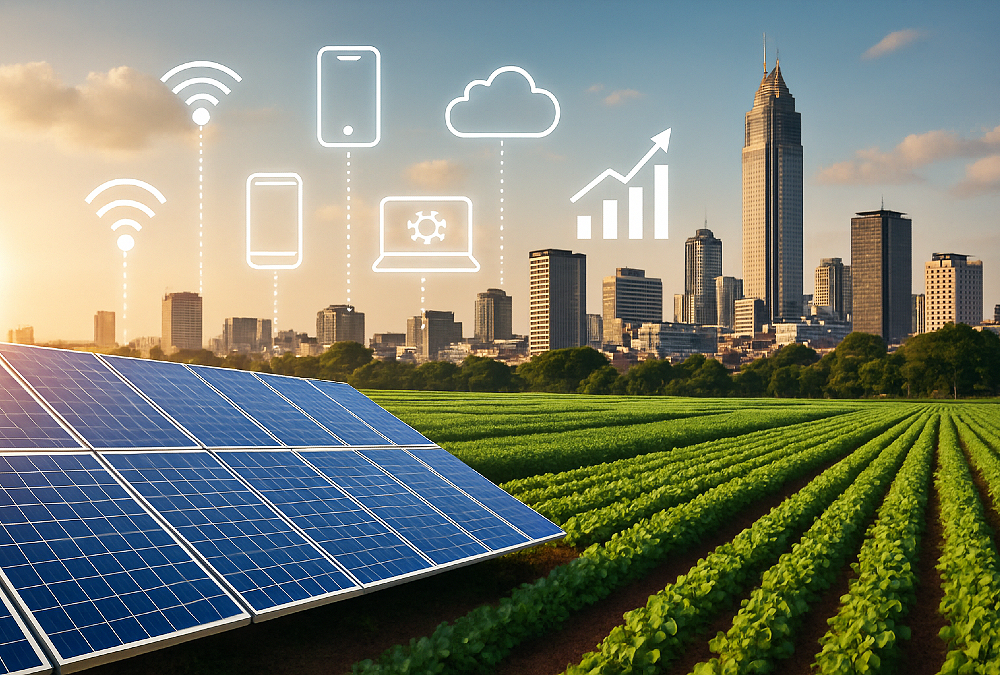
A new wave of investment is transforming agriculture into a high-growth, technology-driven sector. Climate-smart irrigation, solar-powered cold chains, precision farming, and digital marketplaces are boosting yields and connecting smallholder farmers to formal markets.
Simultaneously, Africa’s green economy is accelerating. With abundant solar, wind, and hydro resources, the continent is poised to lead in renewable energy deployment.
Projects like the Sahara Solar Initiative and decentralized mini-grids across West Africa are not just reducing emissions – they are powering homes, clinics, and factories.
This dual transformation – agritech and clean energy – is creating jobs, enhancing food security, and attracting ESG-focused capital. It’s no longer enough to call Africa “rich in natural resources.”
The focus is shifting to how those resources are sustainably harnessed for inclusive growth.
What About Cheap Labor? A Misplaced Emphasis
Yes, Africa has the world’s youngest and one of its most cost-competitive labor forces. But low wages alone don’t drive transformation.
Without adequate infrastructure, education, and policy stability, human capital remains underutilized.
The real advantage isn’t cheap labor – it’s untapped potential. And that potential is only unlocked when paired with the four drivers above.
Final Insight: Momentum Over Myth
These four trends – infrastructure, digital innovation, urban consumption, and green-agricultural transformation – are not speculative. They are measurable.
They are investable. And they are interdependent.
Smart capital is no longer waiting for permission. It’s flowing into roads, data centers, solar farms, e-commerce platforms, and agribusinesses because the returns are becoming clear.
This is not a story of charity or risk – it’s a story of strategic opportunity.
So the question isn’t whether Africa will rise. It’s who will position themselves to rise with it.
Which of these four trends are you watching most closely? Are you investing, innovating, or advising in this space?
Davida Ademuyiwa is a UK politician and founder of DaviGlobal International Trade & Investment. She facilitates cross-border investment and connects capital with scalable ventures across the UK, Europe, the Middle East, and Africa. She also serves as Regional Ambassador for the Conservative Policy Forum in the East of England, contributing to grassroots policy dialogue alongside her work in global trade and investment.
