
Opinion
The EU–Indian Ocean Trade Deal: A Pact Between Promise and Power
A landmark agreement with four island-nations offers economic opportunity – but raises urgent questions about sovereignty, food security, and who really gets a seat at the table.

By Danilo Desiderio
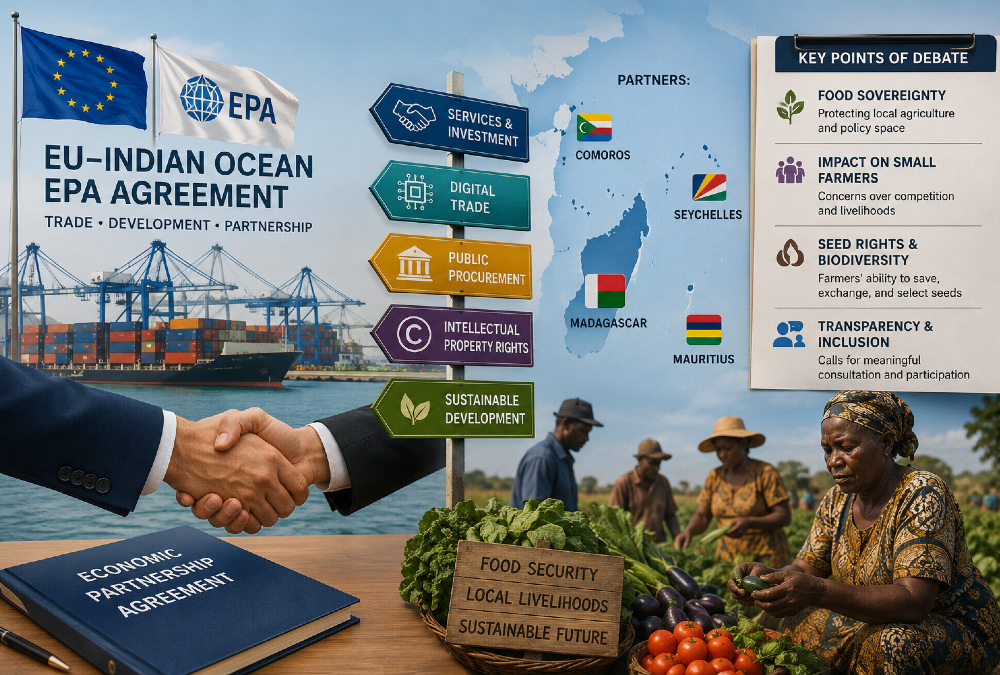
On June 10, 2026, the European Commission announced the conclusion of an enhanced Economic Partnership Agreement (EPA) with Madagascar, Mauritius, Seychelles, and Comoros – signed in Mauritius and widely billed as a new chapter in EU–Indian Ocean relations. Supporters describe it as a transformative step: a broadened, modernized framework that moves far beyond traditional tariff preferences to cover services and investment, digital trade, public procurement, intellectual property rights, and sustainable development including labor and environmental standards.
That is an ambitious agenda. And it may well deliver on its promises. But ambition, in trade policy, has a habit of generating as many anxieties as it does opportunities.
In the Indian Ocean islands, those anxieties are already audible – and they deserve to be taken seriously.
More Than a Trade Deal
The most contested element of the agreement is its intellectual property chapter, which establishes protections for 135 EU geographical indications – regional food and beverage designations, think Champagne or Parmigiano-Reggiano – in Madagascar, Mauritius, and Seychelles, following a transition period. The chapter also addresses plant varieties and the enforcement of intellectual property rights more broadly.
The European Commission frames these provisions as tools to promote innovation, attract investment, and create a more predictable business environment. It is not wrong to do so.
Clearer rules around intellectual property can, in principle, strengthen the conditions for long-term economic growth. But in Madagascar, civil society organizations have raised pointed objections, arguing that stronger IP protections could, over time, erode farmers’ rights over seeds and agricultural biodiversity.
Their concern is not abstract: in a country where smallholder agriculture underpins rural livelihoods, restrictions on the ability to save, exchange, and select seeds strike at the very foundations of food resilience.
This debate is part of a broader and longstanding critique of North-South economic agreements, one that has surfaced repeatedly across Africa. The core argument is not that trade is bad – it is that trade agreements often prioritize market liberalization over the structural economic transformation that developing nations need most.
Whether the enhanced EPA’s provisions on services, investment, digital trade, and procurement will adequately support domestic development objectives, or merely open new channels for foreign capital, remains to be seen.
The Voices Left Outside the Room
Beyond the substance of the agreement lies a procedural grievance that is harder to dismiss. Critics – including farmers’ organizations and civil society representatives – contend that they were not meaningfully involved in the negotiations. If accurate, this is a serious problem, and not only on democratic grounds.
Trade agreements derive their legitimacy not merely from governments signing on the dotted line, but from the societies they are meant to serve. When those societies feel excluded from the process, they are less likely to trust the outcome – and less likely to support its implementation.
Skepticism hardens into resistance. Formal adoption does not guarantee real compliance, genuine ownership, or durable results. An agreement signed in good faith can still fail in practice if the social foundation beneath it is too thin to bear the weight.
The concerns raised about this EPA include four recurring themes: the lack of meaningful consultation with civil society; the risk that European agricultural exports could undermine domestic food production; competitive pressures on small-scale farmers who lack the resources to adapt; and – perhaps most viscerally – the fear that farmers could lose traditional rights to save and exchange seeds, practices that are not merely agricultural habits but cultural ones, embedded in centuries of rural life.
A Familiar Anxiety, an Unresolved Question
What makes this moment striking is that none of these concerns are new. They have been raised – in different registers, with different evidence – since the first wave of EPAs was negotiated in the 2000s.
The fact that they persist, despite decades of accumulated experience, is worth reflecting on. It does not automatically vindicate the critics; the history of trade liberalization also contains genuine success stories, cases where greater market integration lifted productivity and living standards.
But persistent public anxieties are rarely irrelevant. They tend to reveal something real: about the distribution of benefits, about trust, about power, and about who controls the future.
It is also worth noting the immediate context. Many African countries are still grappling with fertilizer shortages and rising agricultural input costs – legacies, in part, of global supply chain disruptions that have exposed the fragility of food systems dependent on imported inputs.
In this environment, questions about food sovereignty carry extra weight. The margin for error is smaller than it used to be.
What Happens Next Matters More Than the Text
The enhanced EPA supersedes an earlier interim arrangement – the EU-ESA-5 iEPA – which covered five Eastern and Southern African states: Comoros, Madagascar, Mauritius, Seychelles, and Zimbabwe. The new agreement applies only to the four Indian Ocean island nations; Zimbabwe remains outside it, at least for now.
Whether this deal ultimately functions as a catalyst for development or as a new set of constraints will depend far less on the legal text than on how the agreement is implemented and governed over the coming years. The provisions on sustainable development, labor standards, and environmental protection matter enormously – but only if they are enforced rather than merely inscribed.
The same is true for any safeguards designed to protect domestic producers and preserve policy space.
The comparison with the African Continental Free Trade Area (AfCFTA) is instructive here. Continental integration frameworks face analogous questions about legitimacy and implementation, and the lesson from those processes is consistent: technical soundness is necessary but not sufficient.
Trade agreements are social compacts. They require not only legal validity but political trust – and trust, unlike tariff schedules, cannot be negotiated into existence. It must be built.
An Opportunity That Must Be Earned
None of this is to say the deal is a mistake. Predictable access to one of the world’s largest consumer markets, a stronger investment climate, and opportunities for integration into global value chains are genuine prizes for small island economies with limited domestic demand and narrow export bases.
The agreement’s supporters make a credible case.
But the test of any trade agreement is not what it promises; it is what it delivers – to whom, and on what timeline. For the enhanced EU–Indian Ocean EPA to fulfill its stated ambitions, the European Commission and the four signatory governments will need to do more than implement its technical provisions. They will need to demonstrate, in practice, that the deal is designed to serve the populations of Madagascar, Mauritius, Seychelles, and Comoros – not merely to open their markets.
That means genuine and ongoing engagement with civil society. It means transparency in implementation. It means monitoring whether farmers’ rights are protected in fact, not just in principle. And it means remaining open to adjustment when evidence suggests that outcomes are falling short of intent.
Economic agreements, however well-crafted, do not enforce themselves. The legitimacy that governments confer at the signing ceremony is only the beginning. The harder work – earning the confidence of the people most directly affected – lies ahead.
Danilo Desiderio serves as the CEO of Desiderio Consultants Ltd in Nairobi, Kenya, specializing in African customs, trade, and transport policies and is a senior associate to the Horn Economic and Social Policy Institute (HESPI).
