
Opinion
Africa’s AI Crossroads: A Lesson from Kenya’s Connectivity Revolution
When bureaucratic paralysis threatened to lock East Africa out of the internet age, a handful of officials chose action over consensus. As the continent now debates AI regulation, that decision has never felt more urgent.

By Sheena Raikundalia
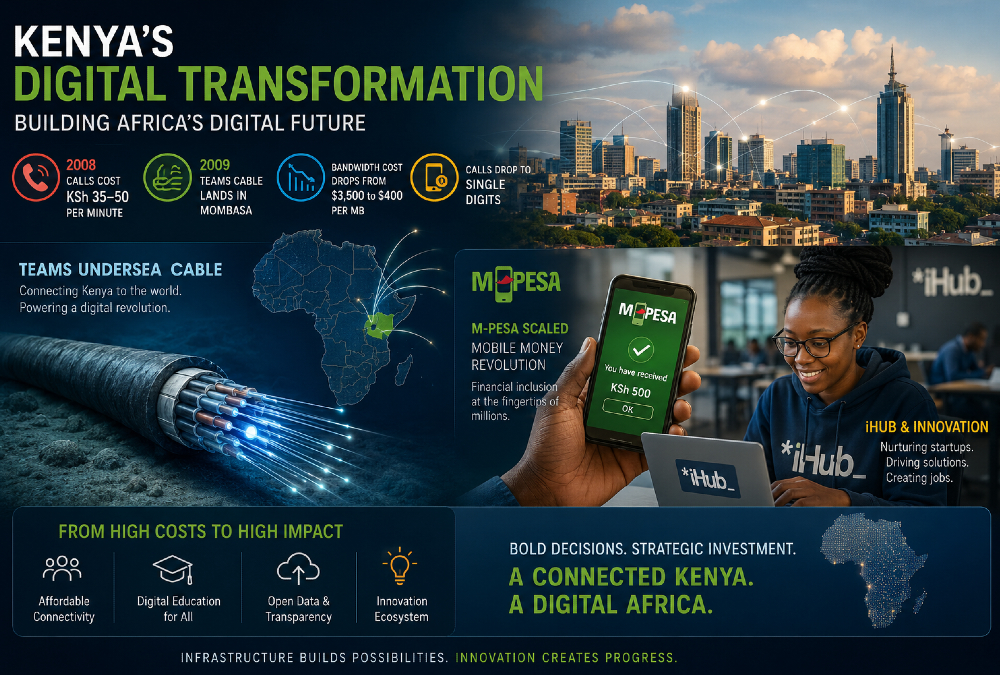
In 2008, placing a phone call in Kenya cost between KSh 35 and KSh 50 – roughly 50 to 75 cents – per minute. Ordinary Kenyans developed elaborate workarounds: the “flash,” a single ring designed to prompt a callback, or the discipline of waiting until midnight, when off-peak rates made conversation marginally affordable. Safaricom’s then-CEO Michael Joseph famously described these behaviors as Kenya’s “peculiar calling habits.”
He was wrong about the peculiarity. What he was observing was a poverty tax on human communication.
The story of how that tax was abolished – and why every African policymaker now wrestling with artificial intelligence regulation needs to understand it – was told last week at a panel during the GITEX Kenya summit by Ambassador Bitange Ndemo, one of the architects of Kenya’s digital transformation. It is a story not of technology, but of political courage.
The Infrastructure Problem Nobody Was Solving
Before 2009, not a single undersea fiber-optic cable served the East African coast. International bandwidth, the invisible plumbing of the modern economy, cost between US$3,500 and US$7,500 per megabyte per month.
The World Bank had identified the problem and commissioned a solution: a regional cable consortium spanning 23 nations. Three years passed. The solution produced meetings. The meetings produced nothing.
This is a pattern familiar to anyone who has watched multilateral bodies attempt to solve urgent problems through the machinery of consensus. The perfect became the mortal enemy of the functional.
The Decision to Stop Waiting
What happened next is the part that deserves to be studied in policy schools across the continent. Ndemo, backed by then-Communications Secretary Mutahi Kagwe and President Mwai Kibaki, made a unilateral decision: Kenya would act alone.
They withdrew from the regional protocol. They flew to the UAE. They negotiated directly with Etisalat and secured a deal that placed 85 percent ownership of the resulting infrastructure in Kenyan hands.
They did all of this while receiving death threats from satellite operators whose extraordinarily profitable business model – built entirely on the absence of affordable alternatives – was about to be dismantled. They pushed forward anyway.
The TEAMS cable landed in Mombasa in June 2009. Bandwidth prices collapsed, falling from US$3,500 to roughly US$400 per megabyte. The cost of a phone call dropped to single digits. The poverty tax had been repealed.
The Fear Nobody Talks About
What makes Ndemo’s account particularly valuable – and rare among official narratives of policy success – is his admission of what came next. After the cable landed, he was terrified.
He lay awake worrying that nobody would use it. That critics would label it a white elephant. That the infrastructure would sit idle, a monument to overreach.
So he went back to work. He pushed the World Bank for subsidized broadband to every Kenyan university. He lobbied for laptops for students. He championed the Kenya Open Data Initiative, a project that required storing government data on servers in San Francisco – a direct violation of a British colonial statute that remained, absurdly, on the books.
Standing before President Kibaki, Ndemo made a personal pledge: “I have never let you down. I will not let you down. But with this, I will build you a legacy.”
Kibaki said yes.
What followed is now the founding mythology of African tech: iHub, the innovation space that catalyzed a generation of startups. M-Pesa, the mobile money platform that became a global case study in leapfrog development.
And when COVID-19 arrived and the world scrambled to go cashless, Kenya was ready – operating on infrastructure built a decade earlier by officials who refused to wait for consensus.
The demand was never the problem. The courage to build was.
The AI Crossroads
Africa now stands at an identical junction, and the parallels are not metaphorical – they are structural. The question is not whether artificial intelligence will transform the continent’s economies. It will. The question is whether African governments will act, or convene.
Ndemo’s message at GITEX was unambiguous: don’t worry about demand. Build. The demand will follow the infrastructure, exactly as internet usage followed the cable. And build together – not because multilateral institutions are efficient (they are often the opposite), but because the problems worth solving are continental in scale.
As Ndemo noted, with some wry understatement, even nations that spent centuries in bloody conflict with one another managed to construct the European Union. Africa has greater reasons and richer resources to do the same.
But the warning he issued deserves to be printed, framed, and mounted on the wall of every ministry currently drafting AI regulation on this continent: Do not over-regulate AI. Do not kill the baby before it’s born.
The Real Risk
There is a version of African AI policy that looks, from a distance, like responsible governance. It involves extensive multi-stakeholder consultations, carefully worded risk frameworks, committees studying what Brussels and Washington have already done, and regulation drafted in anticipation of harms that remain largely theoretical.
It is the EASSy cable process, restaged for a new technology.
EASSy – the Eastern Africa Submarine Cable System – was the 23-nation regional initiative that spent years in negotiation while East Africa remained cut off from affordable global connectivity. Kenya’s decision to exit that process and act unilaterally is what made the difference. Had Kibaki’s government waited for continental consensus, the cable might have landed years later, and M-Pesa might have scaled into a far more constrained digital environment.
The same logic applies today. Africa is not behind in AI because it lacks the intellectual capital – it demonstrably does not. It is not behind because the problems AI can solve are less acute here – they are, in many domains, more acute. It risks falling behind for precisely the same reason it nearly missed the broadband revolution: a preference for the safety of process over the discomfort of action.
What We Owe the Next Generation
The midnight calls are gone. The Kenyans who once flashed each other across a fragile mobile network now transact, communicate, and build businesses on infrastructure that exists because a small number of officials decided that waiting was its own kind of failure.
The question facing African policymakers today is not whether to regulate AI – some regulatory framework is both inevitable and appropriate. The question is whether regulation will be designed to enable or to insulate; to accelerate African participation in a transformative technology, or to manage the anxiety of those who would prefer to observe from a careful distance.
History has already run this experiment once. We know how the cautious version ends.
Are we building? Or are we still waiting for 23 countries to agree?
Sheena Raikundalia is an accomplished entrepreneur, former lawyer, government policy advisor, and angel investor with deep expertise across the legal, financial services, and impact investment sectors in Europe and Africa. She has played a pivotal role in advancing Africa’s technology and innovation ecosystems, leveraging a career that spans top-tier London law firms, leadership as Country Director of the UK-Kenya Tech Hub for the UK Foreign, Commonwealth & Development Office (FCDO), and her current position as Chief Growth Officer at agri-tech company Kuza One. Sheena is recognized for her strategic vision, commitment to fostering innovation, and strong advocacy for Africa’s growth potential in technology, entrepreneurship, and impact investment.
