
Opinion
Africa’s Banking Titans and the Leaders Who Will Define Their Future
The continent’s top ten banks have never been stronger. But sustained growth will demand a style of leadership that most boardrooms have yet to fully embrace.

By Des H Rikhotso
Africa’s banking sector is no longer a footnote in the global financial narrative – it is an increasingly central chapter. From the boardrooms of Johannesburg to the trading floors of Lagos and Cairo, a cohort of institutions has emerged that can credibly claim world-class scale, ambition, and resilience.
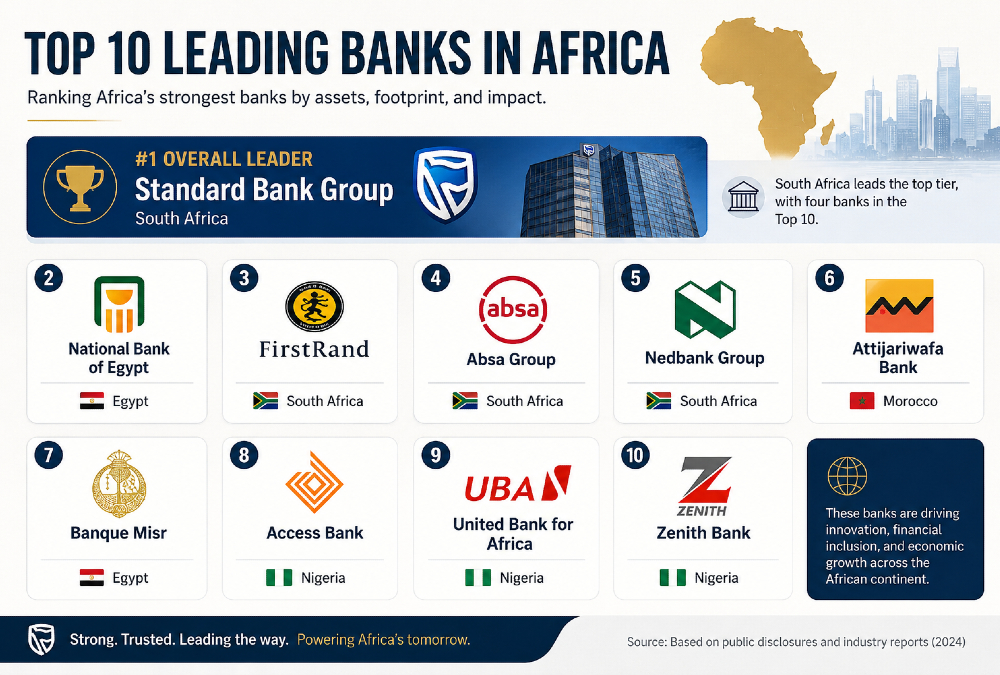
The ranking below reflects the continent’s ten most consequential banking groups by total assets, regional reach, and strategic influence.
| # | Bank | Country |
|---|---|---|
| 1 | Standard Bank Group | South Africa |
| 2 | National Bank of Egypt | Egypt |
| 3 | FirstRand | South Africa |
| 4 | Absa Group | South Africa |
| 5 | Nedbank Group | South Africa |
| 6 | Attijariwafa Bank | Morocco |
| 7 | Banque Misr | Egypt |
| 8 | Access Bank | Nigeria |
| 9 | United Bank for Africa | Nigeria |
| 10 | Zenith Bank | Nigeria |
South Africa’s dominance is immediately apparent: Standard Bank Group, FirstRand, Absa Group, and Nedbank Group collectively occupy four of the top five positions, a reflection of the country’s comparatively mature regulatory environment and deep capital markets.
Egypt contributes two institutions – the National Bank of Egypt and Banque Misr – whose combined balance sheets underpin the Arab world’s most populous economy.
Nigeria’s trio of Access Bank, United Bank for Africa, and Zenith Bank rounds out the list, testament to the relentless energy of sub-Saharan Africa’s largest economy.
Morocco’s Attijariwafa Bank, meanwhile, stands as the pre-eminent francophone institution on the continent, with a footprint that spans more than two dozen countries.
Scale Is Necessary. It Is Not Sufficient.
Balance-sheet size tells only part of the story. The more searching question – the one that will separate the institutions that merely endure from those that genuinely flourish – is whether the people running these banks possess the kind of leadership that the current moment demands.
And on that count, the evidence across the African corporate landscape is decidedly mixed.
The most effective leaders encountered across the continent this year share a quality that is deceptively simple and genuinely rare: they listen. Not performatively, not in the managed style of the leadership seminar, but with the authentic attention of someone who understands that the information required to lead well rarely surfaces through formal reporting lines.
It arrives in the unguarded remark, the quiet resignation, the team member who stops volunteering ideas.
“Empathy is no longer a soft skill. It is a competitive advantage – one that the best-run institutions are beginning to treat with the same rigor they apply to capital adequacy ratios.”
The Exhaustion Beneath the Surface
There is a broader context that lends this argument its urgency. Across every sector, digital fatigue is not a passing inconvenience – it is a structural condition.
The pandemic-era compression of boundaries between professional and personal life has not fully reversed. Employees at every level are carrying more than they tend to show, operating under pressures that manifest not in dramatic crises but in the slow erosion of discretionary effort: the deliberate work that no job description captures and no performance review adequately measures.
For Africa’s flagship banks, this is not merely a human-resources concern. It is a strategic one. Institutions whose cultures run on pressure and compliance rather than trust and purpose will find themselves increasingly unable to attract and retain the caliber of talent that competing in a rapidly digitizing financial landscape requires.
A Different Calculus of Leadership
The shift that high-performing organizations are beginning to make is not, it must be stressed, a relaxation of standards. Banks that serve tens of millions of customers across sovereign borders cannot afford sentimentality.
The argument is more precise than that. It is that the conditions under which people perform at the highest level have changed – and leadership models must change with them. Specifically, the transition looks like this:
- From control to support. Authority is no longer a sufficient motivator for sustained excellence. The manager who creates the conditions for a team member to solve a problem independently generates more durable value than the one who dictates the solution.
- From management to service. The most effective senior leaders increasingly understand their role as one of removing obstacles rather than issuing directives—a fundamental inversion of the traditional hierarchy.
- From pressure to presence. Being visible and available in a meaningful sense—not micromanagement, but genuine engagement—signals to teams that their work is seen and that their difficulties will be acknowledged.
- From command to care. This does not require the abandonment of commercial rigor. It requires the recognition that people perform differently when they trust that the institution has a genuine interest in their development.
Grace and Grit Are Not Opposites
The framing that pits commercial toughness against human sensitivity is a false one, and it has done considerable damage to the way African institutions develop their leaders. The most enduring competitive advantage in financial services is trust – with customers, with regulators, with the communities in which banks operate.
Trust, in turn, is built by organizations whose internal cultures model the values they project externally.
Leading with grace – with the recognition that the people executing a strategy are themselves the strategy – is not a concession to softness. It is a disciplined acknowledgment of how durable institutions are actually built.
The banks at the top of Africa’s rankings did not arrive there by accident. They will remain there only if the leaders who succeed today’s generation understand that getting results from people and helping people become stronger in the process of pursuing those results are not competing objectives.
They are, in the end, the same objective.
How are you bringing more humanity into your leadership – and your institution – today?
Des H Rikhotso is a seasoned C-Suite Multi-Industry (Automotive – OEM + Retail, Logistics, Oil & Gas, etc) business executive with 25+ years of Business Leadership Experience across the South, East and Western Sub-Sahara Africa Region. Based in Kampala, Uganda he serves as East Africa Region Country Director and Business Executive, driving Business Strategic Growth and Operational Excellence – contributing his Business Leadership Experience to the Region. Des has held Business Leadership roles at BMW Group Africa, Volkswagen Group Africa, Peugeot Motors South Africa, Toyota/Lexus South Africa, Lexus East Rand (Unitrans/CFAO), Nissan Group of Africa, G.U.D Holdings (Africa Exports Operations Division),The HDR Group of Companies and The Ezra Group of Companies (a Leading Uganda & East Africa Conglomerate). He holds Under-Graduate and Post-Graduate business degrees from the University of the Western Cape, Wits University (Wits Business School) and the University of South Africa.
