
Opinion
Africa Must Own Its Intelligence Layer – Before Someone Else Does
The continent’s most consequential infrastructure investment is not a power plant or a data center. It is a language model trained on African data, built by African researchers, and governed by African institutions.

By Victory Azimih
Africa’s greatest strategic asset has never been its natural resources, its demographics, or even its extraordinary economic potential. It is agency – the capacity to make sovereign choices about how the continent develops, who benefits, and on whose terms.
For decades, that agency has been eroded by dependency: on foreign capital, on imported technology, and on governance frameworks designed elsewhere for different priorities.
Artificial intelligence threatens to deepen that dependency in ways that are both more subtle and more consequential than anything that preceded it. But it also presents an extraordinary opportunity – if African nations and institutions act with urgency.
The Stack Problem
Understanding what is at stake requires understanding the AI value chain. At the base sits physical infrastructure: energy, data centers, and connectivity.
Above that lies compute – the processing power that trains and runs AI systems. Higher still is the model layer: the large-scale systems that learn patterns from data, automate decisions, and generate economic value.
At the apex are the applications that serve end users.
Much of the recent conversation about African technology sovereignty has focused, rightly, on the lower layers. Building data centers, securing reliable electricity, and expanding broadband access are genuine prerequisites for participation in the AI economy.
But owning infrastructure without owning models is a bit like building a highway and then watching foreign trucking companies haul all the freight. The physical asset is real; the value capture is not.
The model layer is where intelligence lives – and where the highest margins, the deepest competitive moats, and the most durable geopolitical leverage reside. It is also the layer most conspicuously absent from current African AI investment.
Why African Models Are Not Optional
The conventional assumption – that frontier AI models developed in San Francisco, London, or Beijing can simply be deployed across African markets – deserves far more scrutiny than it typically receives.
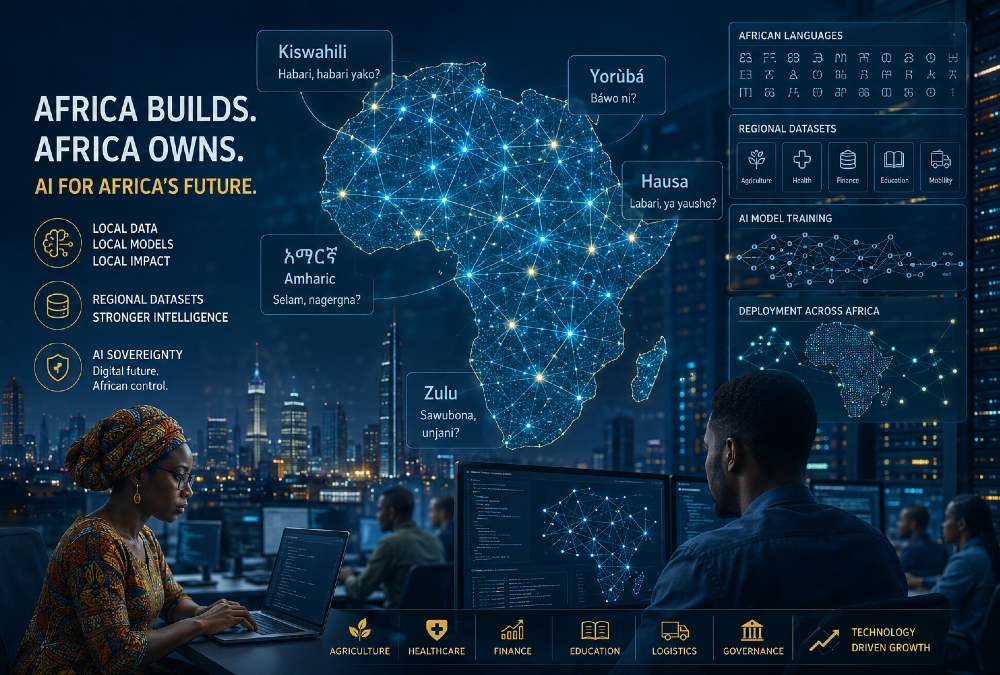
Africa is home to more than 2,000 languages, the overwhelming majority of which are either absent from or severely underrepresented in the training datasets of today’s leading models. Kiswahili, Yoruba, Hausa, Amharic, Zulu, and hundreds of others are not edge cases; they are the primary languages in which hundreds of millions of people conduct commerce, access healthcare, engage with government services, and raise their children.
A model that cannot reliably process these languages is not a general-purpose intelligence tool in African contexts. It is a product built for someone else.
The data gap extends well beyond language. Africa’s economic structures – informal labor markets, cash-based micro-enterprises, non-standard agricultural supply chains, climate-adaptive farming practices – differ systematically from the environments in which leading AI systems were trained.
Models that optimize for formal, digitally mediated economies may perform poorly, or even harmfully, when applied to African realities without significant adaptation.
There is also a political economy dimension that cannot be ignored. When the intelligence layer is foreign-owned, Africa becomes, at best, a market and, at worst, a testing ground.
Decisions about what these models optimize for, whose values they encode, and which use cases they prioritize are made by people with little accountability to African citizens or governments. This is not a hypothetical concern.
The debate over “AI colonialism” – the risk that AI deployment replicates older patterns of technological dependency – is already live among researchers and policymakers on the continent.
A Strategic Hierarchy
Not all investments in African AI are equally urgent or equally defensible. A clear-eyed prioritization reveals four layers of strategic opportunity, ranked by long-term impact.
National and regional foundation models represent the highest-value, most strategically significant investment. Foundation models trained on African language corpora and local datasets would serve as the backbone for virtually every downstream application – government service delivery, financial inclusion, agricultural extension, clinical diagnostics, and logistics optimization.
Their development requires significant capital, sustained institutional commitment, and deep research expertise, but their strategic returns are correspondingly large. Countries and regional bodies that invest in foundation model capacity now will set the terms for AI deployment for a generation.
Sector-specific vertical models offer a faster path to commercial adoption and near-term revenue. Agriculture yield prediction calibrated to African soil types and climate variability, credit-scoring systems designed for informal economies, disease-detection models trained on locally prevalent conditions, and last-mile logistics optimization tools are all commercially viable opportunities with relatively well-defined data requirements.
The private sector, including African and diaspora venture capital, is well-positioned to drive this layer – but it benefits enormously from the public goods created by foundation model investment.
Pan-African data alliances address the fundamental input problem. Data is the raw material of intelligence, and African AI development faces a significant structural disadvantage: data that does exist is fragmented across national jurisdictions, often under-digitized, and subject to incompatible regulatory frameworks.
Cross-border data-sharing agreements – modeled, perhaps, on the European Health Data Space or elements of the African Continental Free Trade Area – would dramatically expand the training resources available to African model developers. The nations and institutions that lead on data governance will exercise disproportionate influence over the continent’s AI trajectory.
Research and talent ecosystems are the long-run constraint on everything else. Every major AI economy – the United States, China, the United Kingdom, Canada, France – is anchored by a cluster of research universities, national laboratories, and public-private partnerships that develop talent and generate foundational knowledge.
Africa has exceptional mathematical and scientific talent; what it largely lacks are the institutional structures that retain and deploy that talent at scale. Closing this gap requires sustained investment in graduate education, research infrastructure, and competitive compensation – not as a cultural aspiration, but as an economic and national security imperative.
Risks Worth Naming
Intellectual honesty demands acknowledging the genuine obstacles. Political fragmentation across 54 sovereign states creates significant coordination costs.
Regulatory misalignment, data localization conflicts, and competing national interests could easily dissipate the energy generated by any pan-African AI initiative. Progress will require diplomatic investment commensurate with the technical effort.
Capital risk is real. African AI models, particularly foundation models, require investment horizons and risk tolerances that are difficult to match with conventional venture financing.
Blended finance structures – combining development finance institution capital, philanthropic funding, and private equity – will be necessary to bridge the gap between early-stage research and commercial viability.
Reputational risk runs in both directions. If African AI projects are led by foreign institutions with African branding, the “AI colonialism” critique will stick – and will undermine the political legitimacy that large-scale data-sharing and public investment require.
Local ownership, governance, and accountability must be substantive, not cosmetic.
Execution risk is perhaps the most immediate concern. Talent gaps, underfunded universities, and limited research infrastructure mean that ambition must be matched with realistic sequencing.
Trying to build frontier foundation models before establishing the research pipeline to sustain them would be a costly mistake.
None of these risks is fatal. All of them are manageable with coordinated strategy, credible institutions, and serious policy frameworks.
The countries that will lead African AI are not necessarily the largest or the wealthiest – they are the ones that commit earliest and most coherently.
The Choice Ahead
The case for African AI sovereignty is ultimately simple: intelligence is infrastructure. Just as no serious development economist would recommend that African nations permanently outsource their energy systems or their financial architecture, no serious technology strategist should be comfortable with permanent dependence on externally developed AI.
The continent that trains its own models shapes its own future. The continent that does not will find its future shaped by others – optimized for other priorities, trained on other data, and accountable to other interests. The window to make this choice is open. It will not remain open indefinitely.
Victory Azimih is a visionary entrepreneur and global investment consultant specializing in Africa’s economic growth and industrial transformation. As the CEO and founder of Azeemi Global, he leads a pioneering firm dedicated to accelerating the continent’s development through cutting-edge technology and infrastructure solutions. Under his leadership, Azeemi Global focuses on harnessing the potential of artificial intelligence, blockchain, and smart infrastructure to unlock sustainable investment opportunities across Africa. Based in Lagos, Nigeria, Azimih is at the forefront of driving Africa’s future as a hub of innovation and industrialization.
