
Opinion
The Dubai Vacuum: Middle East Crisis Could Reshape the Global South’s Economic Future

By Ryan Elcock
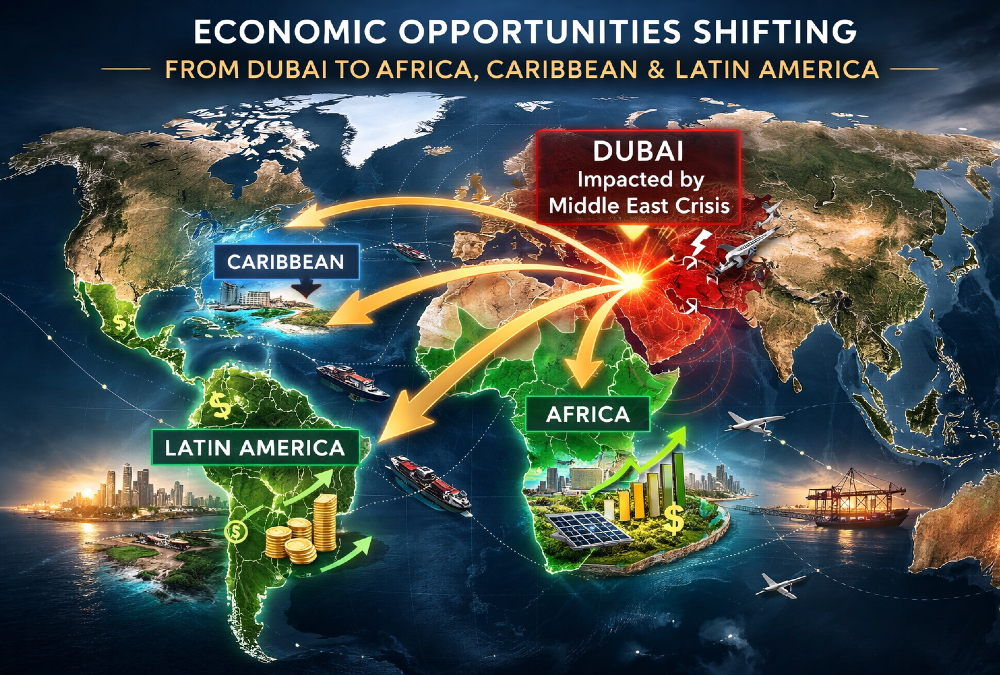
The world changed on February 28, 2026. Not incrementally – not in the slow, grinding way that economists debate in retrospect – but decisively, irreversibly, and within hours.
The US-Israeli military operation codenamed Operation Epic Fury struck more than 1,250 targets across Iran in its first 48 hours, culminating in the confirmed assassination of Supreme Leader Ayatollah Ali Khamenei. The Iranian Revolutionary Guard Corps responded by effectively sealing the Strait of Hormuz – the single most critical maritime passage in the global economy – removing roughly 20 million barrels of oil per day and 20 percent of the world’s liquefied natural gas (LNG) supply from active circulation.
This is not an account of the conflict. What has been conspicuously absent from the coverage – with the analytical depth the moment demands – is any serious discussion of what comes next.
Specifically: which nations, which industries, and which investment strategies are structurally positioned to absorb the economic vacuum this crisis has created. That is the subject of this analysis.
When the strikes landed, one question demanded an answer: if the Middle East is suddenly off the table, where does the world turn? To find out, I spent four days pulling live conflict data from WorldMonitor and GDELT, real-time shipping feeds from Kpler and MarineTraffic, and commodity market signals from Bloomberg and Reuters, leveraging several AI tools throughout the research process. I then ran a Monte Carlo simulation across 39 distinct country-sector-scenario combinations to map every plausible outcome.
I. The Structural Shock: Understanding What Actually Happened
The Strait of Hormuz is not simply a waterway. It is, economically speaking, the jugular vein of the global industrial economy. Under normal conditions, it carries approximately 20 percent of global seaborne crude oil, 20 percent of the world’s LNG shipments, and one-third of all global jet fuel supply.
As of March 3, 2026, traffic through the Strait had fallen by a minimum of 80 percent. At least five tankers had been damaged, two crew members killed, and approximately 150 ships were stranded in the region.
Major carriers – Maersk and Hapag-Lloyd among them – had suspended all transit. Passage insurance was revoked effective March 5, 2026.
The Numbers as of March 3, 2026
- 20 million barrels per day removed from global circulation. OPEC+ pledged only 206,000 bbl/day in response – structurally insufficient.
- Gold at US$5,390/oz – a record high. Dubai’s US$170 billion annual gold flow is severed. J.P. Morgan is targeting US$6,300 per ounce by year-end.
- US$47–85 billion in planned Middle East data center investment is now under review. AWS, Microsoft Azure, Google Cloud, and Oracle all have active UAE projects in question.
- A 162 percent surge in Cape of Good Hope maritime traffic. Rerouting adds 10–14 days to Asia routes, elevating South Africa’s strategic value overnight.
The Dubai Vacuum
Over four decades of deliberate nation-building, Dubai assembled perhaps the most efficient concentration of economic functions in modern history. It was simultaneously a gold trading hub processing an estimated US$170 billion annually in physical gold flows; a logistics and refining corridor for Gulf energy; a hyperscale data center market representing approximately US$169 billion in regional technology spending for 2026; and a financial services center hosting the regional operations of dozens of the world’s most significant investment banks and asset managers.
Within 96 hours of the operation’s commencement, Iranian retaliatory strikes hit Dubai’s airports and port infrastructure. Dubai International and Al Maktoum International airports were confirmed closed.
Jebel Ali – the largest port in the Middle East – suspended operations. Investment firms operating out of the DIFC began halting fundraising. Amazon Web Services confirmed that drone strikes had directly hit two of its UAE data centers, with a third facility in Bahrain sustaining damage. The UAE’s ADX and DFM exchanges suspended trading indefinitely.
This is what might be called the “Dubai Vacuum” – not merely a temporary disruption, but a structural fracture in the safe-harbor brand proposition that Dubai spent four decades constructing. Capital does not return easily to a location whose security has been this comprehensively compromised.
The question for serious analysts is not “When will Dubai recover?” It is: “Where will the capital go while it waits?”
II. The Commodity Windfall: A Deeper Look at the Numbers
Oil: A Fiscal Windfall of Historic Proportions
Nigeria exports approximately 1.5 million barrels of oil per day against a fiscal framework calibrated at US$64–66 per barrel. At US$79.57 per barrel at the time of writing, every dollar above that threshold represents pure surplus revenue.
Angola’s breakeven is US$58. Libya’s is US$60. Algeria’s is US$55.
These four nations alone are generating approximately US$33 billion in annual windfall revenue above their fiscal breakeven assumptions – and this is before the sustained US$100-plus-per-barrel scenario that multiple major banks are now forecasting.
The critical question is not whether these nations will benefit. They will. The question is whether they possess the institutional capacity and strategic vision to convert this windfall into a permanent structural advantage. That is where the refinery opportunity becomes central.
Gold: Africa’s Unrealized $1 Trillion Inheritance
Africa produces more than a quarter of the world’s gold output, yet holds only approximately 2 percent of global gold reserves. More pointedly: the continent exports the vast majority of its gold in raw, unrefined form – primarily to Dubai and Switzerland – surrendering enormous value at the point of refining, trading, and reserve accumulation.
With Dubai’s gold infrastructure now functionally severed, and gold at US$5,390 per ounce and rising, the economic case for building Africa’s own refining and trading infrastructure has never been more compelling. Ghana’s Gold Board is targeting 127 metric tonnes of artisanal gold annually through official channels.
At US$5,300 per ounce, that tonnage represents US$21.6 billion in annual value. The Rand Refinery–Gold Coast Refinery partnership – announced in January 2026 and providing LBMA-certified refining of 50 tonnes per year – is the foundational proof of concept.
Retaining even 15 percent more of the value chain through in-country refining would add over US$3 billion per year to Ghana’s economy alone.
Critical Minerals: The Battery Economy Imperative
The global energy transition is creating structural demand for minerals that are disproportionately concentrated in African geology: cobalt (Africa holds more than 70 percent of global reserves), platinum group metals (South Africa holds more than 90 percent), copper (more than 40 percent in the DR Congo and Zambia), and lithium (Zimbabwe, among others).
The DR Congo exports 97 percent of its cobalt production to China in unprocessed form. The value differential between raw cobalt and battery-grade cobalt sulfate exceeds 300 percent.
This is the defining economic paradox of our time: the nations that hold the materials essential to the global energy transition are capturing almost none of the value. The Ivanhoe Mines Kamoa-Kakula copper smelter – Africa’s largest – has commenced heat-up operations.
The DR Congo, Zambia, and Zimbabwe together form a critical minerals processing corridor that, with appropriate capital and policy frameworks, can become the world’s premier battery supply chain hub.
III. The Opportunity Map: Where the Capital Should Go
Guyana: The Western Hemisphere’s Most Consequential Oil State
Guyana does not register in most analysts’ mental models of the global energy order. It should. The country’s oil production currently runs at approximately 900,000 barrels per day on a trajectory – driven by ExxonMobil’s offshore Stabroek block – that has made it the fastest-growing oil economy on the planet, with GDP growth projections in the 23–42 percent range.
It is geopolitically stable, OECD-aligned in its regulatory framework, and strategically located in the Western Hemisphere, meaning it can serve European and North American markets with zero Hormuz exposure.
The Green Frontier Refinery project – a 100,000-barrel-per-day modular facility with Phase 1 capital expenditure of US$1.5 billion – is designed to go operational within 24 months. Our Monte Carlo simulation assigns Guyana an Opportunity Score of 81.8 – the highest in the analysis – with a weighted net present value of US$28.9 billion and an internal rate of return of 32 percent.
Trinidad & Tobago: The Caribbean’s LNG Powerhouse
As Qatar pre-emptively pauses production due to the Hormuz crisis, and as European buyers scramble for non-Gulf LNG sources, Trinidad & Tobago’s Atlantic LNG facility is positioned as the most immediate beneficiary of the disruption. The nation’s existing petrochemical infrastructure – including methanol and ammonia production – provides a diversification layer that no other Caribbean nation can match.
Our Monte Carlo simulation assigns a weighted score of 83.3, with a success probability of 87 percent under the baseline scenario.
Mauritius: The Overlooked Safe Haven at the Center of Africa
Over three decades of deliberate policy design, Mauritius has built something extraordinarily rare in the African context: a genuinely world-class financial services and technology jurisdiction. Its instability score on WorldMonitor stands at 17 out of 100 – among the lowest on the continent.
With AWS recommending that customers in the UAE migrate workloads globally, and technology firms actively reassessing their Gulf concentration, Mauritius is the logical African beneficiary. The Innovative Mauritius Scheme, combined with 2026 tax incentives for AI operators and Virtual Asset Service Providers, creates a “Data Haven” jurisdiction in a politically stable, well-connected island economy.
Ghana and West Africa: The New Bullion Capital
Ghana’s GoldBod–Gold Coast Refinery agreement – enabling LBMA-certified refining commencing at one metric tonne per week in February 2026 – positions Accra as the natural successor to Dubai’s gold refining function. The partnership with South Africa’s Rand Refinery provides the accreditation necessary to access global institutional markets.
Combined with emerging refining capacity in Côte d’Ivoire (Ivory Coast), the West African gold cluster is building the infrastructure to become the world’s primary gold refining hub outside Switzerland.
IV. Three Structural Shifts That Will Outlast the Conflict
1. The Cape of Good Hope Dividend
The rerouting of global shipping via the Cape of Good Hope has elevated South Africa’s strategic maritime importance to a level not seen since the pre-Suez era. MarineTraffic records a 162 percent surge in Cape traffic.
Ships rerouting to Asia or Europe via the Cape add 10–14 days to transit times – a structural elevation of the value of South Africa’s ports, bunkering capacity, and ship services industry that will not disappear when the Hormuz situation eventually resolves.
2. The Digital Infrastructure Displacement
The targeting of AWS data centers in the UAE and Bahrain is not a warning shot. It is a fundamental redrawing of the risk map for the global technology industry.
An estimated US$47–85 billion in planned Middle East data center investment is now facing material uncertainty. AWS, Microsoft Azure, Google Cloud, and Oracle all have active UAE projects under review.
The Stargate UAE one-gigawatt AI cluster may be restructured or deferred entirely.
The beneficiaries will be politically stable, well-connected jurisdictions with reliable power grids and favorable tax environments. Mauritius and Barbados sit at the top of that list – Barbados scoring 8.4 out of 10 on political stability and 8.1 out of 10 on FDI climate in our country scoring matrix.
3. De-Dollarization and the New Financial Architecture
The Pan-African Payment and Settlement System (PAPSS) reduces intra-African trade friction from an estimated 30 percent to approximately 1 percent – a transformative reduction that makes AfCFTA-enabled trade financially viable at scale. The Caribbean Payment and Settlement System (CAPSS), already successfully piloting cross-border transactions in local currencies between Barbados and the Bahamas, mirrors this architecture for the Caribbean basin.
BRICS Pay, given momentum by Brazil’s 2025–2026 rotating presidency and its focus on local currency trade settlements, provides a non-dollar settlement mechanism that directly reduces exposure to dollar volatility and Hormuz-linked inflation. These are not peripheral experiments. They are the early architecture of a parallel settlement system that, if the Hormuz disruption persists, will achieve institutional legitimacy at remarkable speed.
V. The Dangote Paradigm: The Proof of Concept Is Already Built
Perhaps the single most consequential industrial project in Africa’s history – one that most analysts outside the energy sector remain largely unaware of – is the Dangote Petroleum Refinery in Lagos. At 650,000 barrels per day, it is the world’s largest single-train refinery.
Since commencing gasoline production in September 2024, it has reduced West African gasoline imports by 25 percent, jet fuel imports to a ten-year low, and diesel imports to a five-year low.
In February 2026, it shipped its first gasoline cargo to the United States.
Read that again: an African refinery is now exporting refined fuel to the United States.
Plans finalized in late 2025 target a doubling of capacity – from 650,000 to 1.4 million barrels per day – positioning Nigeria as the primary global alternative to Middle Eastern refining capacity that is now under kinetic threat. Oxford Economics projects annual foreign exchange savings of US$50 billion for Nigeria from this single facility.
The Dangote refinery is not simply an impressive industrial project. It is the proof of concept for the entire refining opportunity thesis. The question for the next 24–36 months is whether the investment capital arrives in time to replicate and expand this model across the continent.
VI. What Could Still Go Wrong
A rigorous analysis demands honest acknowledgment of the risks.
Infrastructure deficits are real. Several nations with the greatest geological endowment – the DR Congo, Suriname, and parts of West Africa – have infrastructure quality scores that reflect decades of underinvestment. Capital expenditure overrun factors in our model range from 1.0x to 2.5x baseline estimates, calibrated against McKinsey infrastructure benchmarks. This risk is non-trivial.
The window may be shorter than anticipated. A ceasefire achieved within five weeks – our 21 percent probability best-case scenario – reduces some urgency, though the structural damage to Dubai’s brand proposition persists across all scenarios. Even in the best case, our Monte Carlo analysis shows positive expected returns across all primary opportunity zones.
Institutional capacity remains the binding constraint. The nations that convert this crisis into a permanent advantage will be those with the governance quality to manage large-scale investment programs without dissipating them in political dysfunction. Mauritius, Barbados, Trinidad & Tobago, Ghana, and Guyana score well on this dimension. Others require more careful structuring of investment vehicles and oversight mechanisms.
What this crisis has done, is compress a decade of geopolitical transition into a single, unmistakable event. The question now is not whether the world is changing. It is whether you are positioned to understand – and act on – where it is going.
VII. This Is Not a Crisis. It Is a Reordering.
The Bretton Woods system ended on August 15, 1971, when President Nixon closed the gold window. The event had been building for years, but the break – when it came – was sharp, irreversible, and restructured the entire global financial architecture within a decade.
What we are watching in real time, beginning February 28, 2026, may be the energy and digital infrastructure equivalent of that moment.
The Persian Gulf has served, for the better part of a century, as the energy backbone of the global industrial economy. Dubai emerged, over the last four decades, as its financial and digital services hub.
Both are now structurally compromised – not temporarily inconvenienced, but fundamentally reassessed in the minds of every capital allocator, logistics operator, technology executive, and finance minister on the planet.
The Global South possesses, for the first time in modern history, the combination of resources, emerging infrastructure, and geopolitical positioning to absorb diverted capital at scale. The Dangote Refinery is not an anomaly – it is a harbinger.
Ghana’s gold refining partnership is not a footnote – it is the first chapter of an entirely new book about where the world’s gold is processed, priced, and stored. Guyana’s oil output is not a curiosity – it is, in the context of a Hormuz closure, one of the most strategically valuable barrels of oil on the planet.
The nations and investors who understand this – who can look past the immediate noise of the conflict and see the structural realignment it is catalyzing – will define the economic architecture of the next 25 years. Based on our Monte Carlo analysis, across all three scenarios, the window to act remains open for approximately 12 to 36 months before early-mover advantages are substantially captured.
Ryan Elcock serves as the Vice-Chair and Co-Founder of the Brampton Community & Economic Empowerment Network (BCEEN) and is also the Co-Founder and Chief Operating Officer of The Habari Network.
