
Opinion
The Dubai Playbook: 5 Strategic Lessons Africa Can’t Afford to Ignore

By Davida Ademuyiwa
In little more than half a century, Dubai transformed from a quiet desert emirate into one of the world’s most dynamic global hubs – renowned for its trade, logistics, finance, tourism, and innovation. It didn’t inherit this status. It engineered it.
What’s most striking about Dubai’s rise isn’t just the scale of its ambition, but the clarity of its execution. With no natural oil reserves to fall back on, the city-state bet on vision, infrastructure, and governance – and won.
For Africa, the lesson isn’t to replicate Dubai. That would be neither feasible nor necessary.
But the mindset behind Dubai’s success – bold, long-term, and globally oriented – is one the continent can no longer afford to ignore.
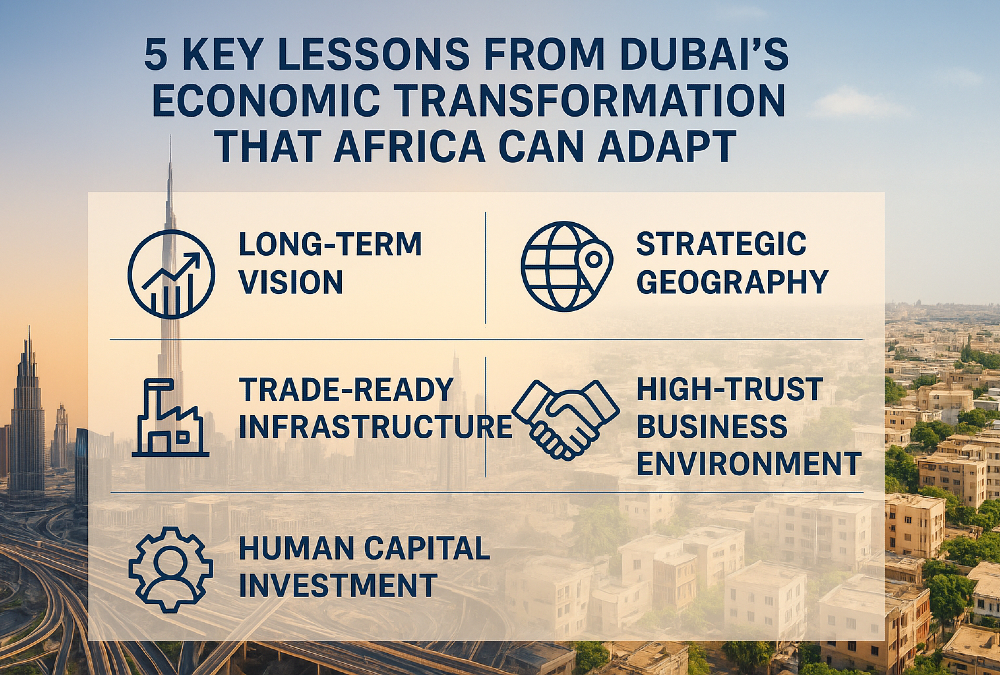
As Africa stands at a pivotal crossroads, here are five strategic imperatives drawn from the “Dubai Playbook” that could redefine its economic future.
1. Lead with Long-Term Vision – Beyond Political Cycles
Dubai’s transformation was never the product of a single administration or election cycle. It was driven by a consistent, multi-decade vision championed by leaders who planned for 2040, not just the next term.
Africa, too, must decouple development from political turnover. Sustainable growth demands continuity – of policy, investment, and institutional memory.
Countries that anchor their strategies in long-term blueprints, like Rwanda’s Vision 2050 or Ethiopia’s Homegrown Economic Reform, are already proving that stability breeds confidence.
The message is clear: Africa needs more nation-builders and fewer short-term tacticians.
2. Leverage Strategic Geography – Become the World’s Crossroads
Dubai didn’t just connect continents – it redefined connectivity. Positioned between East and West, it became the default logistics and travel hub for global flows of goods, capital, and people.
Africa, with its 54 countries, 1.4 billion people, and proximity to Europe, Asia, and the Americas, is uniquely positioned to become the ultimate global gateway. From Lagos to Mombasa, Abidjan to Djibouti, African nations sit at the nexus of rising trade routes and digital corridors.
With the African Continental Free Trade Area (AfCFTA) in motion, the continent has a historic opportunity to turn geography into competitive advantage – by streamlining borders, harmonizing regulations, and building seamless regional networks.
3. Invest in Trade-Ready Infrastructure – Not Just Access
Dubai didn’t build roads and ports for local convenience. It built them to move cargo, attract airlines, and serve global supply chains.
Its Jebel Ali Port, one of the busiest in the world, wasn’t designed for Dubai alone – it was designed for the world.
Too much of Africa’s infrastructure still prioritizes access over integration. What’s needed now is trade-ready infrastructure: modern ports, electrified rail lines, reliable energy grids, and digital highways – all engineered to plug African economies into global value chains.
The returns are undeniable. Every dollar invested in efficient logistics can unlock exponential gains in export competitiveness and job creation.
4. Foster a High-Trust Business Environment
Investors don’t just follow markets – they follow predictability. Dubai succeeded by offering transparency, rule of law, regulatory clarity, and fast-moving bureaucracy.
Africa must do the same. Corruption, red tape, and policy inconsistency remain major deterrents to foreign and domestic investment.
The solution lies in building institutions that inspire trust – through digital governance, independent judiciaries, and investor-friendly reforms.
Countries like Ghana, Kenya, and Mauritius have made strides, but the continent needs systemic change. A high-trust environment isn’t a luxury – it’s the bedrock of economic transformation.
5. Prioritize Human Capital as a National Asset
Dubai’s greatest resource wasn’t sand or oil – it was its ability to attract, empower, and retain talent. Today, over 90 percent of its population are expatriates, drawn by opportunity, safety, and ambition.
Africa, home to the youngest population on the planet, holds an even greater advantage. By 2050, one in three young people globally will be African.
But potential is not destiny.
To unlock this demographic dividend, Africa must invest aggressively in education, skills development, healthcare, and innovation ecosystems. It must also create conditions that encourage talent to stay – and attract diaspora expertise back home.
Africa Has More – Now It Must Build Bigger
Dubai built to attract the world. Africa doesn’t need to attract the world – it is the world’s future.
With abundant resources, youthful energy, and unmatched geographic potential, Africa has more raw ingredients for success than Dubai ever did. What’s missing isn’t capacity – it’s coordinated ambition.
The Dubai story proves that transformation is possible, even against daunting odds. Africa doesn’t need to copy Dubai. It needs to outthink, outbuild, and outvision it.
The playbook is clear. The time to act is now.
Davida Ademuyiwa is a UK politician and founder of DaviGlobal International Trade & Investment. She facilitates cross-border investment and connects capital with scalable ventures across the UK, Europe, the Middle East, and Africa. She also serves as Regional Ambassador for the Conservative Policy Forum in the East of England, contributing to grassroots policy dialogue alongside her work in global trade and investment.
