
Opinion
The Dark Side of Foreign Investment: Lessons from Mauritania’s Fishing Crisis

By Danilo Desiderio
Foreign investment is often heralded as a catalyst for transformation – especially in Africa, where resource-rich nations seek to industrialize and integrate into global supply chains. But behind the glossy promises of economic growth and modern infrastructure lies a cautionary tale: when poorly governed, foreign investment can extract more than capital – it can erode ecosystems, displace communities, and deepen inequality.
Nowhere is this more evident than in Mauritania’s fisheries sector, where a 25-year fishing agreement signed in 2010 with a major Chinese distant-water fleet operator has triggered a slow-motion crisis. Fifteen years on, the deal remains in force – while coastal communities reel from its consequences.
A Deal That Favored Profits Over People
The agreement, which promised US$100 million in infrastructure development, included funding for new wharves and over 30 fishmeal processing plants. On paper, it looked like a win: jobs, exports, and foreign capital.
In reality, the benefits have been highly concentrated. Wealthy investors export protein-rich fishmeal – made from species like octopus and yellow mullet – to feed livestock and farmed fish abroad, while local populations face rising food insecurity.
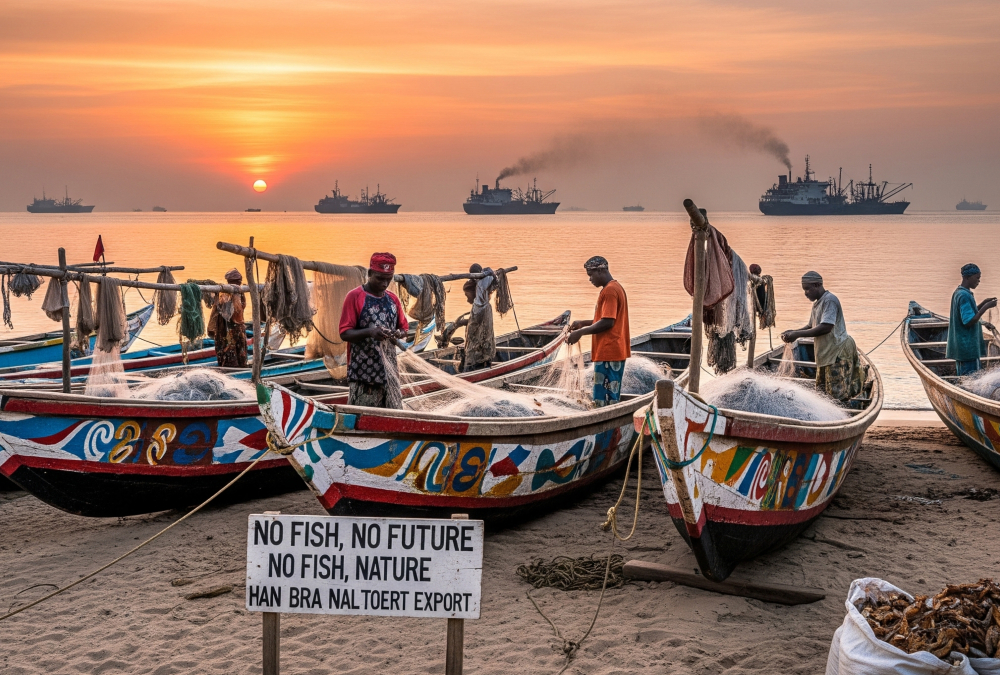
Meanwhile, artisanal fishers, who have relied on these same waters for generations, now struggle to survive. Iconic fish stocks that once thrived near shore have collapsed.
Small-scale fishers must venture farther into dangerous waters, often returning with nothing. Their livelihoods – once the backbone of coastal economies – are being systematically undermined.
This is not development. It is displacement disguised as progress.
The Hidden Costs of Industrial Fishing
The environmental toll is equally alarming. Industrial trawlers, operating with minimal oversight, have exceeded sustainable catch limits, depleting marine stocks faster than they can replenish.
Coastal ecosystems – already fragile – are unraveling. Mangroves are degraded, seabeds are scarred, and biodiversity is in decline.
And when environmental harm translates into economic hardship, tensions rise. In neighboring The Gambia, public anger over pollution from fishmeal factories boiled over into violent protests, including the torching of factory sites.
Such unrest is not an anomaly – it is a symptom of broken social contracts and extractive investment models.
Moreover, pollution and habitat destruction can deter tourism, further undermining local economies. When development benefits only a few while imposing costs on many, it becomes a source of instability, not prosperity.
Three Critical Lessons for Africa’s Development Future
Mauritania’s experience offers three urgent lessons for African nations navigating foreign investment:
- Not All Investment Is Development
Capital inflows that extract resources without adding local value do more harm than good. True development requires value addition, job creation, and inclusive growth – not just commodity exports. - Governance Gaps Undermine Sovereignty
Weak regulatory frameworks and lack of enforcement allow foreign actors to operate with impunity. Without transparent, legally binding agreements and institutional oversight, states risk losing not just fish – but public trust. - Local Producers Must Be Protected
Small-scale fishers, women-led cooperatives, and local SMEs are not obstacles to modernization; they are pillars of resilient economies. Investment policies must actively safeguard their rights and access to resources.
A recent report by the Malabo Montpellier Panel highlights that Africa’s fisheries and aquaculture sector is growing faster than anywhere else in the world – recording the highest aquaculture expansion rate since 2022. Yet this growth comes with mounting risks: overfishing, ecosystem collapse, and the marginalization of traditional fishers.
Without course correction, Africa’s blue economy could become a story of missed opportunity.
A Better Model: Namibia’s Sustainable Fisheries Framework
There is a better way – and Namibia offers a compelling example.
Since the early 2000s, Namibia has built one of Africa’s most effective fisheries management systems. Under the Marine Resources Act (2001), the government enforces science-based catch quotas for key species like hake and horse mackerel, ensuring fishing remains within ecological limits.
These quotas are set with input from local fishers, scientists, and industry stakeholders, fostering transparency and shared responsibility.
Foreign fishing agreements are issued only under strict licensing terms, with clear environmental and social conditions. Revenue from these deals funds conservation, monitoring, and community development programs.
The result? Rebounding fish stocks, thriving local industries, and equitable benefit-sharing.
Namibia proves that foreign investment can drive sustainable growth – if governments set the rules, enforce them, and prioritize national interests.
Toward a More Equitable Future
Africa does not need to choose between development and sovereignty. But it must be selective.
To ensure foreign investment uplifts rather than exploits, African nations must:
- Enforce environmental safeguards and science-based fishing quotas to protect marine ecosystems.
- Demand transparency and local inclusion in all investment agreements.
- Prioritize partnerships that transfer technology, skills, and infrastructure – not just raw materials.
Without these guardrails, foreign capital risks hollowing out economies, not building them.
Conclusion: Development That Leaves No One Behind
Mauritania’s fishing crisis is not inevitable – it is a policy failure. Other African countries need not repeat it.
As global demand for seafood and marine resources grows, so too does the urgency for responsible governance. The future of Africa’s blue economy depends not on how much investment it attracts, but on how that investment is structured.
True development is inclusive, sustainable, and accountable. It empowers local communities, restores ecosystems, and builds lasting prosperity.
With strong institutions, clear rules, and a commitment to equity, foreign investment can be a force for good – not a vehicle for extraction.
The choice is not between isolation and exploitation. It is between sovereignty and subordination. Africa must choose wisely.
Danilo Desiderio serves as the CEO of Desiderio Consultants Ltd in Nairobi, Kenya, specializing in African customs, trade, and transport policies. He is a customs and trade expert at the World Bank and a senior associate to the Horn Economic and Social Policy Institute (HESPI).
