
Opinion
The Caribbean: A Clean Energy Revolution on the Front Lines of Climate Change
By Richard Schiffman
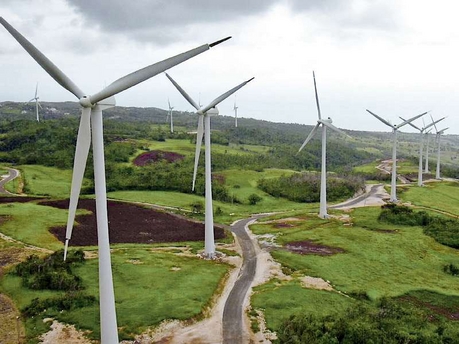
Wigton wind farm in Manchester, Jamaica. PHOTO/Jamaica Gleaner
Lefties Food Stall, a pint-sized eatery serving Barbados’ signature flying-fish sandwiches, recently became the first snack shack on the Caribbean island-nation to be fitted with a solar panel.
The nearby public shower facility sports a panel as well. So does the bus shelter across the street, the local police station, and scores of houses on the coastal road leading into the capital, Bridgetown.
Like many other island-nations in the Caribbean, Barbados has to ship in all of the oil that it uses to produce electricity – making power over 4 times more costly than it is in the fuel-rich United States.
That high price has proven to be a boon for Barbados’ fledgling solar industry. Nearly half of all homes boast solar water heaters on their roofs, which pay for themselves in lower electric bills in less than 2 years. Increasingly, industries like the country’s desalination plant are installing solar arrays to meet a portion of their power needs.
This move to solar is being driven by tax incentives for green businesses and consumers. In an address marking the United Nations Environment Programme’s (UNEP) “World Environment Day” in Bridgetown’s Independence Square, Barbados Prime Minister Freundel Stuart recently pledged that the island-nation would produce 29 percent of its energy from renewables by the end of the next decade.
That rather conservative goal is still over twice what the United States currently produces with renewables. It will not be hard to reach. Not only is Barbados blessed with abundant sunshine, it also has year-round trade winds to run wind turbines, and sugar cane waste – or bagasse – that can be used as a biofuel.
The Stuart administration in Barbados is furthermore looking into harnessing the energy of the tides, as well as introducing ocean thermal energy conversion (OTEC), a technology that employs the temperature difference between cooler deep and warmer shallow sea waters to generate electricity.
Clean energy technologies are slowly making headway throughout the Caribbean. And the nearby United States, the world’s number-one historical emitter of carbon emissions, should pay attention.
