
Opinion
The Automation Imperative: Why Southern Africa’s Manufacturing Moment Has Arrived

By Lance Chisue
As regional integration deepens, the choice for manufacturers is no longer whether to automate – but how to do it intelligently.
Southern Africa is finally thinking like an integrated market. With sixteen member states and a consumer base approaching 400 million, the Southern African Development Community (SADC) has spent two decades building the scaffolding for serious capital: harmonized investment protocols, reduced cross-border friction, and predictable regulatory frameworks under instruments like the Protocol on Finance and Investment.
The region is no longer merely promising opportunity – it is structuring itself to reward long-term commitment.
For manufacturers, the timing is acute. Labor costs are climbing. Pharmaceutical compliance standards are tightening. Export demand across the region is accelerating. Yet many operations still rely on semi-manual secondary packaging – a gap that grows more expensive by the quarter.
The Integration Dividend
SADC’s evolution matters now for three structural reasons.
First, genuine market integration enables access across sixteen economies without navigating sixteen distinct regulatory mazes.
Second, the region commands strategic assets that advanced economies covet: renewable energy potential, critical mineral reserves, and emerging transport corridors linking hinterland production to global shipping lanes.
Third, and most critically for capital allocators, policy harmonization is rendering intra-regional and foreign investment more predictable than at any point in the post-apartheid era.
From Johannesburg, the opportunities in energy transition, mineral beneficiation, and regional interconnectivity appear particularly compelling. For firms evaluating African expansion, SADC offers meaningful runway – provided they enter with appropriate operational infrastructure.
The Automation Threshold
Here is where macro trends meet shop-floor reality. Rising input costs and stringent good manufacturing practice (GMP) requirements are rendering manual secondary packaging economically irrational.
The question for regional manufacturers is no longer whether to automate, but how to automate without committing capital they cannot recover.
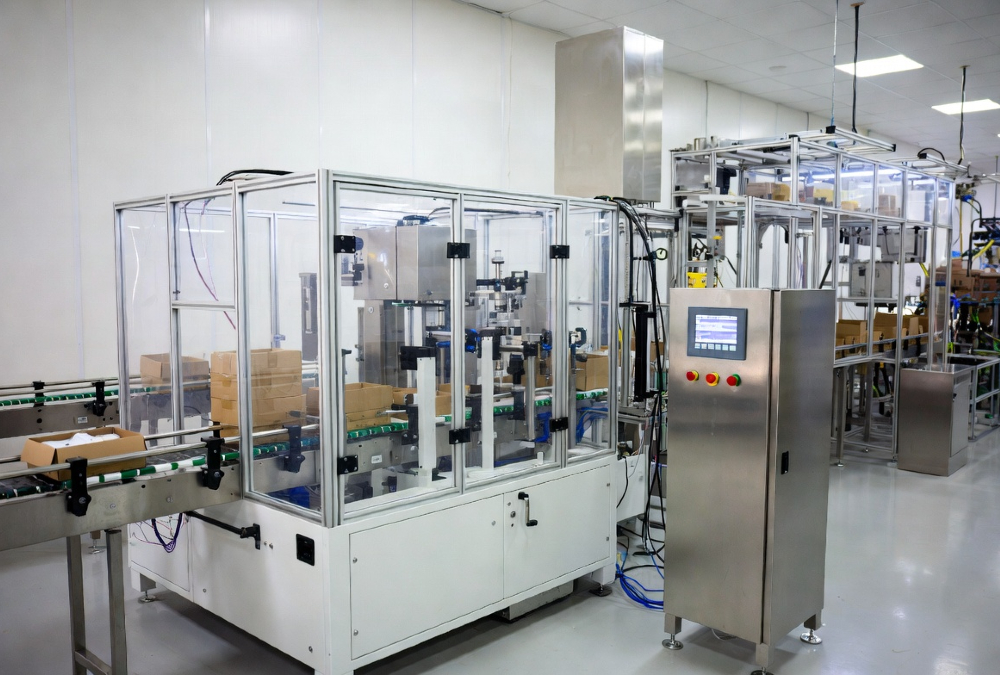
This is the logic behind recent partnerships bringing proven automation technology to regional markets. American-made compact cartoning systems – engineered for pharmaceutical and nutraceutical precision but sized for facilities with limited footprint – are now available through regional distribution channels.
These systems offer lower capital expenditure entry points, rapid changeover capabilities for multi-SKU production environments, and the compliance architecture necessary for export-grade operations.
Collaboration as Competitive Advantage
The deeper lesson extends beyond equipment procurement. Regional manufacturing competitiveness will depend increasingly on cross-functional collaboration – between engineering and sales, between local operators and international technology providers, between firms that historically protected silos and those building partnerships.
Research consistently demonstrates that diverse, collaborative teams solve complex problems faster and execute more effectively than siloed counterparts. The historical record is unambiguous: Edison’s lightbulb emerged from laboratory teamwork, not solitary genius; Apple’s original iPhone required the integration of hardware, software, and design disciplines; the Microsoft-Intel partnership reshaped global computing architecture.
An African proverb captures the operational truth: If you want to go fast, go alone. If you want to go far, go together.
The Immediate Calculus
For manufacturers scaling across SADC in 2026, the operational checklist is specific. Production lines constrained by manual cartoning, struggling with consistency, preparing for export compliance, or seeking throughput improvements without massive capital deployment require immediate assessment.
The regional infrastructure now exists to support such transitions. Feasibility analysis, site evaluation, and return-on-investment modeling can be executed locally.
The remaining variable is whether manufacturers will seize the automation imperative before competitors do.
Southern Africa has structured itself for patient capital. The question is which manufacturers will match that patience with operational sophistication.
Lance Chisue is the Founder and CMO of Sales Connect Africa, a Pretoria-based firm specializing in helping manufacturers enter and grow in Southern African markets. He leverages sales expertise and strategic visibility to connect products with buyers, supporting manufacturers in navigating complex regional market dynamics and distribution channels. Lance is dedicated to empowering manufacturers to succeed by bridging gaps between products and customers in emerging African markets
