
Opinion
The Arithmetic of Injustice: Why Africa Pays for Debt It Doesn’t Owe

By Kelly Mua Kingsly
The numbers tell a peculiar story. Africa’s projected debt-to-GDP ratio stands at 60.8 percent for 2026 – a figure that would be the envy of many developed economies.
Yet this statistical advantage masks a deeper paradox: while the United States shoulders debt at 123 percent of GDP, Japan at a staggering 264 percent, and France at 112 percent, these nations borrow at interest rates of 3-4 percent to finance infrastructure, research and development, and comprehensive social programs. African countries, by contrast, face punitive borrowing costs and mounting debt service obligations that consume resources desperately needed for development.
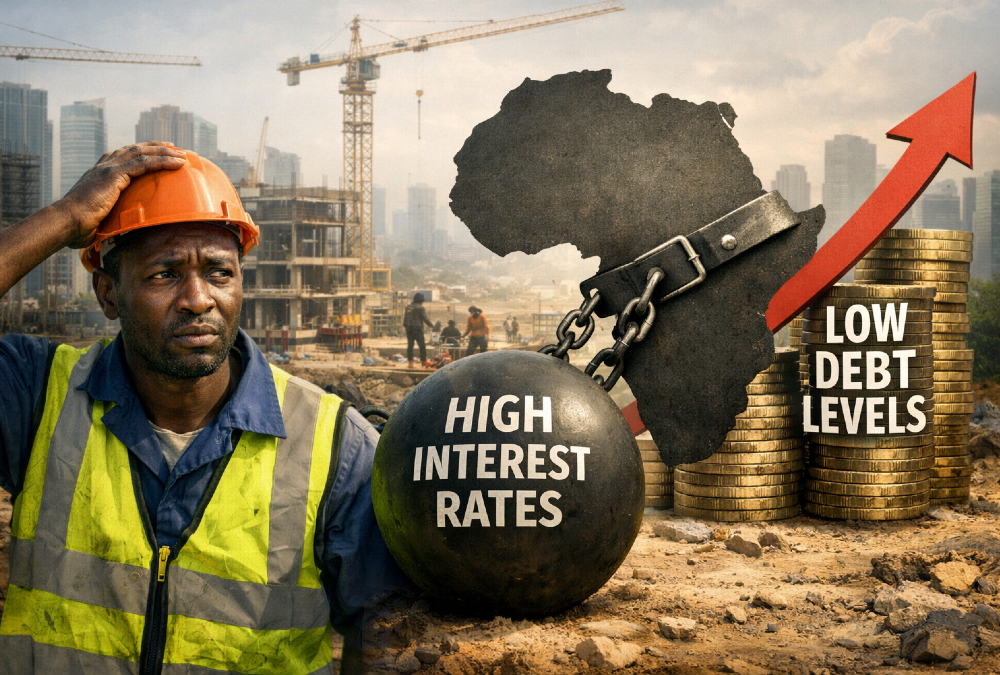
This disparity raises an uncomfortable question that policymakers and investors alike must confront: why does lower debt fail to secure better credit terms for African nations?
The Declining Debt Ratio Enigma
Thirty-four African nations are projected to show declining debt-to-GDP ratios – a development that conventional economic wisdom would celebrate as unambiguously positive. Yet the interpretation of this trend is far from straightforward.
Three competing narratives emerge, each with profoundly different implications for Africa’s economic future.
The optimistic reading points to fiscal responsibility. Countries across the continent have implemented structural reforms, imposed budget discipline, and strengthened revenue collection systems.
This interpretation suggests that African governments are learning from past mistakes and building the institutional capacity necessary for sustainable growth.
The pessimistic alternative suggests growth stagnation. When economies expand weakly or contract, existing debt burdens naturally shrink relative to GDP – not because debt is being paid down, but because the denominator is failing to grow.
This mathematical illusion of improvement conceals economic malaise rather than revealing genuine progress.
The third possibility may be the most troubling: credit market exclusion. African nations may be showing lower debt ratios precisely because international capital markets have shut them out, preventing borrowing even when critical investments hang in the balance.
In this scenario, declining debt reflects not virtue but vulnerability – an inability to access the capital necessary to build roads, power grids, and human capital.
A Tale of Two Economic Models
The divergence between African economies is becoming increasingly pronounced, and the patterns reveal crucial insights about sustainable development strategies.
Diversified economies – Morocco with its manufacturing and tourism sectors, Côte d’Ivoire (Ivory Coast) with its agricultural processing and services growth, Rwanda with its technology ambitions and service sector expansion – are managing debt levels while maintaining economic momentum.
These countries have reduced their vulnerability to external shocks by building multiple revenue streams and developing resilient economic structures.
Commodity-dependent economies face a starkly different reality. Algeria’s reliance on hydrocarbons, Botswana’s diamond dependence, and Gabon’s oil concentration create fiscal roller coasters where a single adverse year in global commodity markets can erase years of careful budgeting.
For these nations, debt sustainability hinges less on domestic policy choices than on price movements determined in London, New York, and Shanghai.
The Uncertainty Principle in Economic Forecasting
Projections for 2026 must be understood for what they are: educated guesses rather than predetermined outcomes. Multiple variables will determine whether African nations meet, exceed, or fall short of current expectations.
Commodity price movements remain the wild card. Oil markets could surge on geopolitical tensions or collapse under the weight of renewable energy transitions and demand destruction.
Diamond prices might rebound as luxury consumption recovers, or they might stagnate as synthetic alternatives gain market share and younger consumers shift preferences.
Currency fluctuations add another layer of complexity. Most African debt is denominated in foreign currencies, meaning that exchange rate movements can dramatically alter debt burdens overnight.
A strengthening dollar inflates obligations even as domestic revenue remains constant.
Political developments – from elections and leadership transitions to policy shifts and regional conflicts – can rapidly reshape fiscal landscapes. Similarly, GDP growth surprises in either direction will fundamentally alter debt dynamics, while unexpected fiscal measures such as emergency spending or windfall taxes can transform government balance sheets.
Consider Botswana’s position: a swift rebound in diamond markets could vindicate the country’s specialized economic model and generate budget surpluses. Conversely, oil-dependent nations could find themselves in crisis if prices decline further, forcing painful austerity or dangerous levels of additional borrowing.
The Fundamental Question
The data suggests that Africa’s economic landscape is approaching an inflection point. Diversification strategies are showing promise, reform efforts are yielding institutional improvements, and digital technologies are creating new pathways for growth.
Yet vulnerabilities persist: commodity dependence remains acute for many nations, climate shocks are intensifying, and the global financial architecture continues to penalize African borrowers with higher risk premiums that often reflect prejudice as much as genuine credit analysis.
Will 2026 mark the beginning of a fundamental transformation in Africa’s economic trajectory, or will it reveal that structural constraints remain too powerful to overcome? The answer may well determine development outcomes for decades to come – not just for Africa, but for a global economy increasingly dependent on the continent’s resources, markets, and human capital.
The debt numbers alone cannot answer this question. What matters is whether African nations can translate fiscal discipline into productive investment, whether diversification can accelerate before the next commodity crash, and whether the international community will finally recognize that sustainable development requires access to affordable capital – not lectures about fiscal responsibility from countries whose own debt ratios would be catastrophic if subjected to the same punitive interest rates imposed on African borrowers.
The paradox persists: Africa’s relatively low debt should be a source of strength, yet it remains a marker of exclusion. Until this changes, the continent will struggle to finance the investments necessary to break free from cycles of underdevelopment – regardless of what the debt-to-GDP ratios might suggest.
Kelly Mua Kingsly brings extensive expertise in public finance and strategic leadership. He currently serves as the Head of Finance Operations at the Ministry of Finance of Cameroon, while also holding a dual role as Project Finance Manager at the Ministry of Economy, Planning, and Regional Development, and Censor at the Central Bank of Central African States (BEAC). He has previously served as Chairperson of the Board of the African Trade & Investment Development Insurance (ATIDI) and as a Director on the Board of Quantum Blockchain Capital. Driven by a strong passion for Africa’s economic transformation, he is deeply committed to advancing the continent’s path toward industrialization.
