
Opinion
Stop Attending Africa – Start Building It

By Victory Azimih
A troubling contradiction haunts African development: we discuss building the continent everywhere except where construction actually happens.
African leaders, policymakers, and investors shuttle between Paris, London, Brussels, Dubai, Singapore, and Washington to “discuss Africa.” We attend impeccably branded conferences, deliver eloquent speeches, stay in luxury hotels, photograph ourselves with presidents and governors, and exchange business cards alongside LinkedIn connections.
Then we board flights home – and Africa remains structurally underbuilt.
This is not progress. This is performance.
The Conference Circuit vs. Continental Construction
The question grows more urgent with each passing summit: when will Africans begin solving African problems at scale? The answer cannot be found in another panel discussion.
Africa does not need more panels. Africa needs projects.
Africa does not need more declarations. Africa needs deployments.
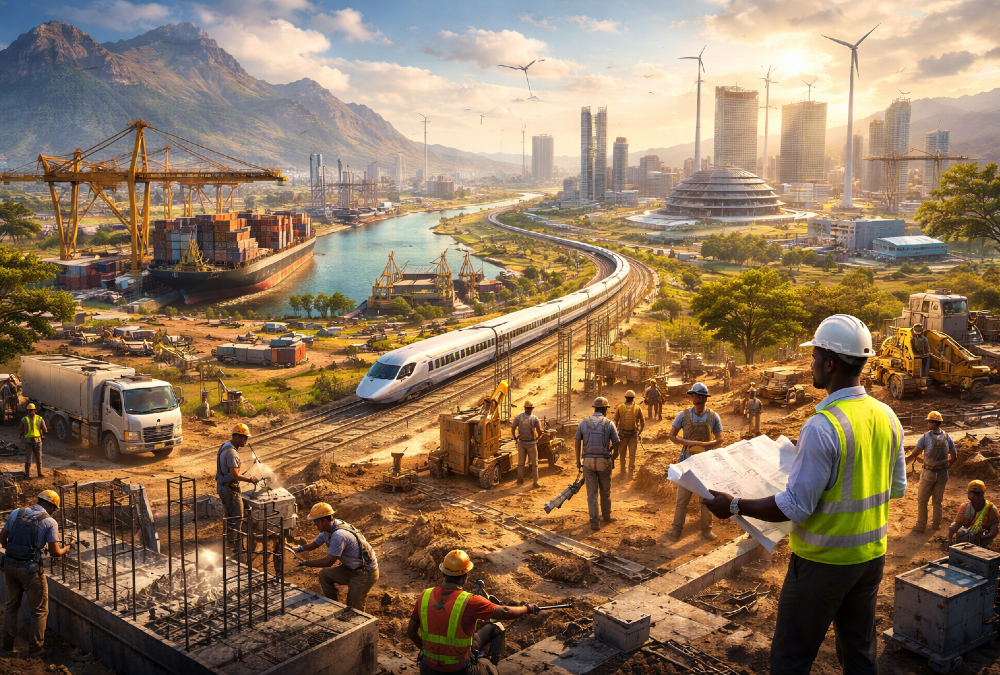
Africa does not need more white papers. Africa needs capital mobilized into steel, concrete, power grids, data networks, railways, farms, factories, ports, and refineries.
The harsh truth is this: independence is not political – it is industrial.
What True Sovereignty Actually Requires
A continent cannot call itself independent if it cannot move its own goods efficiently, power its own industries, process its own resources, feed its own population, educate and employ its youth, or build its own digital and physical infrastructure.
Africa cannot claim sovereignty while exporting raw materials and importing finished goods. This represents economic vulnerability disguised as independence – a structural dependency that undermines every political achievement of the past century.
A Continental Construction Agenda for the 21st Century
What Africa requires now is not slogans, conferences, or photo opportunities. The continent needs a comprehensive infrastructure agenda built on proven financial mechanisms:
Public-Private Partnerships (PPPs) that construct tangible assets rather than producing reports. Joint Ventures (JVs) that retain African equity and ownership stakes.
Special Purpose Vehicles (SPVs) that mobilize institutional capital at unprecedented scale. Industrial corridors, logistics networks, refineries, power plants, data centers, railways, ports, and housing systems – all deployed at continental scale.
The Population Dividend or Demographic Disaster?
Africa’s population continues its rapid expansion, yet fundamental questions remain unanswered:
Where are the homes for the next generation? Where is the food security architecture to sustain 2.5 billion people by 2050?
Where are the rail lines connecting agricultural zones to ports? Where are the industrial parks processing African resources into finished goods?
Where are the refineries capturing value from the continent’s natural wealth? Where are the continental logistics networks enabling efficient trade?
Where are the digital infrastructures and artificial intelligence systems that will power Africa’s participation in the Fourth Industrial Revolution?
A large population without corresponding infrastructure is not a demographic dividend – it is a systemic risk that threatens political stability, economic prosperity, and social cohesion.
The Decisive Decade
This decade will determine Africa’s trajectory for the next century. The continent faces a binary choice: become an integrated industrial bloc capable of competing in global markets, or remain the world’s largest supplier of cheap labor and unprocessed raw materials.
There is no middle ground between these futures.
A Call to Action for Serious Capital
My message to investors and policymakers who claim commitment to African development is straightforward: Stop attending Africa. Start building Africa.
Deploy capital into concrete projects. Structure viable deals. Mobilize Special Purpose Vehicles. Form Joint Ventures with African partners. Lock in Public-Private Partnerships that share risk and reward equitably.
Build the railways, roads, ports, refineries, farms, data centers, housing complexes, and power systems that create the foundation for sustained economic growth. This infrastructure represents what genuine independence looks like – not the symbolic independence of flags and anthems, but the material independence of productive capacity and economic self-determination.
The Work That Defines a Century
The construction of continental infrastructure is not merely an economic project. It represents the work that will define the next hundred years of African history – the difference between a century of prosperity or continued dependency, between demographic dividend or disaster, between political stability or state fragility.
The question is no longer whether Africa needs development. The question is whether those who claim to support African development are willing to move beyond conferences and commitments to the difficult work of construction.
The blueprints exist. The financing mechanisms are proven. The technical expertise is available.
What remains is the political will to deploy them – and the moral courage to demand results rather than rhetoric. Africa’s future will not be discussed into existence. It must be built.
Victory Azimih is a visionary entrepreneur and global investment consultant specializing in Africa’s economic growth and industrial transformation. As the CEO and founder of Azeemi Global, he leads a pioneering firm dedicated to accelerating the continent’s development through cutting-edge technology and infrastructure solutions. Under his leadership, Azeemi Global focuses on harnessing the potential of artificial intelligence, blockchain, and smart infrastructure to unlock sustainable investment opportunities across Africa. Based in Lagos, Nigeria, Azimih is at the forefront of driving Africa’s future as a hub of innovation and industrialization.
