
Opinion
Rwanda’s Flying Taxi: A Bold Leap Into Africa’s Aviation Future

By Jean Claude Niyomugabo
Last week, Kigali took to the skies – not just metaphorically, but literally.
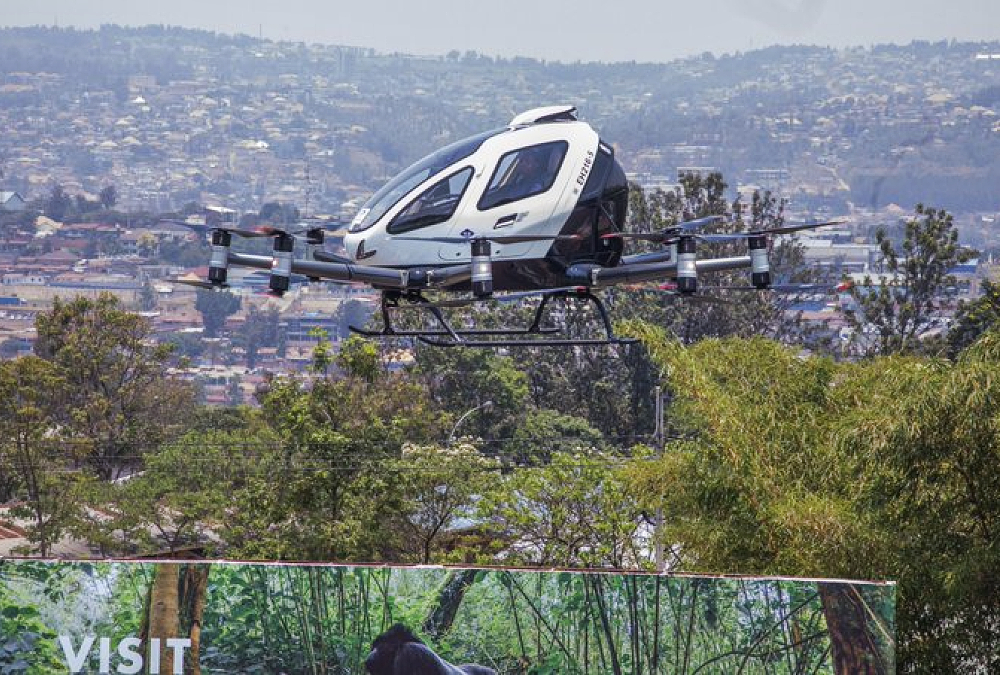
In a historic first for the African continent, Rwanda launched the region’s inaugural self-flying electric passenger air taxi. The EHang EH216-S, an autonomous vertical take-off and landing (eVTOL) aircraft capable of carrying two passengers, ascended nearly 100 meters above the capital in a seamless, silent demonstration that didn’t just dazzle onlookers – it redefined what’s possible for urban mobility in Africa.
This wasn’t merely a tech demo. It was a declaration.
Rwanda, long lauded for its digital governance and infrastructure ambition, has once again positioned itself at the vanguard of African innovation. Partnering with China Road and Bridge Corporation and global eVTOL leader EHang, the Rwandan government didn’t just test a new aircraft – it activated an entire ecosystem: one built on clean energy, regulatory foresight, and public-private collaboration.
Beyond the Hype: Solving Africa’s Real Mobility Crisis
Africa’s aviation sector has long been held back by crumbling infrastructure, prohibitive costs, and gridlocked urban centers. In cities like Lagos, Nairobi, and Kinshasa, commutes can consume hours – and carbon.
But Rwanda is flipping the script.
By embracing autonomous electric flight, the country isn’t chasing sci-fi fantasies. It’s solving urgent problems: reducing congestion, cutting emissions, and expanding access to reliable transport without waiting decades for traditional infrastructure upgrades.
The EHang flight was proof that leapfrogging is not only possible – it’s practical.
And it’s scalable.
Beyond passenger transport, these technologies hold transformative potential for medical supply delivery, emergency response, and last-mile logistics across rural and underserved regions. Imagine vaccines reaching remote clinics in minutes instead of days.
That’s not speculative – it’s imminent.
A Broader Vision: Rwanda as Africa’s Innovation Hub
The flying taxi is just the tip of the iceberg.
Rwanda is systematically building itself into Africa’s digital, economic, and technological epicenter. Its investments span fiber-optic broadband networks covering 95 percent of the population, a thriving fintech landscape powered by mobile money adoption, solar-powered data centers, and regulatory sandboxes that invite global startups to test and scale under clear, supportive frameworks.
Minister of Infrastructure Vincent Biruta put it plainly: “This is not about flying taxis. It’s about creating an environment where technology and regulation evolve together.”
That balance – between bold experimentation and rigorous safety – is precisely what attracts billion-dollar investors and world-class talent. Unlike many nations that wait for perfect conditions, Rwanda builds them. And in doing so, it’s becoming the continent’s most trusted proving ground for next-generation mobility.
A Beacon for the Entire Continent
Africa’s story is no longer one of scarcity – it’s one of surging potential. With over 60 percent of its population under 25, rapid urbanization, and abundant renewable resources – from solar-rich deserts to geothermal hotspots and hydropower rivers – the continent doesn’t need to copy old models.
It needs to invent new ones.
Rwanda’s eVTOL milestone sends a powerful signal: Africa doesn’t have to wait for permission to lead.
It’s no longer enough to ask whether African nations can adopt innovation. The question now is: Who will be the first to master it?
From Kenya’s drone-delivered blood banks to Nigeria’s AI-powered agritech platforms, innovation is already bubbling up across the continent. But Rwanda’s air taxi launch is different – it’s visible, symbolic, and audacious.
It captures global attention because it answers a fundamental truth: the future of mobility won’t be shaped solely in Silicon Valley or Shenzhen. It will be co-created in Kigali, Dakar, and Cape Town.
The Road Ahead: From Demonstration to Destination
The real test lies ahead. Regulatory frameworks must mature.
Charging infrastructure must expand. Public trust must be earned.
But Rwanda has already done the hardest part: it dared to begin.
As other African capitals watch closely, they will see not just a flying machine – but a blueprint. One that proves sustainable, smart, and inclusive urban transformation is achievable even in emerging economies.
The sky is no longer the limit. It’s the launchpad.
Rwanda isn’t just flying a taxi. It’s launching a movement. Let the rest of Africa follow.
Jean Claude Niyomugabo is an entrepreneur and digital communication specialist with a strong passion for Africa’s development. He is dedicated to harnessing the power of social media to drive positive change and enhance livelihoods. With diverse interests and a strategic approach to digital engagement, he strives to create meaningful impact through innovation and connectivity.
