
Opinion
Nigeria’s Non-Oil Export Boom Signals a New Era for Regional Trade

By Ziad Hamoui
The numbers are in – and they signal something far more consequential than a quarterly trade report.
Nigeria raked in US$3.2 billion from non-oil exports during the first half of 2025, a staggering 19.59 percent jump from the same period last year. At first glance, this looks like another statistical footnote.
Look closer, and the data from the Nigeria Export Promotion Council reveals a structural transformation that is rewriting the economic playbook for West Africa.
Export diversification in Africa’s most populous nation is no longer aspirational policy rhetoric. It is happening now.
From Crude to Cocoa – and Far Beyond
The headline figures tell only part of the story. Agricultural commodities remain the workhorses: cocoa, sesame seeds, and cashew nuts continue finding eager buyers in global markets.
But dig into the export ledger and a more compelling narrative emerges.
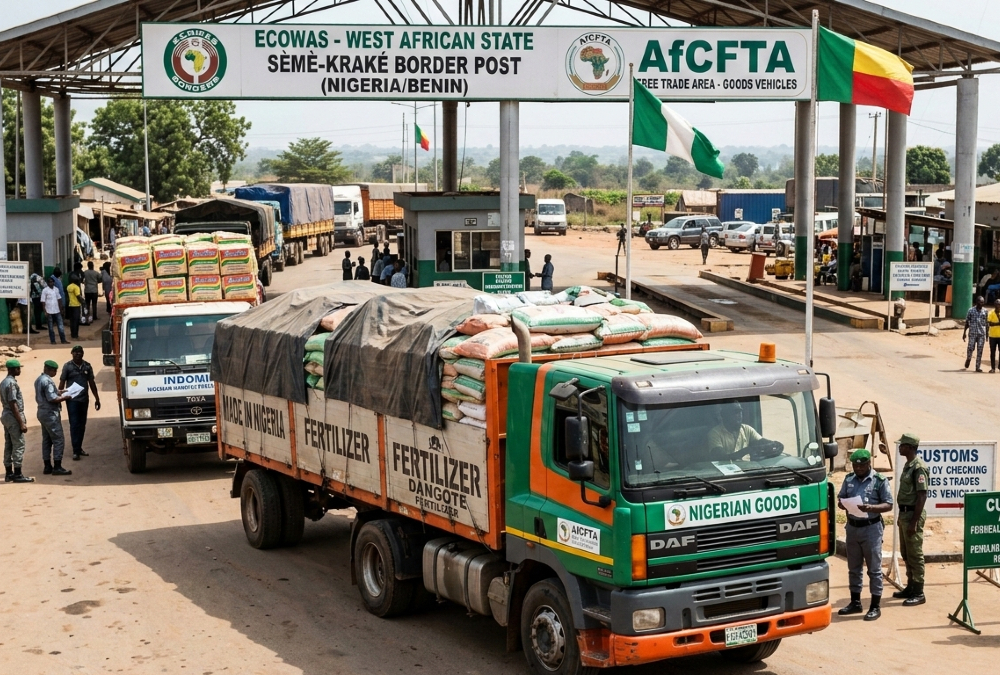
Nigeria shipped US$787 million worth of fertilizer and urea alone – positioning itself as a regional supplier of industrial inputs rather than merely a raw-materials exporter.
Vehicles and processed goods are increasingly crossing borders. The non-oil portfolio now encompasses 236 distinct products, up from a fraction of that number just years ago.
For transport operators hauling cargo across West African corridors, the shift is visceral. Manifests that once bulged with unprocessed commodities now feature semi-processed and manufactured goods.
This compositional change is not abstract economic theory – it is transforming daily operations at border posts from Seme to Noepe.
The AfCFTA Reality Check
Here is where regional trade architecture meets ground truth. The African Continental Free Trade Area’s rules of origin and cumulation provisions – often dismissed as bureaucratic fine print – are suddenly operationally relevant.
Traders and logistics providers from Lagos to Lomé are discovering that where products are manufactured, and how their components are sourced, now determines tariff treatment and market access.
The policy frameworks negotiators hammered out in Addis Ababa and Kigali are being stress-tested in real time by Nigerian exporters moving goods across ECOWAS corridors.
The Double-Edged Integration
Nigeria’s manufacturing ascent creates a complex dynamic for its neighbors. The upside is substantial: Nigerian demand for inputs generates markets for suppliers across coastal and landlocked ECOWAS economies alike.
A cashew processor in Ouagadougou or a component manufacturer in Accra can now plug into Nigerian supply chains.
Yet the competitive pressure is equally real. Manufacturing competitiveness, once established, exhibits powerful agglomeration effects.
Production networks and supplier ecosystems generate self-reinforcing advantages that become prohibitively expensive to replicate elsewhere. Neighbors who lag in industrial capacity development risk watching Nigerian firms capture regional market share that proves difficult to reclaim.
The window for competitive response is narrowing.
Infrastructure as the Binding Constraint
This trajectory validates a long-standing thesis: infrastructure investment married to policy reform produces measurable economic returns. The Abidjan-Lagos Corridor, the Lagos-Badagry Expressway upgrades, and the Ghana-Burkina Faso railway are no longer developmental luxuries.
They are essential arteries for trade volumes that are growing faster than transport capacity.
The mismatch is stark. Nigerian exporters still grapple with exorbitant energy costs, chronic port congestion, and regulatory friction that erodes margins.
The gap between Abuja’s policy ambition and the operational reality at Apapa Port remains painfully wide.
Yet the direction of travel is unambiguous. Africa’s largest economy is demonstrating that resource dependence is a choice, not a destiny – and that choice is reshaping commercial possibilities across an entire region.
Ziad Hamoui is the Co-Founder and Past President of the Borderless Alliance, a leading private-sector advocacy group promoting economic integration and removing trade and transport barriers in West Africa. With extensive experience in Ghana’s road transport, logistics, and shipping sectors, he currently serves as Executive Director of Tarzan Enterprise Ltd., a long-established family business. He is a former Co-Chair of the Africa Food Trade Coalition, Co-Founder of the Trade Facilitation Coalition for Ghana, and serves on multiple high-level advisory committees on trade, transport, agriculture, and security. A Chartered Fellow of the Chartered Institute of Logistics and Transport (CILT) Ghana, he is also a former member of its Governing Council.
