
Opinion
Nigerian Solar Manufacturing: A Blueprint for African Industrial Transformation

By Ziad Hamoui
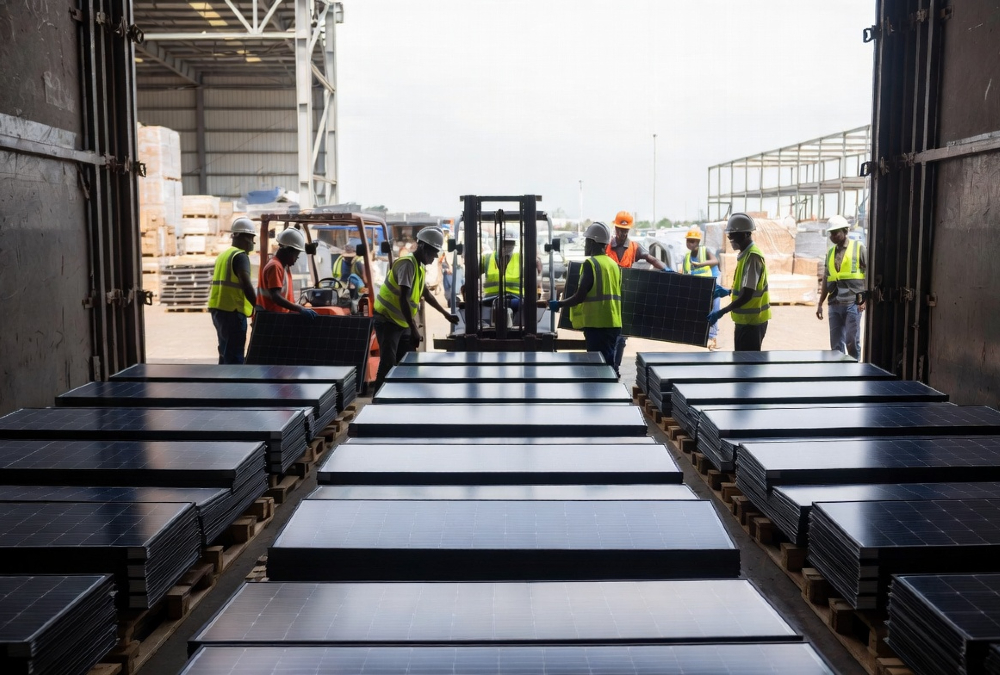
When the first shipment of Nigerian-manufactured solar panels arrived in Accra last month, it marked more than a commercial transaction. It represented a fundamental shift in Africa’s industrial narrative – one that moves beyond rhetoric about self-sufficiency toward demonstrable manufacturing capability and regional trade integration.
The transformation has been remarkably swift. Three years ago, Nigeria imported over 90 percent of its solar equipment from China, India, and Europe.
Today, the country exports photovoltaic panels to its neighbors, having expanded domestic solar PV manufacturing capacity from 120 MW to approximately 650 MW under the current administration.
This acceleration didn’t happen by accident. The Rural Electrification Agency of Nigeria forged strategic partnerships with Renewable Energy Service Co., Ltd. and Levene Photovoltaic Technologies to build local manufacturing infrastructure.
Meanwhile, the Energy Commission of Nigeria secured a pivotal deal with LONGi Solar – the world’s largest solar panel manufacturer – to establish production facilities on Nigerian soil.
The Architecture of Success
What makes this case study particularly instructive is the convergence of three critical elements: coherent government policy, private sector execution, and functional regional trade frameworks.
The Rural Electrification Agency’s local content requirements, reinforced by performance-based contracts under the World Bank and African Development Bank-funded Nigeria Electrification Project, created genuine incentives for domestic value addition rather than mere assembly operations. The manufacturing processes that genuinely matter – cell stringing, lamination, framing, and quality assurance – now occur in Abuja rather than Shanghai or Mumbai.
Ghana emerged as the logical first export market. Strong bilateral trade ties, a dynamic off-grid energy sector, and comparable solar deployment challenges create a compelling commercial rationale.
But the potential extends far beyond bilateral arrangements. Countries including Senegal, Côte d’Ivoire (Ivory Coast), and Benin, where the ECOWAS Centre for Renewable Energy and Energy Efficiency already coordinates mini-grid deployments, represent natural expansion markets.
Regional Integration: From Theory to Practice
Scaling this success demands more than manufacturing capacity alone. As industry observers like Rinret Best from Vectar Energy have noted, cross-border trade frictions, unharmonized tariffs, and bureaucratic delays threaten to erode cost advantages and undermine delivery schedules unless regional trade facilitation mechanisms function effectively.
This is where institutional architecture matters. The ECOWAS Trade Liberalization Scheme, streamlined customs documentation, and reduced border waiting times through Joint Border Posts aren’t bureaucratic niceties – they are essential enablers of cross-border commerce.
What we are witnessing is the African Continental Free Trade Area operating in concert with Regional Economic Communities like ECOWAS. Neither framework delivers results in isolation.
The US$2.8 million ECOWAS-AfDB-UNDP institutional support project launched in August 2025 for vulnerable West African states, combined with Nigeria’s recent formalization of its ECOWAS Schedule of Tariff Offers, suggests that institutional coordination is advancing beyond declarations toward implementation.
A Replicable Model?
The trajectory from import dependency to self-sufficiency to regional export capacity within a single political administration offers a template worth examining. It demonstrates that African countries can build manufacturing competitiveness when policy creates appropriate conditions and regional markets provide sufficient scale.
Yet questions remain about replicability. Solar panel manufacturing benefits from relatively standardized production processes, clear performance metrics, and established global supply chains that facilitate technology transfer. The sector also enjoys strong development finance support and climate finance flows that may not be available for other industries.
Still, the fundamental architecture – strategic public-private partnerships, local content requirements with enforcement mechanisms, performance-based contracting, and regional market integration – could theoretically apply to other manufacturing sectors. Agricultural processing, pharmaceutical production, and consumer electronics assembly all face similar challenges of achieving scale, accessing technology, and navigating regional trade barriers.
The critical question for West Africa’s industrial development isn’t whether this model can work – Nigeria’s solar sector has answered that affirmatively. The question is which sectors possess the right combination of regional demand, accessible technology, policy commitment, and private sector capacity to follow this trajectory.
The answer will determine whether Nigerian solar panels in Ghana represent an isolated achievement or the opening chapter of Africa’s industrial transformation.
Ziad Hamoui is the Co-Founder and Past President of the Borderless Alliance, a leading private-sector advocacy group promoting economic integration and removing trade and transport barriers in West Africa. With extensive experience in Ghana’s road transport, logistics, and shipping sectors, he currently serves as Executive Director of Tarzan Enterprise Ltd., a long-established family business. He is a former Co-Chair of the Africa Food Trade Coalition, Co-Founder of the Trade Facilitation Coalition for Ghana, and serves on multiple high-level advisory committees on trade, transport, agriculture, and security. A Chartered Fellow of the Chartered Institute of Logistics and Transport (CILT) Ghana, he is also a former member of its Governing Council.
