
Opinion
Nigeria-Benin Trade Pact: A $4 Billion Blueprint for West African Integration

By Ziad Hamoui
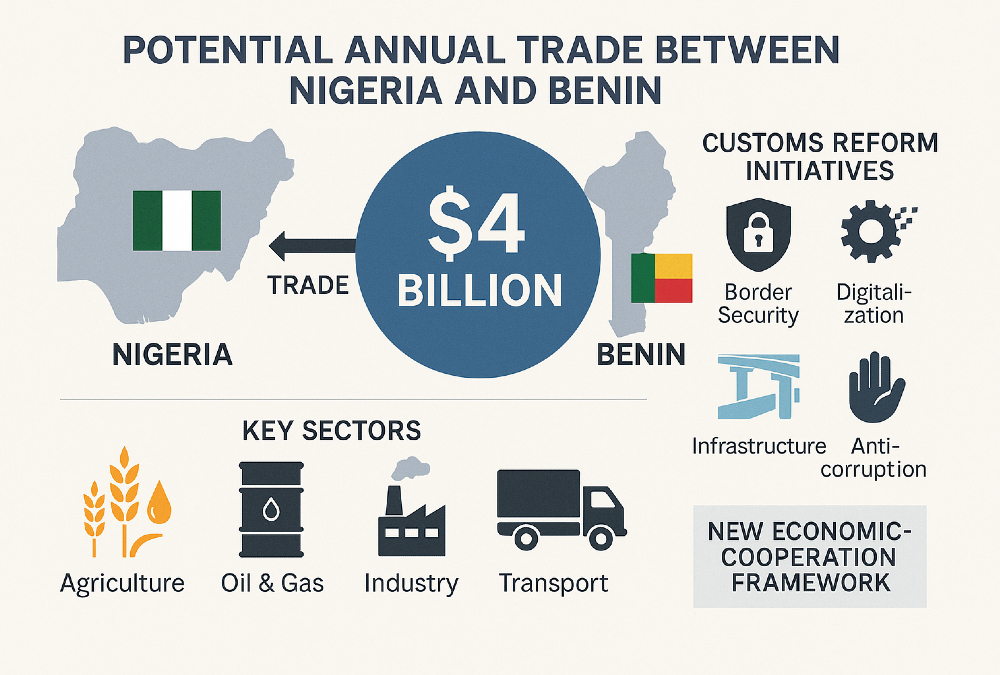
In a transformative step for regional economic integration, Nigeria and Benin have formalized a landmark Framework for Enhanced Economic Cooperation – a strategic agreement poised to unlock over US$4 billion in annual trade between the two neighboring nations. More than just a bilateral trade deal, this pact marks a pivotal moment in West Africa’s journey toward a seamless, prosperous, and interconnected single market.
The agreement, anchored in four strategic pillars – trade in goods and services, private sector engagement, customs modernization and trade facilitation, and strengthened legal and regulatory frameworks – represents a shift from decades of informal cross-border commerce to a structured, rules-based economic partnership. For a region long hindered by bureaucratic bottlenecks, inefficient border procedures, and fragmented policies, this framework offers a tangible model for reform.
A Model for Implementation in Action
What makes this deal particularly promising is its emphasis on implementation. The creation of dedicated technical working groups focused on logistics coordination, infrastructure development, and customs harmonization signals a commitment to turning policy into practice.
This systematic approach – driven by public-private collaboration – is exactly the kind of institutional innovation needed to breathe life into broader continental initiatives like the African Continental Free Trade Area (AfCFTA) and the Economic Community of West African States (ECOWAS) integration agenda.
As advocates for borderless trade at the Borderless Alliance, we have long argued that regional integration hinges not on grand declarations, but on targeted, operational reforms. The Nigeria-Benin corridor – historically one of West Africa’s most active informal trade routes – was ripe for transformation.
By formalizing trade flows, reducing non-tariff barriers, and investing in digital customs platforms, both nations are setting a precedent for efficiency, transparency, and mutual economic growth.
Scaling the Blueprint Across West Africa
The implications extend far beyond two countries. This partnership serves as a real-world blueprint for other underperforming trade corridors across West Africa.
Consider the Lagos-Abidjan axis, a vital economic artery linking Nigeria, Benin, Togo, Ghana, and Côte d’Ivoire (Ivory Coast) – currently constrained by inconsistent regulations and poor infrastructure. Or the Niger-Nigeria land route, where cumbersome border checks stifle the movement of agricultural goods.
Each of these corridors could benefit from the Nigeria-Benin model: structured dialogue, joint technical teams, and private sector inclusion.
Moreover, unlocking formal trade between Nigeria and Benin could significantly reduce smuggling, increase tax revenues, and create thousands of jobs in transport, logistics, and agribusiness. It also strengthens regional resilience – diversifying supply chains and reducing dependence on external markets.
As AfCFTA moves from negotiation to implementation, regional leaders must look to bilateral successes like this one. The Nigeria-Benin pact proves that progress is possible when political will meets practical design.
It’s time to scale what works.
The question is no longer whether regional integration is feasible – but how quickly we can replicate this model across Africa’s most strategic trade corridors.
Ziad Hamoui is the Co-Founder and Past President of the Borderless Alliance, a leading private-sector advocacy group promoting economic integration and removing trade and transport barriers in West Africa. With extensive experience in Ghana’s road transport, logistics, and shipping sectors, he currently serves as Executive Director of Tarzan Enterprise Ltd., a long-established family business. He is Co-Chair of the Africa Food Trade Coalition, Co-Founder of the Trade Facilitation Coalition for Ghana, and serves on multiple high-level advisory committees on trade, transport, agriculture, and security. A Chartered Fellow of the Chartered Institute of Logistics and Transport (CILT) Ghana, he is also a former member of its Governing Council.
