
Opinion
Namibia Tops Africa in Global FDI Performance, Ranks Second Worldwide in 2025 Index

By Des H Rikhotso
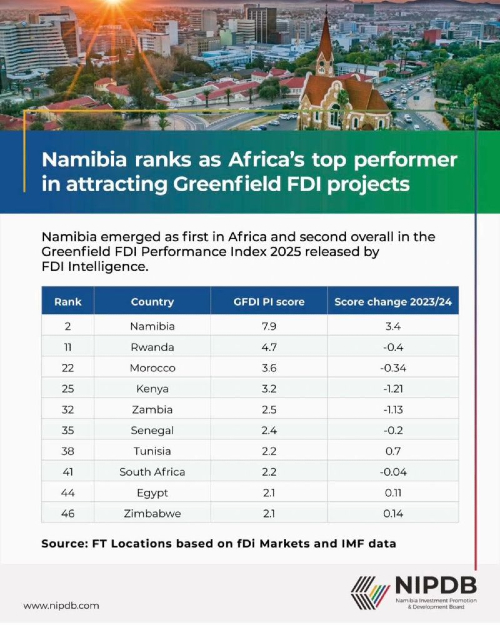
In a remarkable testament to strategic economic reform and investment appeal, Namibia has risen to first place in Africa – and second globally – in the 2025 Greenfield Foreign Direct Investment (FDI) Performance Index, according to a recent report by fDi Intelligence. This achievement underscores the country’s growing reputation as a top-tier destination for high-impact, sustainable investment on the world stage.
The Greenfield FDI Performance Index evaluates how effectively countries attract new, capital-intensive foreign investment projects relative to their economic size. Unlike traditional FDI metrics that focus solely on volume, this index emphasizes efficiency – rewarding nations that punch above their weight in converting their economic potential into tangible investment outcomes.
Namibia’s leap of 10 positions from the previous year is not just impressive; it’s emblematic of a broader transformation underway.
Long known for its rich mineral and hydrocarbon resources, Namibia is now successfully diversifying its investment portfolio beyond extractive industries. A growing emphasis on renewable energy, green hydrogen, and advanced manufacturing is attracting global capital and shifting perceptions about the country’s economic trajectory.
Notably, Coca-Cola Beverages Africa recently committed US$50 million to build a state-of-the-art bottling line and a sustainable water treatment plant – highlighting investor confidence in Namibia’s infrastructure, regulatory stability, and long-term vision.
Reforms That Attract: How Namibia Built an Investor-Friendly Climate
This momentum is no accident. It reflects years of coordinated effort by the Namibia Investment Promotion and Development Board (NIPDB), government agencies, and private sector partners to streamline regulations, enhance transparency, and improve the overall ease of doing business.
From digitalizing licensing procedures to offering targeted incentives for green industries, Namibia has created a more agile and investor-friendly ecosystem.
The NIPDB has rightly taken pride in this milestone, calling it a shared victory among stakeholders committed to inclusive economic growth. “This ranking validates our strategy to position Namibia as a gateway for sustainable, high-value investment in Southern Africa,” a spokesperson said.
“We remain focused on unlocking opportunities that generate jobs, foster innovation, and improve the quality of life for all Namibians.”
A Model for Africa: Sustainable Growth Beyond Natural Resources
For international investors and policymakers alike, Namibia’s ascent offers a compelling case study: that even smaller economies can lead global investment trends through vision, consistency, and reform. As African nations compete to attract post-pandemic capital and build resilient economies, Namibia’s success signals a new era of opportunity – one rooted in sustainability, partnership, and forward-looking governance.
As the world reevaluates where to deploy capital in an age of climate consciousness and supply chain resilience, Namibia is not just keeping pace – it’s setting the standard.
Des H Rikhotso (PgDip-BA, MBL) is a seasoned C-suite executive with 25+ years of leadership across Southern and Sub-Saharan Africa. Based in Kampala, he serves as East Africa Regional Business Executive, driving strategic growth and operational excellence. Des has held senior roles at BMW, Volkswagen, Peugeot, Toyota/Lexus, Nissan, and G.U.D Holdings. He holds business degrees from the University of the Western Cape, Wits University, and the University of South Africa.
