
Opinion
IShowSpeed: How One Streamer Is Rewriting the Continent’s Narrative

By Mark-Anthony Johnson
In an era when digital creators wield influence rivaling traditional media, one American YouTuber is undertaking an unprecedented experiment in cultural diplomacy.
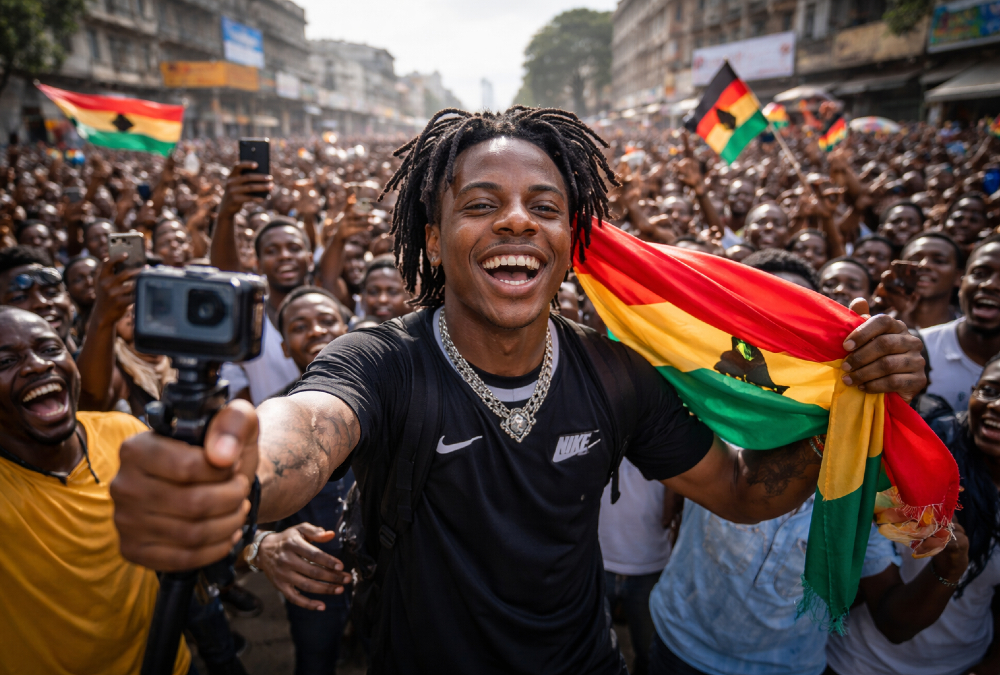
IShowSpeed – the online persona of 20-year-old Darren Jason Watkins Jr. – has embarked on a 28-day livestreamed journey across 20 African nations, broadcasting unfiltered encounters with the continent’s diversity to his 48 million YouTube subscribers. What began as an ambitious content project has evolved into something far more significant: a real-time challenge to entrenched stereotypes about Africa, delivered through the most modern medium imaginable.
The Phenomenon Behind the Tour
IShowSpeed’s rise exemplifies the democratization of global influence. Unlike carefully scripted television documentaries or meticulously edited travel series, his “In Real Life” streams offer raw, immediate connection.
His audience doesn’t merely watch Africa – they experience it alongside him, unvarnished and unpredictable. When thousands of Kenyans flooded Nairobi’s streets to greet him on January 11, 2026, or when Kenyan President William Ruto officially welcomed him via video message, it underscored a crucial shift: digital creators now command attention that transcends entertainment, entering the realm of cultural exchange.
The tour’s structure reveals sophisticated planning beneath its spontaneous veneer.
Launching in late December 2025 in Angola and scheduled to conclude around January 26, 2026, Speed moves at a breathtaking pace – nearly one country per day. He has already traversed South Africa (where he rang in the New Year in Cape Town), Botswana, Eswatini, Mozambique, Rwanda, and Zimbabwe, with forthcoming stops expected in Algeria, Benin, Egypt, Ethiopia, Ghana, Ivory Coast, Liberia, Morocco, Namibia, Nigeria, Senegal, and Zambia.
Major sponsorships enable this logistical feat, positioning it as potentially the largest creator-led travel livestream ever attempted.
Countering Monolithic Narratives
Africa’s portrayal in Western media has long oscillated between exoticization and catastrophization – a continent reduced to safaris and suffering, its 54 nations flattened into a monolithic narrative.
Speed’s approach, whether intentional or instinctive, disrupts this framework. His viral moments – racing a cheetah in Botswana, fleeing from a lion during a safari, cage diving with sharks off South Africa’s coast – certainly play to adventurous spectacle.
Yet they coexist with quieter cultural immersions: savoring koeksisters in South Africa while wearing a Springbok rugby jersey, receiving an honorary name from Eswatini’s royal family, engaging with local football enthusiasts across multiple nations.
This duality matters. By showcasing both Africa’s natural grandeur and its vibrant urban cultures, technological advancement and traditional heritage, Speed presents complexity where simplification has dominated.
His massive crowds aren’t portrayed as exotic curiosities but as enthusiastic participants in a shared digital culture. The hospitality he encounters – from presidential welcomes to street-level warmth – challenges narratives of hostility or danger that have long colored Western perceptions.
The Personal Intersects With the Political
Speed has framed this journey partly as a heritage quest, planning a DNA reveal at the tour’s conclusion to trace his ancestral connections to the continent. This personal dimension elevates the tour beyond voyeurism.
For African diaspora communities, particularly African Americans whose ancestral ties were severed by slavery’s violence, such connections carry profound weight. Speed’s journey becomes a proxy for millions seeking to understand their own origins, broadcast in real time to a global audience.
Yet the tour’s significance extends beyond individual heritage. In an age of rising nationalism and border hardening, watching someone traverse 20 countries in 28 days – welcomed enthusiastically at each stop – offers a counter-narrative to isolationism.
It demonstrates that in digital spaces, borders become porous, and cultural exchange occurs at the speed of streaming bandwidth.
The Limitations of Spectacle
This is not to romanticize Speed’s approach or overlook its limitations. Critics might reasonably argue that such rapid movement prevents deep engagement, that viral moments prioritize spectacle over substance, or that the tour’s commercial backing and structured schedule undercut claims to authenticity.
There’s validity in questioning whether a 20-year-old streamer, however well-intentioned, can meaningfully represent the continent’s complexities in bite-sized clips optimized for social media algorithms.
Moreover, the tour’s focus on fan engagements and thrilling encounters may inadvertently reinforce certain expectations – that Africa exists primarily as a backdrop for Western adventure, that its value lies in how it entertains external audiences. These concerns deserve acknowledgment.
A New Paradigm for Cultural Exchange
Yet dismissing Speed’s influence would be shortsighted. Traditional gatekeepers – documentary filmmakers, journalists, academic institutions – have had decades to reshape Africa’s global image with mixed results.
Meanwhile, a single creator reaches audiences these institutions can barely imagine, particularly among younger demographics who will shape future policy, business relationships, and cultural attitudes.
The question isn’t whether Speed’s tour represents perfect cultural representation – it doesn’t, and arguably no single project could. Rather, we should consider whether it expands the conversation, introduces nuance where monoliths existed, and creates pathways for curiosity where ignorance prevailed.
By these metrics, the tour succeeds.
When millions watch Speed engage with Kenyan football culture, taste Mozambican cuisine, or receive Eswatini royal honors, they encounter specific realities rather than generalized abstractions. They see African nations as destinations for engagement rather than charity, as communities with agency rather than subjects requiring salvation.
This shift in framing, however incremental, matters.
The Future of Digital Diplomacy
IShowSpeed’s African tour may herald a broader transformation in how cultural exchange occurs. As digital creators command increasingly large platforms, their travel content becomes a form of soft power – unofficial ambassadorship that operates outside traditional diplomatic channels.
Whether nations and institutions adapt to leverage these new conduits of influence, or attempt to control them, will significantly shape global cultural dynamics in coming decades.
For now, Speed’s experiment continues, broadcasting African hospitality and diversity to tens of millions in real time. Whatever its imperfections, the tour represents something genuinely novel: a 20-year-old with a camera and internet connection challenging stereotypes that centuries of more formal institutions failed to dislodge.
In the attention economy that defines modern influence, that may be revolutionary enough.
Mark-Anthony Johnson is the founder and CEO of JIC Holdings, a global asset and investment management firm founded in 2009. With over 30 years of experience and strong ties to Africa, his investments span mining, infrastructure, power, shipping, commodities, agriculture, and fisheries. He is currently focused on developing farms across Africa, aiming to position the continent as the world’s breadbasket.
