
Opinion
If Asia’s Growth Is Slowing, East Africa Demands Your Attention

By Lailla Mutajogera
As returns compress across mature Asian markets, East Africa offers investors a compelling alternative: markets where fundamentals are improving faster than asset prices.
For institutional investors accustomed to Asia’s disciplined capital markets, the calculus has shifted. Yields have tightened across the region’s major economies, competition for quality assets has intensified, and valuations increasingly reflect mature market dynamics.
The extraordinary growth that once characterized emerging Asia has given way to incremental gains in markets where capital runs deep but upside potential has narrowed.
East Africa presents a markedly different proposition – not as a speculative frontier, but as a region at an earlier, more dynamic stage of economic development. This is not about chasing headline growth figures.
It is about identifying markets where structural improvements are outpacing price discovery, creating opportunities for investors with the patience and sophistication to navigate developing economies.
The Fundamentals Driving East African Growth
Several converging trends underscore East Africa’s investment case. Urbanization is accelerating at rates exceeding 4 percent annually in major cities, driving demand across housing, infrastructure, and consumer goods.
Regional GDP growth consistently outpaces mature Asian markets, with most East African economies expanding at 5 percent to 6 percent annually. Meanwhile, intra-regional trade is deepening as governments invest heavily in transport corridors, ports, and cross-border infrastructure.
Crucially, asset prices in many sectors have yet to fully reflect these improving fundamentals. Import dependence remains high across consumer goods and industrial products, signaling substantial room for local production to capture market share.
For investors accustomed to compressed margins in competitive Asian markets, East Africa offers sectors where first-mover advantages still exist and where operational excellence can generate outsized returns.
Sectors Attracting Serious Capital
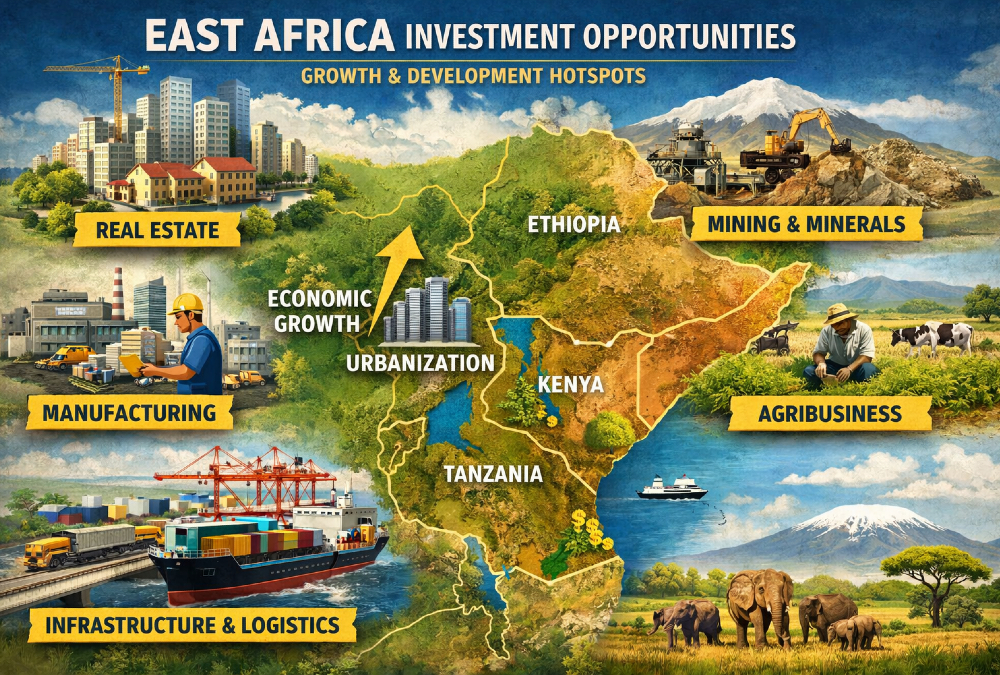
Real Estate and Urban Development
East Africa faces a multi-million-unit housing deficit, particularly in rapidly expanding urban corridors. The opportunity lies not in luxury developments but in affordable housing, mixed-use projects, worker accommodation, and commercial spaces driven by genuine demographic demand.
Population growth and rural-to-urban migration ensure sustained pressure on housing stock for the foreseeable future.
Manufacturing and Light Industry
Manufacturing represents less than 12 percent of GDP across most East African economies – well below the levels that characterized Asia’s industrial transformation. Food processing, packaging, building materials, and consumer goods production all offer margin expansion potential as local manufacturing gradually displaces imports.
Trade barriers and logistics costs create natural protection for well-positioned local producers.
Logistics and Industrial Infrastructure
Trade volumes are growing faster than supporting infrastructure can accommodate, creating immediate bottlenecks in warehousing, cold storage, industrial parks, and last-mile logistics. These are not speculative bets on future demand; they address current capacity constraints in economies where trade is already growing robustly.
Mining and Mineral Processing
East Africa’s mineral wealth – gold, tin, lithium, and various industrial minerals – is well documented. The emerging opportunity, however, lies less in extraction and more in processing, refining, and value addition.
Governments across the region are increasingly prioritizing local beneficiation over raw material exports, creating opportunities for investors with technical capabilities and processing infrastructure.
Agribusiness and Food Systems
Africa produces a significant share of global food crops yet captures only a fraction of the value chain. Post-harvest losses remain substantial due to inadequate storage and processing infrastructure.
Investments in cold storage, processing facilities, and distribution networks address inefficiencies that directly erode farmer incomes and food security while offering attractive unit economics for investors.
A Question of Timing, Not Risk Tolerance
The conventional framing of African investment as inherently high-risk overlooks a more nuanced reality. East Africa is not a bet on potential; it is a calculated entry into markets where economic fundamentals are improving measurably and where asset prices have not yet fully adjusted.
For Asian capital seeking yield and long-term growth beyond saturated home markets, East Africa represents a timing opportunity.
The region’s trajectory mirrors stages that Asian economies passed through decades ago – but with the advantage of modern technology, better governance frameworks, and integration into global value chains from the outset.
The question for sophisticated investors is not whether East Africa merits attention, but whether current market positioning allows them to capture value before pricing fully reflects the region’s evolving fundamentals. Those who enter strategically now, with rigorous due diligence and appropriate local partnerships, stand to benefit as markets mature and capital flows deepen.
The growth Asia once offered has not disappeared. It has simply moved – to markets where structural transformation is still unfolding, and where disciplined capital can still find asymmetric opportunity.
Lailla Mutajogera is an investor, entrepreneur, and CEO of Muta Investment Firm, a cross-border investment company with operations in Uganda, Rwanda, and Dubai. She specializes in connecting global investors with high-impact opportunities in African markets, focusing on commercial real estate, tourism, agribusiness, and asset management. Committed to practical, growth-driven investments, she champions projects that drive sustainable development across the continent.
