
Opinion
Ethiopia’s Quiet Industrial Leap Offers a Blueprint for Africa

By Dishant Shah
Ethiopia’s manufacturing surge reveals what economists often miss: successful industrialization isn’t about speed – it’s about sequence.
A headline slipped through global business pages recently without fanfare: “Ethiopia posts one of Africa’s fastest manufacturing growth rates as industrial parks fill up.” To most observers, it registered as just another quarterly data point.
But beneath that modest statistic lies a profound truth about economic development that the world has largely misunderstood.
Africa’s industrial story is not one of absent effort or lacking ambition. It is a story about the order in which societies choose to build capacity before pursuing efficiency – and why that sequence determines whether growth compounds or collapses.
Infrastructure First, Optimization Later
In Ethiopia, factories did not materialize because markets were suddenly liberalized or foreign capital arrived unbidden. They emerged because the state made a deliberate choice: invest heavily in roads, reliable power grids, logistics corridors, and basic worker housing first, then wait.
Accept years of modest returns. Build the foundation before erecting the structure.
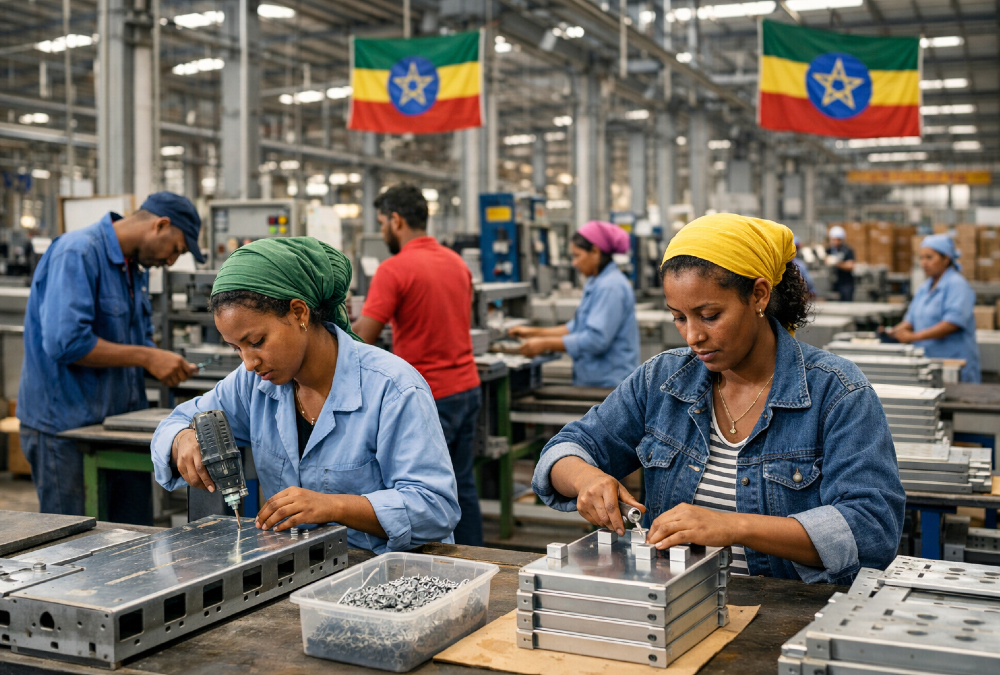
The results speak for themselves. Manufacturing’s share of gross domestic product (GDP), while still developing, has grown steadily. Exports of textiles and light manufactured goods have multiplied several-fold.
Most significantly, hundreds of thousands of first-generation industrial workers have transitioned into formal employment, creating an emerging industrial workforce where none existed a decade ago.
This trajectory matters because Africa’s core economic challenge has been systematically misdiagnosed. The conventional wisdom blames a shortage of entrepreneurship or insufficient capital. The real constraint is far more fundamental: coordination at scale.
The Hidden Costs of Underdevelopment
Consider the ground-level realities that shape African manufacturing. Over 60 percent of the continent’s population still lives in rural areas.
Logistics costs in many countries run two to three times higher than comparable Asian economies. Power outages routinely consume 5–10 percent of firm revenues annually – not as occasional disruptions, but as predictable operational expenses.
Under these conditions, efficiency reforms alone cannot unlock growth. Market liberalization means little when trucks cannot reliably reach ports.
Trade agreements deliver minimal value when electricity cuts out mid-production shift. The system itself must be substantially thickened before it can be meaningfully optimized.
What Informal Systems Reveal About African Organization
Yet there’s something that aggregate economic data consistently overlooks: African societies already possess sophisticated coordination mechanisms. They have simply developed outside formal institutional frameworks.
Across the continent, rotating savings groups mobilize capital where banks fear to tread. Community labor pooling accomplishes infrastructure projects that governments cannot fund.
Trust-based trade networks move goods across borders more efficiently than customs bureaucracies. What international observers label as “informality” is not disorder or chaos – it is adaptive organization emerging from conditions of scarcity.
When states align their development strategies with these existing social realities instead of importing foreign policy templates wholesale, scaling becomes achievable. The informal economy is not a problem to eliminate; it is a laboratory of proven coordination models waiting to be formalized and amplified.
The Uncomfortable Truth About Development Sequencing
Africa does not need to “catch up” by accelerating blindly. It needs to build in the correct order, even when that order appears counterintuitive to outside observers.
Roads before markets. Power infrastructure before productivity mandates. Workforce skills before technological sophistication. Basic logistics before just-in-time supply chains.
Countries that respect this developmental sequence often appear inefficient in quarterly reports and annual assessments. They are making investments that show modest initial returns.
They are prioritizing foundational infrastructure over immediate GDP bumps. They look slow.
But they are quietly constructing foundations that compound over decades rather than quarters – the kind of patient capital formation that transformed South Korea from an agricultural economy to an industrial powerhouse, or lifted China’s hundreds of millions into manufacturing employment.
Redefining What Progress Looks Like
The real question facing African industrialization is not whether the continent will develop modern manufacturing capacity and urbanize – demographics alone make that trajectory virtually inevitable. The question is whether global observers possess sufficient patience to recognize progress when it refuses to follow the exact paths laid down elsewhere.
Development is not a race to replicate. It is a process of building institutional muscle, coordination capacity, and productive infrastructure in an order that respects local conditions and existing social structures.
It requires accepting that what appears inefficient today may prove essential tomorrow.
Ethiopia’s filling industrial parks represent more than factory jobs created or export volumes increased. They represent a vindication of an alternative approach: that building the system comes before optimizing it, that infrastructure precedes efficiency, and that patient, deliberate foundations outlast shortcuts every time.
The manufacturing growth rates now emerging across Africa are not accidents. They are the compounding returns on years of investment in the unglamorous work of coordination: roads that function, power that flows, ports that operate, workers who arrive trained.
This is how industrialization actually happens. It has always been this way.
The only question is whether the rest of the world is watching closely enough to notice.
Dishant Shah is a partner at Legion Exim, a company specializing in facilitating the export of high-quality engineering products directly sourced from manufacturers in India to Africa. His areas of expertise include new business development and business management.
