
Opinion
Empathy Engineered: Uganda’s Solar Tents Offer Hope to the Displaced

By Des H Rikhotso
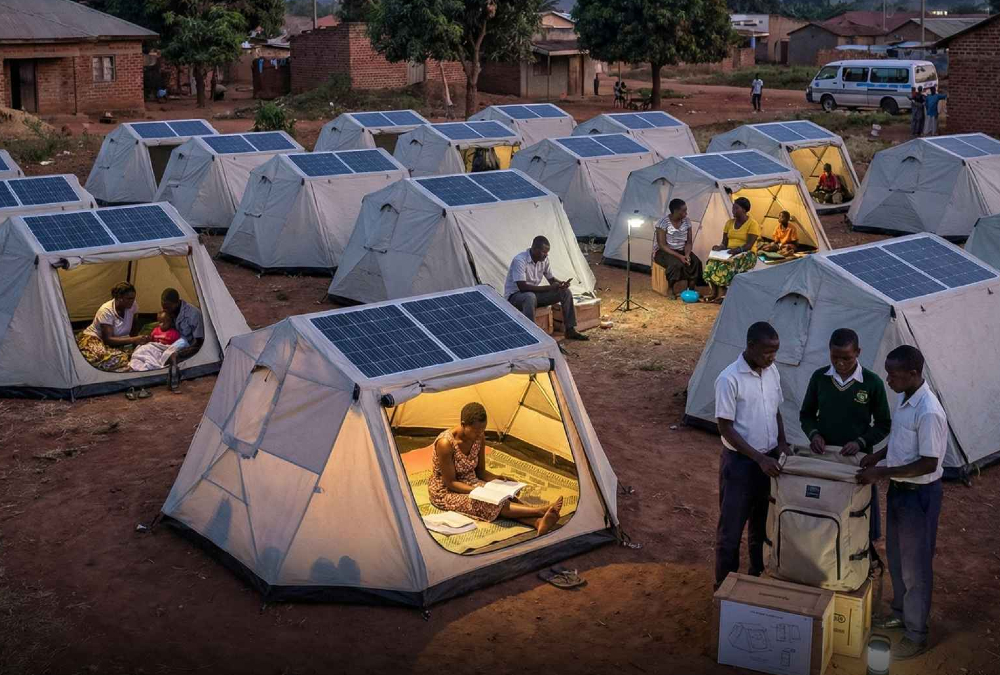
Ugandan students have engineered portable solar-powered tents that collapse into backpacks, offering homeless populations and displaced communities a dignified solution to one of humanity’s oldest problems.
The innovation economy typically obsesses over artificial intelligence, quantum computing, and the next smartphone iteration. Meanwhile, in Kampala, a group of engineering students has solved a more fundamental challenge: how to give shelter, light, and power to those who have none – and make it portable enough to carry on one’s back.
Engineering Empathy Into Design
Their invention – a solar-powered tent that folds into a functional backpack – represents a masterclass in appropriate technology. Unlike the bloated gadgetry that dominates tech headlines, this Ugandan innovation addresses an acute need with elegant simplicity.
Each unit unfolds into a waterproof dome embedded with flexible solar panels woven directly into the fabric. During daylight hours, the panels harvest enough energy to power an integrated LED light and a USB charging port – modest amenities that transform precarious existence into something approaching normalcy.
At night, the tent emits a soft glow. This isn’t merely aesthetic. For those sleeping rough, light means security, visibility, and the psychological comfort of defined personal space.
It signals occupancy. It deters opportunistic theft. Most importantly, it restores a measure of dignity that homelessness systematically strips away.
The Genius of Portability
What distinguishes this design from conventional emergency shelters is its radical portability. When collapsed, the entire system compresses into a lightweight backpack complete with shoulder straps.
No unwieldy frames. No auxiliary equipment. No logistical nightmare. For populations forced into constant movement – whether by economic desperation, climate disasters, or political displacement – this matters enormously.
The design philosophy mirrors the lives of its intended users: perpetually mobile, resource-constrained, vulnerable. Traditional relief tents require vehicles for transport and teams for assembly.
This solution requires only a human back and two hands.
This Ugandan invention challenges the prevailing narrative about where meaningful innovation originates. The world’s attention gravitates toward Silicon Valley’s latest disruptions, yet here is a solution born from proximity to real hardship, designed by students who understand their users not as market segments but as neighbors.
From Prototype to Lifeline
The students drew inspiration from Uganda’s street families and the swelling refugee populations across East Africa, communities exposed to torrential rain, scorching sun, and the constant threat of theft or violence. Their prototype marries recycled plastic fabric with flexible thin-film solar technology, deliberately sourced from local suppliers to minimize costs and maintain ethical production standards.
Several humanitarian organizations now distribute these solar tents across East Africa, where they have proven particularly valuable in regions grappling with climate-induced displacement, forced evictions, and sudden humanitarian crises. As extreme weather events multiply and conflicts drive more people from their homes, the demand for such ingenious, low-cost solutions will only intensify.
Rethinking Innovation
This Ugandan invention challenges the prevailing narrative about where meaningful innovation originates. The world’s attention gravitates toward Silicon Valley’s latest disruptions, yet here is a solution born from proximity to real hardship, designed by students who understand their users not as market segments but as neighbors.
Real innovation doesn’t always require steel and glass towers, venture capital, or semiconductor breakthroughs. Sometimes it demands only empathy stitched together with creativity – a backpack, a solar panel, an LED light, and the fundamental human desire to sleep with a little more peace.
In an era of exponential technological advancement, Uganda’s solar tent reminds us that progress isn’t always about doing more. Sometimes it’s about doing exactly enough, exactly where it’s needed most.
Des H Rikhotso (PgDip-BA, MBL) is a seasoned C-suite Multi-Industry business executive with 25+ years of Business Leadership Experience across the South, East and Western Sub-Sahara Africa Region. Based in Kampala, Uganda he serves as East Africa Region Business Executive, driving Business Strategic Growth and Operational Excellence – contributing his Leadership Voice and Clarity to the Region. Des has held Business Leadership roles at BMW Group Africa, Volkswagen Group Africa, Peugeot Motors South Africa, Toyota/Lexus South Africa, Nissan Group of Africa, G.U.D Holdings (Africa Exports Operations Division) and The HDR Group of Companies. He holds Under-Graduate and Post-Graduate business degrees from the University of the Western Cape, Wits University (Wits Business School) and the University of South Africa.
