
Opinion
Do you know that there are three Guineas in Africa? What are their differences?

By Godfred Zina
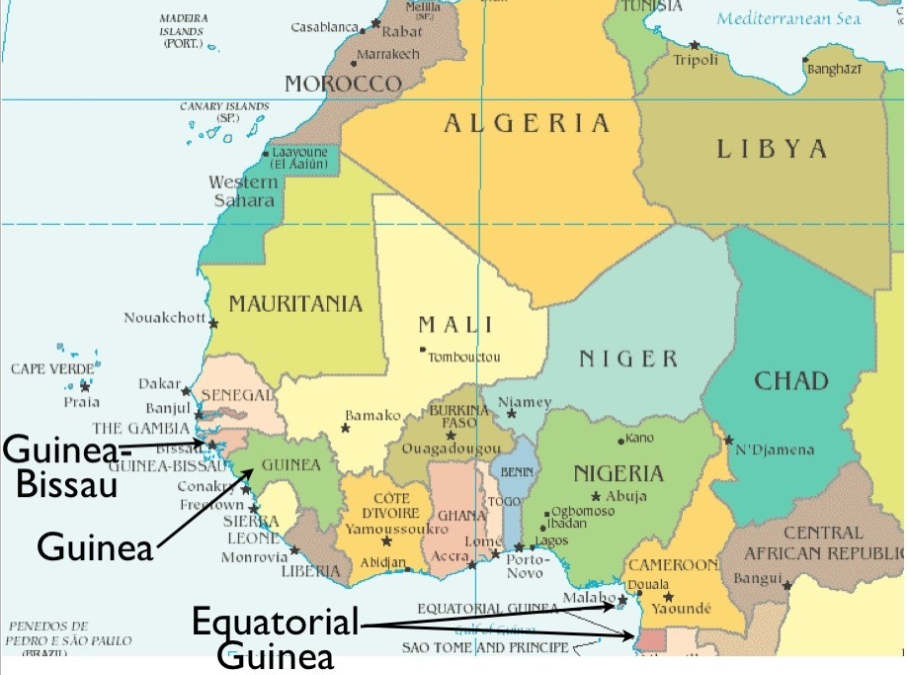
Many people often find it difficult to differentiate between Guinea-Conakry, Guinea-Bissau, and Equatorial Guinea due to their similar names. However, each country has a distinct history and identity.
The term “Guinea” is traditionally associated with coastal West Africa. During the colonial era, the region was divided among Spain, France, Britain, and Portugal. After lengthy struggles, these countries eventually gained independence.
To help distinguish between them, some include their capital cities in their official names. Let’s explore what sets each country apart.
Guinea-Conakry (The Republic of Guinea)
Located on the west coast of Africa, Guinea-Conakry gained its independence from France in 1958. With a rich cultural heritage and diverse ethnic groups, it remains a vibrant nation.
The country has a population of approximately 14 million, with more than 2 million people residing in its capital, Conakry. Guinea-Conakry spans an area of 245,857 square kilometers (94,925 square miles), and French is the primary language spoken.
The country’s political landscape has been marked by instability. In 2021, Colonel Mamady Doumbouya led a military coup, ousting President Alpha Condé. Since then, Guinea-Conakry has faced ongoing challenges in establishing a stable civilian government.
Despite its political difficulties, Guinea-Conakry has a wealth of natural resources that bolster its economy, particularly in mining. The country possesses diamonds, gold, and holds one-third of the world’s bauxite reserves. The World Bank estimated its gross domestic product (GDP) at approximately US$16 billion in 2022.
Guinea-Bissau
Previously known as Portuguese Guinea, Guinea-Bissau is a West African nation that gained independence from Portugal in 1973. It is situated to the north of the Republic of Guinea.
With a population of around 2.17 million people, Guinea-Bissau is considered one of the world’s poorest and most fragile states. Covering a land area of 36,125 square kilometers (13,947 square miles), it is slightly larger than Taiwan or Belgium. The country’s Atlantic coast features the Bijagós archipelago, a cluster of 88 islands.
Despite its small size, Guinea-Bissau is home to a diverse range of ethnic groups, languages, and religions. Political instability has been a recurring issue, with four successful coups and 17 attempted coups since independence. The current president, Umaro Sissoco Embaló, faces significant governance challenges, with poverty remaining a critical concern.
The poverty rate increased to 26.7 percent in 2023 from 26 percent in 2022, based on the international poverty line of US$2.15 per day. According to a 2021 World Bank report, Guinea-Bissau’s GDP stands at US$1.639 billion. The country’s main exports include coconuts and cashews.
Equatorial Guinea
Equatorial Guinea, located in Central Africa, gained independence from Spain in 1968. It is the only African country where Spanish is the official language. The name “Equatorial Guinea” is derived from its proximity to the equator.
The nation consists of a mainland region, Rio Muni, and five volcanic islands, including Bioko, which is home to the capital city, Malabo. The country has an estimated population of 1.7 million people in 2023 and covers a landmass of 28,051 square kilometers (10,830 square miles). It shares borders with Cameroon to the north, Gabon to the east and south, and the Gulf of Guinea to the west.
Equatorial Guinea’s economy is significantly influenced by its abundant natural resources, which include arable land, gold, uranium, diamonds, and columbite-tantalite. However, its substantial oil reserves are the primary driver of economic growth. The country’s economic activity is expected to expand by 4.7 percent.
Since gaining independence, Equatorial Guinea has only had two presidents: Francisco Macías Nguema, who ruled from 1968 to 1979, and his nephew, President Teodoro Obiang Nguema Mbasogo, who has been in power since he led a coup in 1979.
Although Guinea-Conakry, Guinea-Bissau, and Equatorial Guinea share similar names and colonial histories, they are distinct nations with unique characteristics. Understanding their individual backgrounds and current affairs helps clarify the differences and shed light on their unique identities within the African continent.
Godfred Zina is a freelance journalist and an associate with DefSEC Analytics Africa – a consulting agency specializing in the provision of accurate date and assessments on security, politics, investment, trade, and other risks within Africa. He is based in Accra, Ghana.
