
Opinion
Copy-Paste Farming: Why Western Tech Keeps Failing the Developing World

By Balbir Singh
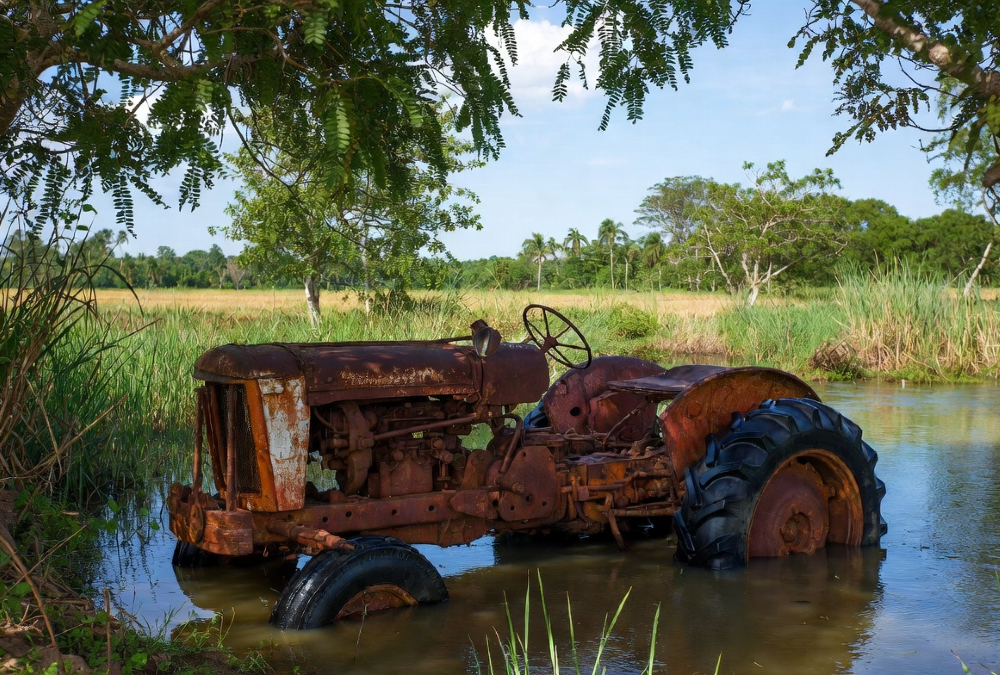
The rusting hulk of a 150-horsepower tractor lies submerged in a river in rural Kenya. A sophisticated pivot irrigation system, designed for the vast plains of Nebraska, sits abandoned in a West African forest, its metal skeleton slowly succumbing to tropical vegetation.
Across Asia, greenhouses built to European specifications stand empty, their climate-control systems long since cannibalized for parts. Welcome to the graveyard of well-intentioned but catastrophically misguided agricultural development.
These scenes are not anomalies. They represent a systematic failure that has plagued agricultural development in emerging economies for decades – a failure rooted in what might be called “copy-paste technology transfer.”
The pattern is depressingly familiar: international development experts arrive with glossy presentations, secure substantial funding, implement Western agricultural solutions with minimal adaptation, and depart before the inevitable collapse. Left behind are communities no better off than before, and often considerably poorer.
The Economics of Expert Fraud
The financial dynamics driving this disaster deserve scrutiny. Development projects routinely see budgets inflated by factors of twenty-five or more – not to accommodate local needs, but to fund luxury vehicles, inflated per diems, and shopping excursions masquerading as study tours.
The Toyota Land Cruiser Prado has become an unofficial symbol of development largesse, its presence in project budgets as predictable as its absence from actual fieldwork.
These so-called experts excel at navigating bureaucratic funding mechanisms while remaining remarkably ignorant of agronomic realities. They understand donor language and proposal formatting far better than soil composition or local labor markets.
The result is a perverse incentive structure where project approval and fund disbursement matter infinitely more than sustainable outcomes.
Rethinking Farm Mechanization
Consider mechanization, often touted as the cornerstone of agricultural modernization. The impulse to import the latest European or American equipment ignores fundamental realities.
A combine harvester designed for the deep, uniform soils of Iowa performs miserably in the varied terrain of sub-Saharan Africa. More critically, when such equipment breaks down – and it will – there are no technicians trained to repair it, no spare parts available locally, and no economic justification for maintaining the supply chain.
The solution is not to reject mechanization entirely, but to calibrate it to local conditions. This means prioritizing equipment that can be maintained with locally available skills and parts.
It means recognizing that manual operations, far from being backward, may represent the most economically rational choice given prevailing wage rates and technical capacity. A simple, repairable cultivator that farmers can fix themselves delivers more value than a sophisticated machine that becomes a very expensive lawn ornament after its first malfunction.
The Irrigation Illusion
Irrigation technology presents similar pitfalls. Drip irrigation and center-pivot systems represent engineering marvels – when deployed in appropriate contexts.
In regions blessed with abundant groundwater or surface water sources, however, these sophisticated systems often prove unnecessarily complex and fragile. Boreholes, check basins, and gravity-fed canal systems may lack technological glamor, but they align with local maintenance capacities and hydrological realities.
The criterion should not be “what’s most advanced?” but rather “what can be sustained?”
A manually operated system that farmers understand and can repair will outperform an automated marvel that mystifies its intended users.
The Greenhouse Gambit
Protected agriculture – greenhouses and controlled-environment farming – exemplifies technology transfer at its most delusional. These systems make economic sense only where premium markets justify the substantial capital and operating costs.
Yet development projects routinely install sophisticated greenhouse operations in areas where consumers cannot or will not pay premium prices for produce.
The logical progression should run from open-field cultivation to plastic mulching to simple tunnels, and only then – if market conditions warrant – to climate-controlled greenhouses. Skipping steps to showcase cutting-edge technology satisfies donor expectations while setting up farmers for failure.
Without the market infrastructure to support premium pricing, automated greenhouses become expensive white elephants.
Scale and Market Realities
Large-scale processing facilities and industrial farms suffer from similar strategic blindness. Development experts often design projects around production capacity while neglecting the more fundamental question: who will buy the output?
A cashew processing plant capable of handling thousands of tons annually means nothing if local production totals hundreds of tons and transportation infrastructure cannot economically access broader markets.
Starting small, testing market receptivity, and scaling gradually based on demonstrated demand represents basic business sense – yet this approach rarely features in development plans. The pressure to deploy large budgets and demonstrate “transformative impact” pushes projects toward grandiosity over sustainability.
The Input Trap
Agricultural inputs – seeds, fertilizers, and pesticides – present another arena where copy-paste approaches founder. High-input, high-output systems developed for industrialized agriculture make poor templates for smallholder farmers operating on thin margins.
When farmers become dependent on expensive imported inputs to maintain yields, they become vulnerable to price shocks and supply disruptions.
Beginning with locally adapted crop varieties, optimizing their performance through selection and agronomic refinement, and minimizing external input dependence creates more resilient farming systems. This approach lacks the dramatic before-and-after photos that donors love, but it builds genuine capacity.
Toward Genuine Development
Reforming agricultural development requires confronting uncomfortable truths. First, we must acknowledge that much of what passes for expertise in this field is little more than credential-wielding incompetence.
True expertise integrates technical knowledge with deep understanding of local contexts – soil types, climate patterns, market structures, cultural practices, and institutional capacities.
Second, we need project structures that reward long-term outcomes rather than short-term disbursements. This means extending project timelines, building in genuine pilot phases, and maintaining engagement through multiple growing seasons.
It means accepting that sustainable change proceeds incrementally rather than transformatively.
Third, development must center local farmers as decision-makers rather than passive beneficiaries. Farmers possess irreplaceable knowledge about local conditions and constraints.
Technologies succeed when they solve problems farmers actually face, not problems that look good in grant applications.
A Call for Humility
The graveyards of failed agricultural projects scattered across the developing world stand as monuments to hubris. They represent the costs of assuming that technology transfer is simply a matter of replication, that what works in Kansas will work in Kenya, that sophisticated equipment automatically generates sophisticated results.
Real agricultural development demands humility – the humility to start with manual systems before introducing mechanization, to test markets before building processing capacity, to work with local varieties before importing hybrids, to engage farmers as partners rather than pupils. It requires distinguishing between experts who drive Land Cruisers and those who understand land cultivation.
The choice before the development community is stark: continue the charade of copy-paste technology transfer with its predictable failures and wasted resources, or embrace the harder, slower work of context-appropriate development. The tractors in the rivers and greenhouses in the forests bear witness to decades of choosing the former.
Perhaps it is time we chose differently.
Balbir (Shekhawat) Singh, PhD, is a results-driven agribusiness techno-commercial professional with over 18 years of experience in sales, marketing, agronomy, product management, farming, commodity trading, and agri-inputs (fertilizers, seeds, agrochemicals). Passionate about advancing sustainable farming, he currently serves as Director General/CEO of Sodesep SA-Fertilizer Abuja, Nigeria. He has worked across emerging markets including India, Uganda, Kenya, Cameroon, Tanzania, Indonesia, and Nigeria.
