
Opinion
Bridging Africa’s Digital Divide: Airtel and Starlink’s Rural Connectivity Gamble

By Jean Claude Niyomugabo
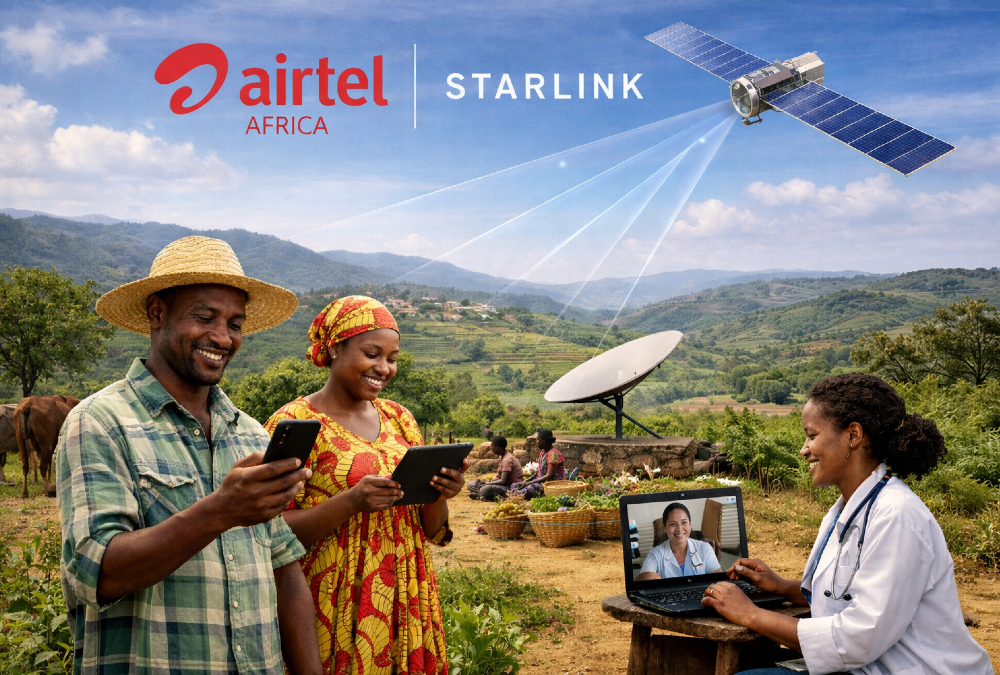
When Airtel Africa announced its partnership with Elon Musk’s SpaceX this week, it marked more than another corporate deal in the telecommunications sector. The agreement to deploy Starlink’s direct-to-cell satellite technology across all 14 of Airtel’s African markets represents a potential watershed moment for digital connectivity on a continent where hundreds of millions remain beyond the reach of reliable mobile networks.
Set to launch in 2026, the partnership will enable customers with compatible smartphones to connect directly to Starlink satellites in areas where traditional cell towers falter or simply don’t exist. The initial rollout will focus on text messaging and data for essential applications, but the implications stretch far beyond basic communication.
Airtel becomes the first mobile operator in Africa to embrace Starlink’s technology at this scale, a distinction that underscores both the magnitude of the continent’s connectivity crisis and the urgency of solving it.
The Last-Mile Problem
Africa’s telecommunications infrastructure has long grappled with a paradox: explosive growth in mobile phone ownership coupled with persistent coverage gaps that leave vast swaths of the population digitally isolated. Traditional cell tower deployment remains economically unviable in sparsely populated rural areas, creating a last-mile problem that has resisted conventional solutions for decades.
Satellite technology offers a way to leapfrog this infrastructure deficit entirely.
For rural communities and smallholder farmers who comprise the backbone of African agriculture, the transformation could be profound. Reliable connectivity in off-grid areas means access to real-time weather forecasts, current market prices, agricultural extension advice, digital payment systems, and emergency services without dependence on distant and unreliable cell towers.
These aren’t luxury features – they’re essential tools for economic survival and advancement in regions where information asymmetry has historically kept farmers trapped in poverty.
The ripple effects extend through entire value chains. Farmer cooperatives can coordinate more effectively. Supply chain logistics become more transparent and efficient.
Communities that have endured generations of digital exclusion gain entry points to the broader economy. When a farmer in rural Tanzania can check commodity prices before selling crops, or a health worker in remote Chad can access telemedicine resources, the practical impact transcends mere connectivity – it redistributes economic power.
The AI Acceleration Factor
Yet perhaps the most consequential dimension of this partnership lies in its potential to accelerate artificial intelligence adoption across African agriculture and rural services. Stable, widespread data access creates the foundation necessary for AI-powered tools to reach their intended users at scale.
Crop monitoring systems that leverage satellite imagery and machine learning, pest and disease detection algorithms that can identify threats before they devastate harvests, yield forecasting models that help farmers and governments plan more effectively, personalized advisory services delivered via mobile apps – all of these AI applications require consistent connectivity to function.
Without it, they remain pilot projects confined to well-connected demonstration farms rather than transformative technologies available to millions of smallholders.
Local agritech startups, which have proliferated across the continent in recent years but often struggle with infrastructure constraints, stand to benefit enormously. With reliable connectivity no longer a limiting factor, data-driven agricultural solutions become viable products rather than theoretical possibilities.
Governments and development partners gain new capabilities for deploying early-warning systems for climate shocks, improving resilience planning, and delivering services more efficiently to remote populations.
As next-generation satellites deliver progressively higher speeds, the technological ceiling continues to rise. What begins with text messaging and basic data access today could evolve into sophisticated AI-enabled platforms that fundamentally reshape agricultural productivity and rural economic development.
Challenges Ahead
None of this is guaranteed, of course. Satellite connectivity partnerships have promised transformative change before, and implementation challenges frequently undermine ambitious visions.
Device compatibility will determine how many existing smartphone users can actually access the service. Pricing structures will shape whether the technology reaches those who need it most or remains accessible only to relatively affluent customers.
Regulatory frameworks across 14 different markets may create obstacles or delays.
The political economy of telecommunications in Africa also introduces complications. Incumbent operators and equipment suppliers have vested interests in the status quo.
Governments balance revenue considerations against development objectives. Data sovereignty concerns persist, particularly around foreign-operated satellite networks handling sensitive communications.
Yet the fundamental logic of satellite-based mobile connectivity remains compelling. Traditional infrastructure models have had decades to solve Africa’s coverage gaps and haven’t succeeded.
The economics of cell tower deployment in low-density areas haven’t changed. Something different is required.
A Genuine Opportunity
What distinguishes this Airtel-Starlink partnership from previous satellite initiatives is its scale, its integration with an established mobile operator, and its timing. Starlink’s direct-to-cell technology is operational, not theoretical.
Airtel has 146 million customers across its African markets and the distribution networks to reach them. The broader technology ecosystem – from AI tools to digital payment platforms to agricultural apps – has matured to the point where connectivity can translate immediately into practical applications rather than waiting for complementary technologies to develop.
If executed effectively, this partnership has the potential not merely to close coverage gaps but to catalyze inclusive digital and AI-enabled economic growth across Africa. The emphasis must remain on “if” – telecommunications history is littered with overhyped announcements that failed to deliver promised benefits.
But the underlying opportunity is genuine.
For the hundreds of millions of Africans who have watched the digital revolution unfold elsewhere while remaining trapped on the wrong side of the connectivity divide, 2026 cannot arrive soon enough. Whether this partnership delivers on its transformative promise will depend on execution details that remain to be seen.
What’s already clear is that business-as-usual approaches haven’t worked. Africa’s connectivity challenge demands bold solutions. This partnership, at minimum, represents a serious attempt to provide one.
Jean Claude Niyomugabo is an entrepreneur and digital communication specialist with a strong passion for Africa’s development. He is dedicated to harnessing the power of social media to drive positive change and enhance livelihoods. With diverse interests and a strategic approach to digital engagement, he strives to create meaningful impact through innovation and connectivity.
