
Opinion
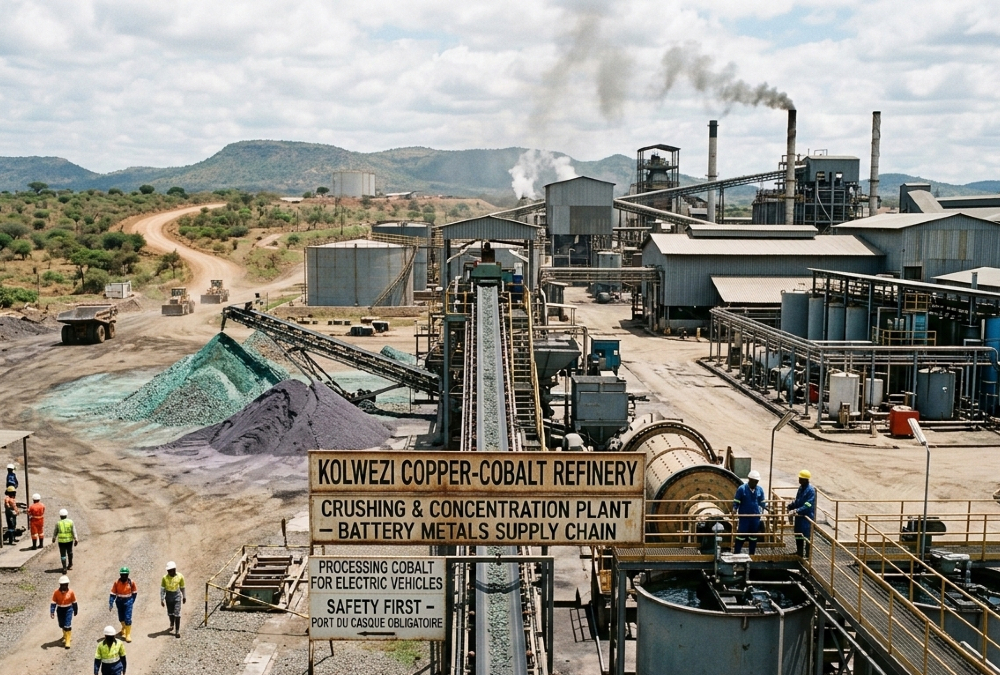
Beyond Extraction: The $16 Trillion Case for Processing Africa’s Minerals at Home

By Lailla Mutajogera
The continent sitting atop the world’s most coveted resources keeps exporting its wealth before it has a chance to build any.
Africa generates more than US$200 billion in mineral output every year. Copper, cobalt, lithium, manganese, gold – the raw materials powering the global energy transition and the digital economy flow from African soil in staggering volumes.
And yet, approximately 85 percent of those minerals leave the continent in their rawest, least profitable form, with the lion’s share of value-added returns captured by refiners, manufacturers, and investors thousands of miles away.
This is not simply a development-policy problem. It is, for the investor paying attention, one of the most consequential inefficiencies in the global commodities market – and it will not last.
The Case for Local Processing Has Never Been Stronger
For decades, the argument for African mineral processing remained theoretical, hamstrung by inadequate infrastructure, regulatory uncertainty, and a financing gap that scared off institutional capital. Those barriers have not vanished, but they have narrowed considerably.
What has changed is the convergence of three forces: surging global demand, more sophisticated government policy, and the cold mathematics of margin compression for raw-material exporters.
Copper, lithium, cobalt, and nickel – the quartet of minerals underpinning electric vehicles, grid-scale batteries, and renewable energy systems – are projected to generate an estimated US$16 trillion in cumulative economic value over the next 25 years. Africa holds a disproportionate share of the reserves.
If that ore is refined locally rather than exported raw, analysts estimate the continent could capture upward of 10 percent of that total. If it is not, the wealth transfer continues.
The margin differential alone makes the investment case compelling. Refined and semi-processed mineral products routinely command two to three times the price of their raw equivalents, while also attracting longer-term offtake contracts and deeper integration into global supply chains.
The investor who finances the smelter, the refinery, or the processing park is not simply capturing a margin – they are inserting themselves into a value chain that raw-material extraction never reaches.
Governments Are No Longer Passive Observers
Perhaps the most underappreciated shift in the African minerals landscape is the accelerating pace of policy reform aimed specifically at attracting value-added investment. Ghana, Zambia, Tanzania, Rwanda, and Nigeria have each introduced combinations of tax incentives, expedited licensing frameworks, and co-investment structures designed to make processing ventures commercially viable rather than merely aspirational.
Zambia and Tanzania have moved to digitize their licensing applications, compressing approval timelines from months to weeks – a meaningful reduction in the carrying costs and uncertainty that have historically deterred mid-market investors. Industrial parks purpose-built around mineral processing corridors are operational or under active development in several of these jurisdictions, reducing the infrastructure burden on private investors who might otherwise face the daunting prospect of building from a greenfield site.
The political logic behind these reforms is not hard to follow. Governments that have watched their mineral wealth leave in shipping containers for generations are increasingly aware that industrialization – not extraction – is what builds a tax base, creates skilled employment, and generates the economic stability that secures their own political futures.
That alignment of interest between sovereign governments and private investors is, historically, a reliable signal that policy frameworks will hold.
Where the Opportunities Are Concentrating
Not every African jurisdiction offers the same risk-adjusted profile, and sophisticated investors will do well to think in terms of mineral-country pairings rather than broad regional exposure.
Ghana’s gold and bauxite sectors are supported by established refining incentives and a relatively mature financial services ecosystem. Zambia remains the continent’s copper heartland, with industrial parks and streamlined licensing making it the most obvious entry point for investors focused on battery-supply-chain metals.
Tanzania offers an unusually diverse mineral portfolio – lithium, graphite, and rare earth elements – alongside a permit environment that has become noticeably more investor-friendly in recent years. Rwanda and Nigeria distinguish themselves through regulatory transparency and improving mineral-data infrastructure, reducing the due-diligence friction that has historically added cost and delay to entry.
Guinea, meanwhile, holds some of the world’s largest bauxite reserves and is actively pursuing state-backed processing partnerships that can provide downside protection for private capital.
The Strategic Imperative
The investors best positioned to capture value in this environment will not be those who treat Africa as simply the cheapest place to source raw tonnage. They will be those who engage government agencies early, build genuine local partnerships across the industrial, logistics, and refining value chain, and orient their business models toward finished or semi-finished exports rather than raw commodities.
Africa’s mineral story is undergoing a structural rewrite. The old model – extract, export, repeat – is facing pressure from above, through government policy, and from below, through the economic logic of a world that is paying ever-higher premiums for processed, traceable, sustainably sourced materials.
The window for investors to position themselves on the right side of that transition is open. It will not remain so indefinitely.
The question, ultimately, is not whether Africa’s minerals will be processed locally. It is whether the investors who finance that processing will be the ones who recognized the opportunity early – or those who arrived after the margins had already been claimed.
Lailla Mutajogera is an investor, entrepreneur, and CEO of Muta Investment Firm, a cross-border investment company with operations in Uganda, Rwanda, and Dubai. She specializes in connecting global investors with high-impact opportunities in African markets, focusing on commercial real estate, tourism, agribusiness, and asset management. Committed to practical, growth-driven investments, she champions projects that drive sustainable development across the continent.
