
Opinion
Beyond Aid: How a River Could Reshape West African Trade
By Gregory September
Regional cooperation just got real. Landlocked Mali can now reach the Atlantic.
For landlocked nations, geography is often destiny. Mali, nestled deep in West Africa’s interior, has long grappled with this reality.
But a transformative infrastructure project is poised to rewrite the rules: the Senegal River is becoming an economic corridor that could fundamentally alter Mali’s trade geography and offer a blueprint for regional integration across the continent.
This is not about aid. This is about strategic infrastructure investment and multilateral cooperation that addresses structural constraints head-on.
A River Becomes a Lifeline
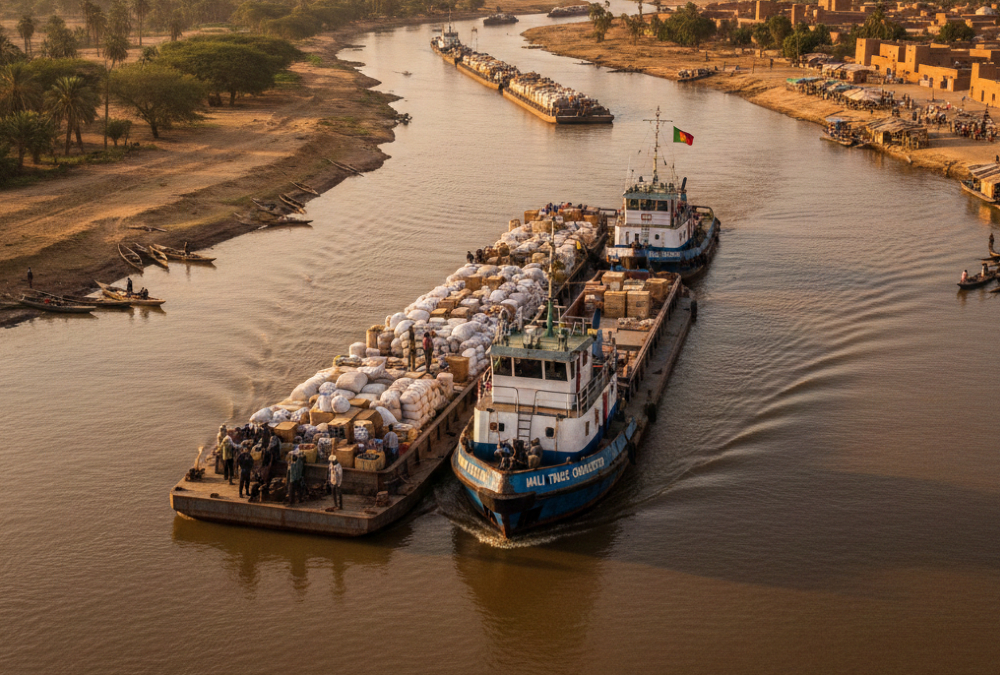
The Senegal River is jointly managed by Mali, Senegal, Mauritania, and Guinea under the Organisation pour la Mise en Valeur du Fleuve Sénégal (OMVS) governance framework. The ambitious navigation project aims to connect Ambidédi in Mali to Saint-Louis in Senegal – a distance of nearly 900 kilometers (560 miles).
If operational, this waterway could fundamentally reshape how Mali accesses global markets.
For decades, Mali has relied heavily on road corridors to move goods to coastal ports. Road freight, however, is expensive. Delays are common. Security risks drive up insurance premiums.
The economics are punishing for a country whose exports – gold, cotton, iron ore, and agricultural products – compete in price-sensitive global markets.
Water transport changes the equation entirely. Inland waterway shipping is globally recognized as one of the lowest-cost freight modes, often significantly cheaper than road or rail for bulk commodities.
For Mali, this could mean transformed trade economics.
What This Could Mean for Mali’s Economy
The potential benefits are substantial and multifaceted:
Diversified export routes. No longer entirely dependent on single corridors through neighboring countries, Mali gains strategic flexibility and bargaining power.
Stronger mining logistics. Mali is Africa’s third-largest gold producer. Lower transportation costs could improve profit margins and attract additional investment in the extractive sector.
Reduced bulk transport costs. Gold, cotton, iron ore, and agricultural goods move far more economically by river than by truck, improving competitiveness in international markets.
Deeper regional integration. Shared infrastructure creates interdependence that can strengthen diplomatic and economic ties across West Africa.
Agricultural market expansion. Smallholder farmers and agricultural exporters gain access to previously unreachable markets at viable costs.
The Challenges Ahead
Yet this is not automatic growth. The success of the Senegal River corridor depends on several critical factors:
Port efficiency at Saint-Louis and other terminals will determine whether the waterway actually accelerates trade or simply relocates bottlenecks. Dredging quality must be maintained year-round to ensure navigability for commercial vessels.
Security stability along the river corridor is essential – instability anywhere along the 900-kilometer (560-mile) route undermines the entire system. Seasonal water levels, influenced by rainfall patterns and climate variability, could limit operational consistency.
Finally, cross-border coordination among four sovereign nations requires sustained political will and bureaucratic cooperation.
These are not trivial obstacles. Infrastructure projects across Africa have frequently underdelivered due to poor maintenance, governance failures, or inadequate complementary investments.
The Senegal River project will only succeed if all four OMVS member states maintain their commitments beyond ribbon-cutting ceremonies.
Infrastructure Diplomacy in Action
This is what infrastructure diplomacy looks like when it works. Not rhetoric, but concrete cooperation on shared economic interests.
Ghanaian President John Dramani Mahama has argued persuasively that no African country can survive in isolation. While the Senegal River project predates his recent remarks, it embodies precisely this philosophy.
Regional cooperation lowers structural constraints that individual nations cannot overcome alone. Landlocked does not have to mean locked out of global trade – if neighbors work together.
The project directly advances three United Nations Sustainable Development Goals.
SDG 9 (Industry, Innovation, and Infrastructure) is addressed through resilient infrastructure that lowers costs and expands productive capacity.
SDG 8 (Decent Work and Economic Growth) benefits as trade corridors stimulate employment in logistics, mining, and agriculture.
SDG 17 (Partnerships for the Goals) is realized through multilateral river governance that enables shared growth across borders.
The Bigger Question for Africa
The Senegal River corridor raises a provocative question for African development strategy: if inland waterways can reduce trade costs so dramatically, should the continent invest more in rivers than roads?
Africa has invested heavily in road infrastructure over the past two decades, often with support from China and other external partners. Roads are essential, but they are also expensive to build and maintain, vulnerable to security disruptions, and relatively costly for bulk freight.
Many of Africa’s major rivers – the Congo, the Niger, the Zambezi – remain underutilized as commercial arteries despite their potential.
The economics are compelling. Water transport typically costs 40-60 percent less than road transport for equivalent distances.
Rivers require less energy per ton-kilometer than any other transport mode. And unlike roads, which degrade rapidly under heavy truck traffic in tropical climates, rivers are self-maintaining natural infrastructure.
Yet rivers also present challenges. They require significant dredging investment, their navigability fluctuates seasonally, and they often cross multiple national borders, creating governance complexities.
The OMVS framework demonstrates that these challenges can be managed, but it requires sustained political commitment.
A Test Case for Regional Integration
The Senegal River navigation project is ultimately a test case for whether African regional integration can move beyond aspirational declarations to concrete economic transformation. If Mali can reliably move its exports to the Atlantic at competitive costs, other landlocked nations will take notice.
If the four OMVS countries can maintain effective joint governance of the waterway, it will provide a model for other shared river systems across the continent.
The stakes extend beyond Mali’s economy. Successful regional infrastructure cooperation could demonstrate that African countries can solve their own development challenges through mutual investment and shared governance, reducing dependence on external aid and debt-financed megaprojects.
For now, the Senegal River project remains a work in progress. But if it succeeds, it may prove that for landlocked African nations, rivers can be highways – and cooperation can be infrastructure.
Gregory September is a South African academic, author, and geopolitical analyst with extensive experience in government and Parliament. He is the founder and CEO of SAUP (Sustainability Awareness and Upliftment Projects NPC), which focuses on sustainability education and community development. He previously served as Head of Research and Development for the Parliament of South Africa. His work centers on sustainability, African geopolitics, and economic development, and he regularly contributes to analysis of global political and economic affairs.
