
Opinion
Are burial scenes centers of political fortunes?
By Hilda Imali Ngusale
The thought of death stings deep in the hearts and minds of loved ones but it does different things to those seeking political fortunes.
In Kenya, a common narrative of declaring political stands in funerals has emerged. Funerals are no longer somber atmospheres for reflecting on the life of the dead but rather parlors of enticing the masses.
Back in the day, when Africa was pre-colonialized, death used to be a passage that procured solemnity, sorrow and a possible reflection of life after the grave.
The guilt and sense of respecting a departed soul was a serious ordeal. “Bad things” would be pronounced to those who even dared not to be sad.
Mourning was exceptionally important so much so that women, who were professional in screaming and wailing, were always encouraged to be engaged in funerals.
There were cultural expectations like shaving of hair, killing of goats, cows and, maybe even, chickens in memory of the dead.
Drinking alcohol and other local brewery, to appease the ancestors, were also entertained. Rice and stew would be plentiful in funeral events thereby mimicking the RSVP expectations imported to the world by the French.
Nearly 6 decades later, burial scenes have evolved and mutated exponentially. Nowadays, burial scenes are westernized with a myriad of practices.
The corpses of the deceased are bought expensive new suits, ties and state of the art caskets so that they can lie in state perfumed with costly splendor. They are then photographed with mourners used as props so as to exhibit the sad ordeal.
There is also another practice of revering the dead through poetry, songs, dances and, even in some cases, documentaries in honor of their departure.
Videos are made so that the family of the dead can be captured. The only challenge is that the such documentary makes very little sense if the corpse was neither wealthy, famous, politician nor the center of attraction to those seeking political mileage.
Indeed, death in Kenya is a political business with a focus on profit. A business that can be explained as too glib, too sudden and too political. To empahasize the words of Jean Jacque Rossuoe, “It is a natural right!”
Tragically, if the number of the dead is colossal, then the funerals become media-focused for storytelling and the masses become emotional and the government becomes responsible. Seemingly there is more recognition for the dead than those who are living.
Therefore, it would not be much of a surprise if the Kenyan government decided to form a Ministry for the dead and hire a ghost minister who would be paid by the Kenyan taxpayers.
Painstakingly, the general response accorded to death is conveniently lost in commercialization and politicization. Burial scenes in Kenya have turned out to be perfect for opportunists whose eyes are fixed on minting millions. An interesting moral disposition for a country that is heavily indebted.
To be specific every Kenyan currently owes approximately Ksh115,690 (equivalent to US$$1,166.90) to international lenders, such as China, who granted the government debt.
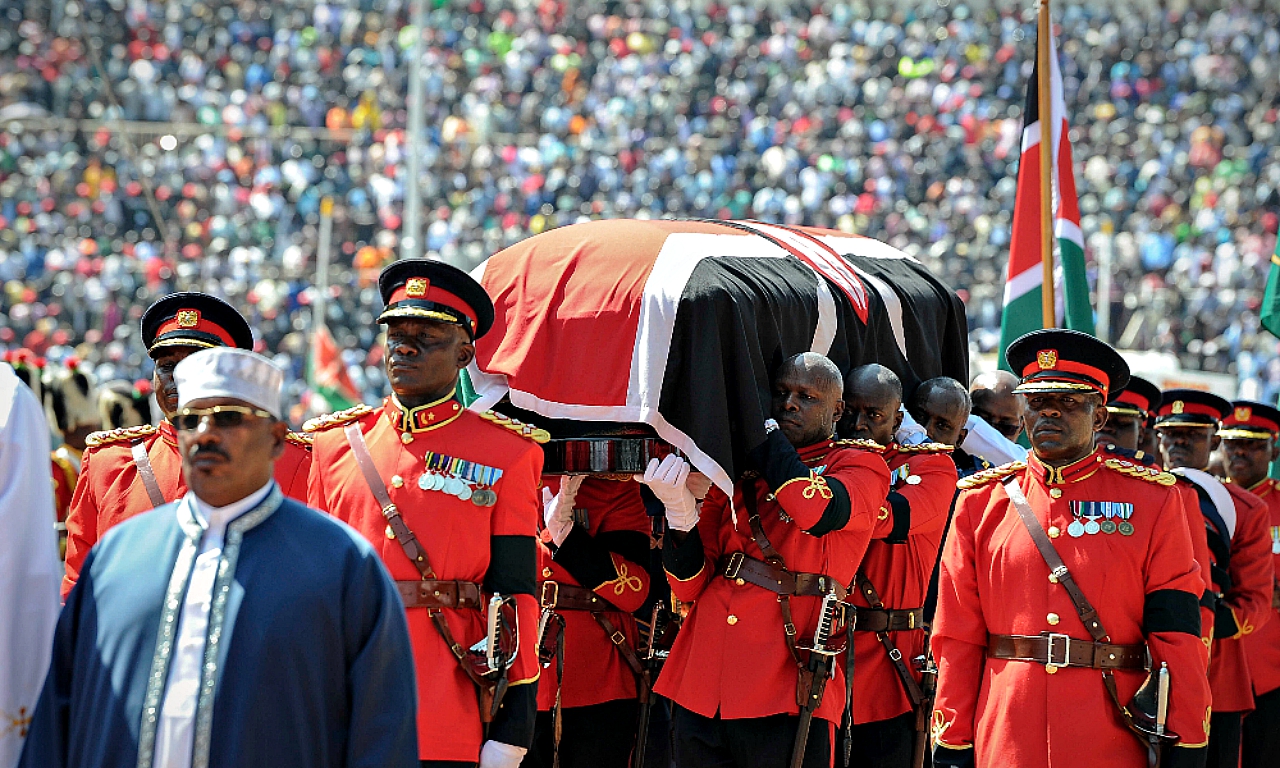
With this in mind, the government of Kenya made no apologies for lavishly spending Ksh300 million (US$3 million) on the late President Moi’s funeral. Money spent to perhaps serve as a permanent reminder that authoritarian long-serving presidents, who ensure that they are wealthier after their reign, die prosperously.
The gigantic expenditure remitted to his funeral speaks more than what is untold. An enormous price to pay in the wake of increased taxes, abysmal government service provisions and potential strikes by teachers and nurses over lackluster pay -increments (or lack thereof).
Arguably, the government of Kenya knows when and how to prick the national budget. As of the end of June 2019, Kenya’s public debt was slightly above Ksh6 trillion (US$ 60 billion).
This debt was procured to fan President Uhuru Kenyatta’s Big Four agenda which, ironically, seeks to reduce mortality rates by increasing the taxes of poor Kenyans.
Economically speaking, it is disturbing to imagine that US$3 million can be spent by the national government to give a former billionaire president a befitting send-off.
Perhaps it’s a silent conspiracy to encourage more dictators to stay in power long enough so as to enjoy such a costly funeral.
Notwithstanding, the pomp, dance and a convenient holiday came packaged with the burial that was not restricted.
Politically speaking, former President Moi’s death, and that of future famous politicians, will remain appealing to a few elites who gain political mileage and are remunerated heavily to be seen by the ordinary citizen.
The treatment of death as a political scene is not only a game of political big wigs but also a sensation to journalists who are compensated to tell bad stories about our society.
Perhaps by becoming a post-colonial dependency which returns Africa and, by extension, Kenyans to happy slaves, there is a begotten social contract for black people.
It seems that there is an unwritten contract which reads that black people, in particular Kenyans, should only place value on what the politicians claim that they are doing for the people and the country – besides refusing to pay tax. Therefore, when the politician dies it is expected that the country should be devastated for losing someone so important.
Perhaps that explains why burial scenes are political platforms for many of Kenya’s politicians.
Hilda Imali Ngusale is an International Relations PhD student at the United States International University-Africa passionate about changing the African stories.
Umaizi © Copyright 2020
