
Opinion
All aboard the Luanda express
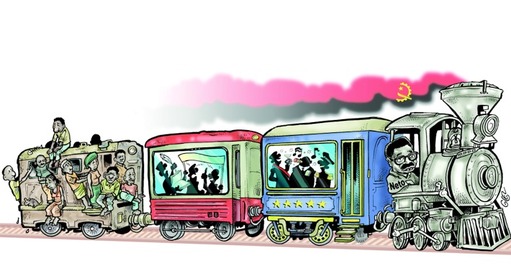
Then as we walk down the corridor, it gets rowdier and the compartments are more crowded. We come to standard class, where we find the middle classes and professionals in an increasingly critical mood. Their arguments are fuelled by grilled fish, a smattering of spicy gindungo and bottles of cold beer.
Holding court in one well-used standard compartment we find the opposition parties. Their top officials are middle-class and middle-aged. They are led by the biggest pretender to power, the União Nacional para a Independência Total de Angola (UNITA). Since Savimbi’s death in 2002, UNITA has been plagued by internal divisions – resulting in the defection of Abel Chivukuvuku.
Chivukuvuku, a charismatic orator, led the Convergência Ampla de Salvação de Angola-Coligação Eleitoral in last year’s parliamentary elections and got eight deputies elected to parliament. UNITA doubled its take to 32 deputies. UNITA and other historic parties have tried to challenge the government in the courts. They have won the odd victory.
In the last elections, they forced electoral commission president Suzana Inglês to resign after they demonstrated the legal flaws in her appointment. A few carriages down, still in standard class, the political arguments get louder and more determined. Here we find impatient young activists who vent their frustration through street protests. That unsettles the first-class carriage. From there, the presidency has ordered a clampdown on such demonstrations.
Virtual free speech
But it cannot shut down the dissidents. Young Angolans talk freely on social media, questioning why their reality is often at odds with the ideals proclaimed by the politicians. Seventeen-year-old activist Nito Alves has become a cause célèbre after the police detained him in September for trying to print T-shirts with slogans critical of Dos Santos.
Our standard-class activists, however, are confined to the large cities. The interior is firmly under the control of the provincial governors, appointed by Dos Santos. According to the constitution, there should be local elections, but officials tell us the conditions are not right. And finally we come to the third class compartments, where the noise is intense.
There is no water in the taps, and the electricity flashes on and off. The menu is that great Angolan staple, funje, eaten with beans stewed in palm oil, washed down with a soda. This is where the vast majority of Angolans are. The Voice of America has a popular phone-in program. Unusually for a program in Angola, you hear the grievances of people in the interior as well as those in the cities.
