
Opinion
All aboard the Luanda express
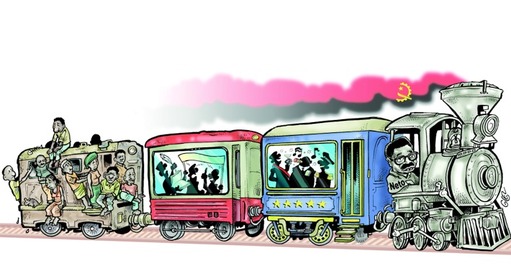
Leaders never miss an opportunity to remind us of the positive changes since the end of the civil war in 2002. Take a ride on the train to hear Angolans’ differing views. For a country that has been wracked by war for more than four decades, first the nationalist campaign against the colonial rulers and then a civil war fueled by the geopolitics of the Cold War, the coming of peace has indeed changed our reality.
Our people travel around the country without difficulty. And to help them, there are three main railway lines. The most important of these lines is the Caminho de Ferro de Benguela, which is being restored with Chinese investment and labor. Once completed, the Benguela line will link Angola to the mineral-rich Katanga Province in southeastern Democratic Republic of Congo and the Copperbelt of Zambia.
This long-awaited railway line should symbolize a new era of economic and political cooperation. But our shiny new trains have also come to symbolize a wider predicament. Angola itself is like an express train – but on a far longer journey than any of us could have imagined. Our national train’s destination was described by the leaders who led the struggle against the colonialists.
Agostinho Neto, Jonas Savimbi and Holden Roberto – in spite of how they led their troops and political cadres – all spoke of a country that would be wealthy, democratic and with a firm commitment to social and economic justice. Our political leaders often repeat these ideals as if we all need reminding of where we are meant to be travelling. And, as the train clatters down the tracks, it seems that we are travelling in very different conditions.
The select few
There is the first-class carriage where President José Eduardo dos Santos, who has been in power since 1979, remains at the centre of a powerful network of patronage. Dos Santos believes that Angola should have an indigenous entrepreneurial class that is able to compete on a global scale.
A select few travel in the luxuriously appointed first-class compartments, where Cristal champagne and dainty smoked-salmon hors d’oeuvres are served up on starched white tablecloths.The passengers stay close to the ruling Movimento Popular de Libertação de Angola (MPLA); they seize the opportunity to make serious fortunes. The business and political elite belong to the same club.
