
Opinion
Agro-Industrialization Is the Foundation of Sovereign Power

By Victory Azimih
The next global crisis will not originate in financial markets. It will begin in the world’s food systems.
Nations that cannot feed themselves are not truly sovereign. They are structurally exposed – and in the 21st century, structural exposure is not merely a humanitarian concern.
It is a geopolitical one. For Africa to realize its full potential, the continent must make a decisive shift: from passive participation in global agriculture to commanding agro-industrial dominance.
This is not a conversation about development. It is a conversation about power.
Food Security Is National Security
Every serious government understands energy security. Far fewer treat food security with the same strategic urgency.
They should. Food imports drain foreign currency reserves. Food-driven inflation destabilizes currencies and erodes purchasing power. Food shortages ignite social unrest. And the fiscal distortions caused by subsidy programs compound these pressures into long-term structural fragility.
When a nation relies heavily on imported staples, it does not merely import food – it exports sovereignty. This is not ideology. It is macroeconomics. A country that controls its own food systems controls:
- Inflation dynamics
- Foreign exchange stability
- Rural employment
- Political resilience
- Social cohesion
Food security, in other words, is economic armor. The nations that recognize this earliest will be the ones best positioned to weather the instability that defines our era.
The Silent Drain of Raw Commodity Exports
Africa produces. Others process. This structural imbalance is among the continent’s most costly inefficiencies – and one of its least discussed.
Every time a raw commodity leaves African shores without value addition, three things happen simultaneously: jobs are exported, margins are exported, and currency strength is exported.
Raw commodity dependency is not merely inefficient. At scale, it becomes a form of economic self-sabotage – not intentional, but structural.
And structure, far more than policy rhetoric, is what determines a nation’s trajectory. Africa’s agricultural abundance should be the foundation of industrial wealth.
Instead, it is too often the raw material for someone else’s.
Processing Is Power
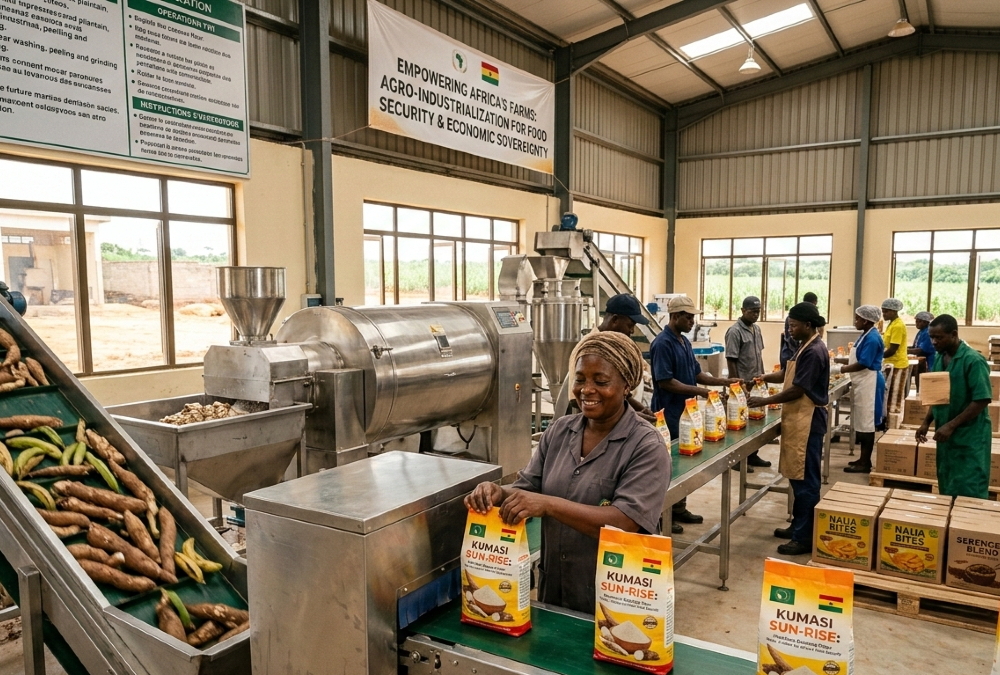
Agro-processing is not simply about feeding populations. It is about retaining capital. When processing occurs domestically, the economic effects are transformative and compounding.
Local suppliers scale up. Logistics networks expand. Packaging industries emerge. Financial services deepen to serve new industrial customers. Demand for skilled labor rises, pulling wages upward.
A single processing facility does not create impact in isolation. It triggers industrial ecosystems. This is how nations industrialize – cluster by cluster, sector by sector, each node reinforcing the others. The logic is not linear. It is exponential.
The Five-Cluster Compounding Model
Serious agro-industrialization is not about building a single plant. It is about designing compounding industrial clusters that reinforce one another across the entire value chain.
A strategic five-cluster model might be structured as follows:
- Primary aggregation and storage
- Processing and refinement
- Packaging and branding
- Logistics and cold-chain systems
- Export and regional trade distribution
Each cluster reinforces the others. Storage infrastructure reduces post-harvest losses – a persistent and staggering drain on agricultural output across the continent.
Processing captures value that would otherwise be surrendered to foreign manufacturers. Logistics enables regional trade at competitive scale.
Branding builds pricing power, allowing African producers to command premium positions in global markets rather than accepting commodity prices.
The GDP impact of this model does not add – it compounds. One cluster creates revenue. Five integrated clusters create economic gravity, attracting further investment, talent, and trade.
Foreign Exchange Stability Through Domestic Value Capture
Foreign exchange volatility is one of the most frequently cited risks in African markets, and with good reason. But the underlying driver of that volatility is import dependence.
Nations that rely on external sources for basic food staples are perennially exposed to global price shocks, shipping disruptions, and the geopolitical leverage of supplier countries. Domestic value capture through agro-industrialization is not just an industrial policy – it is a currency strategy.
Building the capacity to produce, process, and distribute food at home is one of the most direct interventions available to reduce structural FX fragility. It is also among the most durable.
The Reckoning Ahead
The geopolitical realignments of the coming decades will be shaped, in no small part, by which nations have solved the food security equation and which have not. For Africa, the imperative is clear: agro-industrialization is not a sector strategy.
It is a sovereignty strategy. The continent’s leaders, investors, and policymakers would do well to treat it as such – before the next crisis makes the lesson unavoidable.
Victory Azimih is a visionary entrepreneur and global investment consultant specializing in Africa’s economic growth and industrial transformation. As the CEO and founder of Azeemi Global, he leads a pioneering firm dedicated to accelerating the continent’s development through cutting-edge technology and infrastructure solutions. Under his leadership, Azeemi Global focuses on harnessing the potential of artificial intelligence, blockchain, and smart infrastructure to unlock sustainable investment opportunities across Africa. Based in Lagos, Nigeria, Azimih is at the forefront of driving Africa’s future as a hub of innovation and industrialization.
