
Opinion
AGOA’s Renewal: Why Kenya’s Celebration May Be Premature

By Sheena Raikundalia
US President Trump’s decision to extend the African Growth and Opportunity Act through December 2026 has sparked jubilation in Nairobi. But beneath the champagne toasts and optimistic headlines lies a troubling question: After 25 years of preferential access to American markets, why is Kenya still celebrating scraps from Washington’s table?
Understanding AGOA: A Primer on America’s Trade Favor
The African Growth and Opportunity Act (AGOA), signed into law in 2000, grants eligible sub-Saharan African countries duty-free access to U.S. markets across more than 1,800 product lines. On paper, it represents a significant opportunity for economic development.
In practice, it has become a case study in the limitations of trade policy built on dependency rather than partnership.
The arrangement requires annual eligibility reviews, with Washington scrutinizing whether African nations adequately promote market-based economic policies, eliminate barriers to U.S. trade and investment, and meet governance and human rights benchmarks. This isn’t a negotiated trade agreement between equals – it’s a unilateral preference that can be modified or revoked at America’s discretion.
The Silver Lining: Jobs and Export Growth
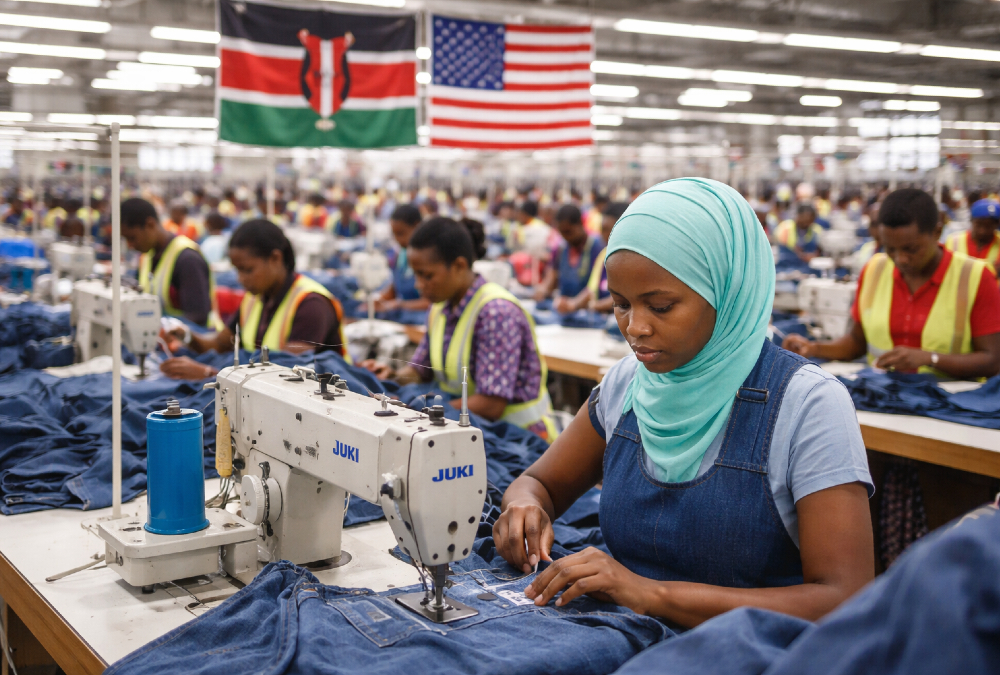
To be fair, AGOA has delivered tangible benefits for Kenya. The country has emerged as one of the program’s leading apparel exporters, with recent figures showing approximately Ksh60.6 billion (US$470 million) in apparel exports annually.
The sector employs more than 66,000 workers in formal jobs and has posted impressive 19 percent year-on-year growth.
Across the African continent, AGOA-eligible exports have diversified to include apparel, automotive components, and select agricultural products. Exports have grown. Jobs have been created. For workers and their families, these are real achievements that shouldn’t be dismissed.
Countries that have successfully industrialized didn’t do so by optimizing for preferential access to foreign markets. They did so by building domestic capacity, protecting infant industries during critical development phases
The Precarious Nature of Preferential Access
Yet AGOA’s structure reveals its fundamental weakness: access depends entirely on Washington’s political calculations. The history is instructive and sobering.
In 2018, Rwanda saw its apparel benefits suspended after imposing tariffs on imported used clothing – a policy decision made collectively by the East African Community to protect local textile industries. South Africa has faced repeated scrutiny over anti-dumping duties on U.S. chicken imports, with AGOA access dangling as leverage in the dispute.
Mali and Guinea lost eligibility following military coups, regardless of the economic consequences for their populations.
These aren’t hypothetical risks. They are documented instances of African countries learning that AGOA access comes with invisible strings attached, strings that can be pulled tight whenever political winds shift in Washington.
The Uncomfortable Comparison: Bangladesh’s Different Path
Here’s where Kenya’s celebration rings particularly hollow. Consider the divergent trajectories of Kenya and Bangladesh over the past quarter-century.
Bangladesh, leveraging preferential trade arrangements with the European Union comparable to AGOA, has developed an apparel industry valued at approximately US$45 billion, characterized by substantial value addition and strong vertical integration. The sector employs about four million workers across a complete value chain that includes spinning, weaving, dyeing, and finishing.
Perhaps most importantly, Bangladesh has diversified its export markets globally, reducing vulnerability to any single trading partner’s political whims.
Kenya, by contrast, has built a US$470 million export-dependent assembly operation. The sector employs about 66,000 workers, predominantly in cut-make-trim assembly operations that require minimal skill transfer or technological development.
The industry relies heavily on imported fabric and remains overwhelmingly focused on the U.S. market.
The comparison is stark: Bangladesh developed industrial depth, input production capacity, vertical integration, and market diversification. Kenya developed dependency.
The Real Cost of Preferential Treatment
Twenty-five years after AGOA’s inception, Kenya and other African beneficiaries face an uncomfortable reckoning. Yes, exports grew. Yes, jobs were created. But at what cost to long-term industrial development?
Preferential access created perverse incentives. Why invest in developing local textile production when duty-free access to American markets made it cheaper to import fabric?
Why diversify into new markets when AGOA made the U.S. market artificially attractive? Why build genuine industrial capacity when assembly operations could capture available benefits with minimal investment?
AGOA didn’t just fail to encourage industrial depth – it actively discouraged it by making shallow integration economically rational in the short term.
Kenya and its African neighbors should view AGOA’s extension not as cause for celebration but as a final opportunity to ask whether dependency dressed up as development opportunity is really worth toasting.
A Quarter-Century of Missed Opportunities
The tragedy isn’t that AGOA exists. Trade preferences can serve as useful initial catalysts for economic development.
The tragedy is that 25 years later, African countries are still treating preferential access as an achievement rather than recognizing it as the temporary training wheels it was meant to be.
Bangladesh learned to ride the bicycle and then modified it into a motorcycle. Kenya is still waiting for someone to push the bike along, celebrating each time Washington agrees not to let go.
Beyond Celebration: What Kenya Should Demand
Rather than celebrating AGOA’s extension, Kenya’s leaders should be asking harder questions: why, after 25 years, do we still lack domestic fabric production capacity?
What prevented us from requiring AGOA-benefiting firms to invest in skills transfer and technology development? Why didn’t we use preferential access as a bridge to building genuine industrial capacity rather than an end in itself?
And most critically, what will we do differently over the next few months to ensure we are not having this same conversation when AGOA comes up for renewal again?
The extension to December 2026 isn’t a victory – it’s borrowed time. The question is whether African leaders will use it to build genuine economic independence or whether they will spend it lobbying for yet another extension, perpetuating a cycle of dependency that serves Washington’s strategic interests far more than it serves African development.
The Path Forward: From Preference to Partnership
Real economic development requires more than preferential market access. It requires industrial policy, strategic investment in value chains, skills development, technology transfer, and – most importantly – the political will to prioritize long-term industrial depth over short-term export numbers.
Countries that have successfully industrialized didn’t do so by optimizing for preferential access to foreign markets. They did so by building domestic capacity, protecting infant industries during critical development phases, and strategically integrating into global value chains on terms that served their development objectives.
AGOA could have been a stepping stone toward that kind of development. Instead, for too many African countries, it became a substitute for it.
Time to Stop Celebrating Dependency
President Trump’s AGOA renewal deserves a more measured response than celebration. It represents a temporary reprieve, not a development strategy.
It offers continued access to American markets, not a path to genuine industrialization.
Twenty-five years is long enough to build an industry. It’s also long enough to recognize when a policy framework has outlived its usefulness.
Kenya and its African neighbours should regard AGOA’s extension not as a cause for celebration, but as a final opportunity to question whether dependency, repackaged as a development opportunity, is really worth celebrating. They should also work harder to deepen intra-African trade through the African Continental Free Trade Area.
The champagne can wait. First, there’s work to do – the kind of difficult, unglamorous work of building industrial capacity that should have begun 25 years ago.
Better late than never, but the clock is ticking, and Washington’s goodwill has an expiration date stamped clearly on it: December 2026.
After that? Kenya had better hope it’s learned to compete on its own merits, because preferential treatment, as history repeatedly demonstrates, is never permanent.
Sheena Raikundalia is an accomplished entrepreneur, former lawyer, government policy advisor, and angel investor with deep expertise across the legal, financial services, and impact investment sectors in Europe and Africa. She has played a pivotal role in advancing Africa’s technology and innovation ecosystems, leveraging a career that spans top-tier London law firms, leadership as Country Director of the UK-Kenya Tech Hub for the UK Foreign, Commonwealth & Development Office (FCDO), and her current position as Chief Growth Officer at agri-tech company Kuza One. Sheena is recognized for her strategic vision, commitment to fostering innovation, and strong advocacy for Africa’s growth potential in technology, entrepreneurship, and impact investment.
